An open letter · for a high-school student
A colour only you can leave.
You're going somewhere this holiday. You might come back with a whole world — if you write down the part that was only yours.
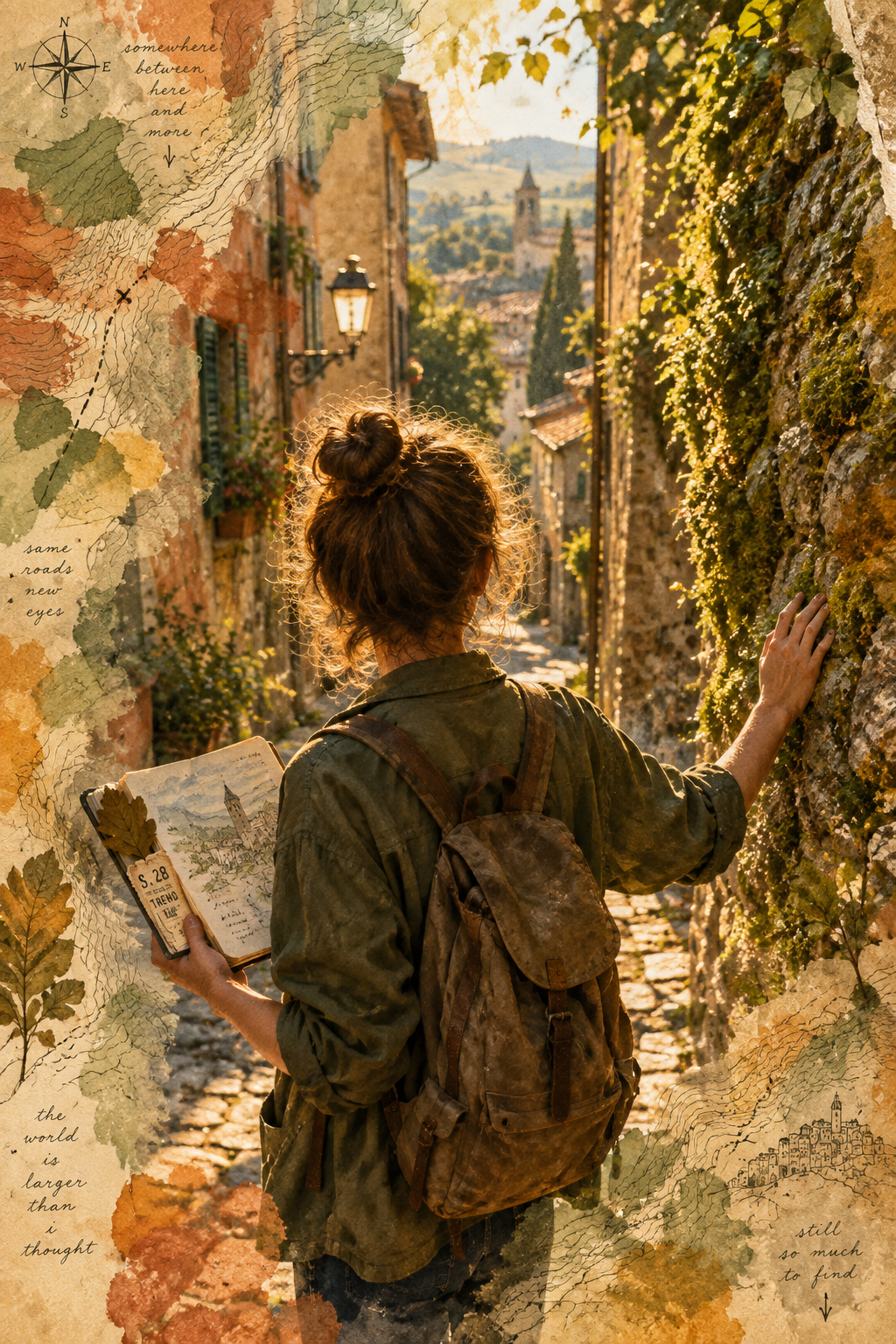
When we talk about how to C//Fellow, we don't draw a border around it. So we're leaving the original thought exactly where it landed — unedited, still warm.
Read the original thought →earthlinc.earth/station/f015fx81nj/a-colour-only-you-can-leave
02 · where it started
It began over brunch.
A friend asked a plain question: how would a high-school student actually join?
Maybe like this. In one week of a summer or winter holiday, a trip refuses to stay only a trip. You map where you go — Google Earth is enough. You arrive. Then you wander into the human things, the natural things, the community, the food, any small detail that catches you.
Not retrieval. A real record of you — at this moment, in this place, in this weather, on this particular walk.
- words
- a hand-drawn line
- a photo
- an object you picked up
- a feeling you can't name yet
Not because it sits in an article, or in a search result — but because your hours and this place overlapped, and you were the one standing there.
03 · open a circle
Five ways a very small record can look.
Tap a circle. None of these took more than ten minutes. Simple records are precious too.
A pin with a reason attached
Anyone can drop a pin. The record is the sentence you write under it.
PIN 03 · the third bridge
why: the river changed colour here —
green upstream, brown after the bend.
guess: the mill, or the rain last night.
One line, drawn slowly
Thirty seconds of real looking, drawn badly, beats a perfect photo you never looked at.
subject: roof line of the blue house
note: the tiles don't match.
someone fixed this roof twice.
Before the heat arrived
Weather is the cheapest data on Earth and nobody else recorded yours.
sky milk-white, no edges
wind from the sea, tastes of salt
temp 22° and climbing fast
sound shutters opening, one by one
A sentence a stranger gave me
Ask, listen, write it down the way they said it. That's culture, recorded live.
“The bread is finished by nine.
Come earlier tomorrow.”
— the woman at the corner oven, who has
opened at 4am for nineteen years
The thing you carried home
A ticket stub, a seed pod, a sticker peeled off a lamp post. Tape it down, write the date, done.
found: seed pod, dry, rattles
where: bench outside the bus station
keeping it because: it sounds like rain
04 · the question everyone asks
“So — YUCROWN provides the tool, the tech, the platform, to support young people to see, record and share. Is that the right way to understand you?”
Actually, no.
If you start the YUCROWN C//Fellow journey, what you meet first is company: people exploring and uncovering things beside you, asking their own strange questions in their own strange places.
Your exploration is yours. Your Station is yours. The process itself is the whole of the achievement — there's no prize hiding behind it.
05 · how a week becomes a record
Three steps, and none of them is homework.
Pick a place you're already going.Map it before you leave — the route, the stops, the bits you're curious about.
Record one real thing a day.Words, a drawing, a photo, an object, a sound. Then add your own angle: what you felt, noticed, guessed, linked.
Publish your Station on Earth LinC and share it with YUCROWN.Your exploration keeps going — and it becomes part of the Earth Library.
06 · before you go
At the beginning you don't need answers. There is no definition yet.
This is how you see the world, record the world, link to the world. It becomes part of your memory — and memory is the only archive nobody can copy.
Listen you, see you. Your LinC to Earth matters to you and us, and our future and Earth.
Bring back something only you could have brought back.
sources & further wandering
- “A Colour Only You Can Leave” — the original, unedited thought behind this letter.
- A brunch conversation among friends, on how a high-school student could take part.
- Google Earth — projects, placemarks and personal maps; the mapping tool mentioned in the original note.
- iNaturalist — a community that records what grows and crawls exactly where you're standing.
- eBird, Cornell Lab of Ornithology — ordinary people's bird observations, kept as science.
- “Field Notes on Science & Nature”, edited by Michael R. Canfield (Harvard University Press) — how researchers actually keep notebooks.
- “On Looking: Eleven Walks with Expert Eyes” by Alexandra Horowitz — one block, eleven ways of seeing.
- “Ways of Seeing” by John Berger — why the way you look is already a position.
- Earth Library, Earth LinC — where published Stations gather and stay.