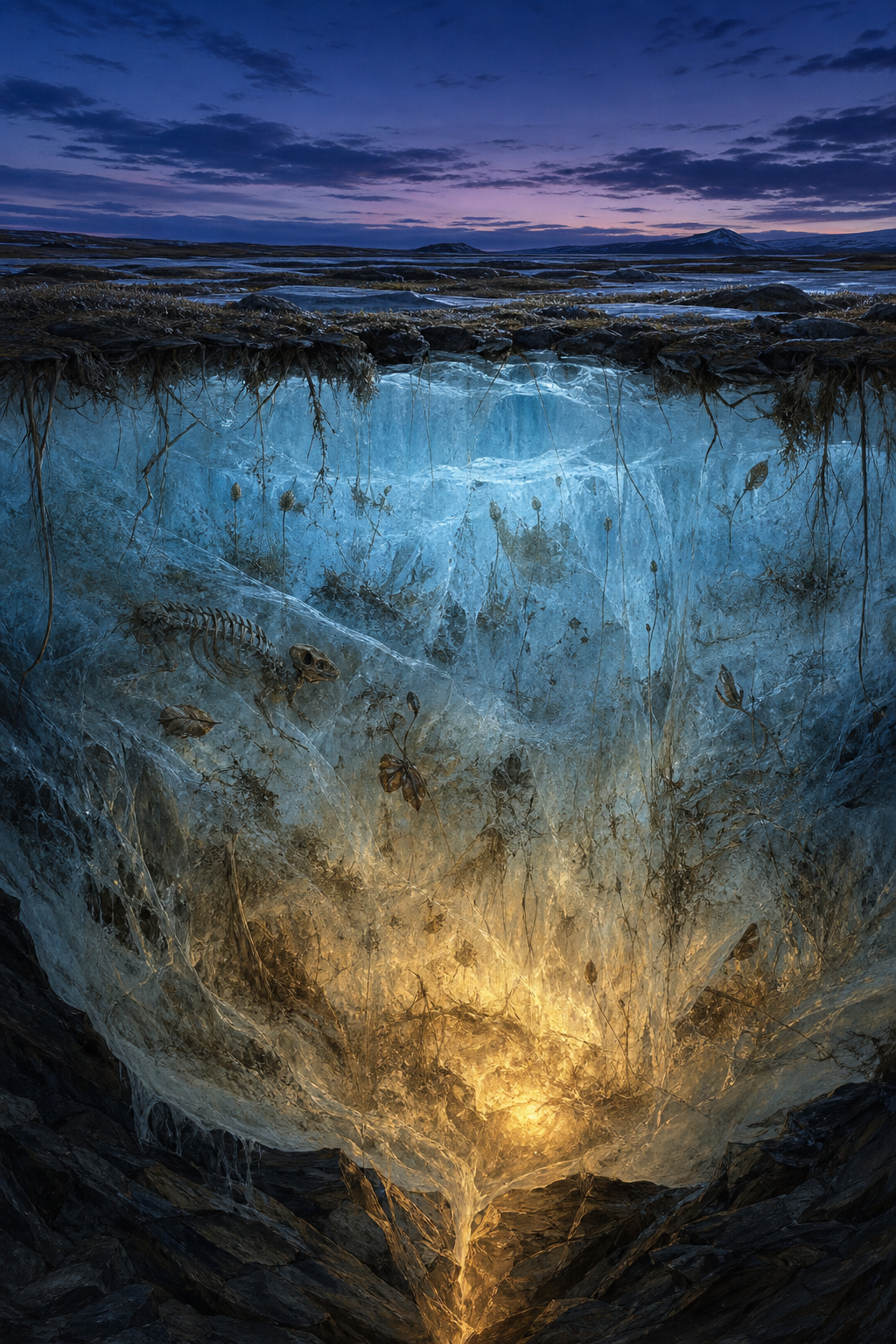
What is frozen beneath the Arctic, and what happens when it thaws?
她研究的不是冻土。
她研究的是:
当地球的记忆开始苏醒,会发生什么?
Some scientists study what they can see. Susan Natali studies what has been invisible for ten thousand years — locked beneath soil so cold that time itself seemed to pause inside it. Her field is permafrost: the permanently frozen ground that underlies nearly a quarter of the Northern Hemisphere's land surface. But her real subject is memory — the organic record of ancient life, compressed and preserved in ice, and the consequence of its release.
Natali grew up asking questions that didn't have tidy answers. She pursued ecology and biogeochemistry, eventually landing at the Woodwell Climate Research Center (formerly Woods Hole Research Center) in Massachusetts, where she leads the Arctic program. Her work is not comfortable work. Every field season — boots in Siberian bog, instrument cables vanishing into thaw — she measures the rate at which the Earth is forgetting itself.
Permafrost covers roughly 23 million km² of the Northern Hemisphere. In Siberia alone, a single region — the Yedoma — holds an estimated 327–466 gigatons of organic carbon, preserved by cold since the last ice age. That is more carbon than humans have emitted since the Industrial Revolution began. It has been sleeping there, quietly, for millennia. Susan's central question: what happens when it wakes up?
This is not a question about geology alone. It is a question about time, about feedback, about whether the planet's own systems will amplify the changes we have already set in motion. In her hands, a temperature probe becomes a stethoscope — she is listening for the planet's pulse, watching whether it quickens.
"The permafrost is not just frozen ground. It is a record — of ancient plants, of animals that walked before us, of carbon that the atmosphere once held. When we warm the ground, we are not just melting ice. We are opening a vault that was never meant to be opened on this timescale." — Susan M. Natali, Woodwell Climate Research Center
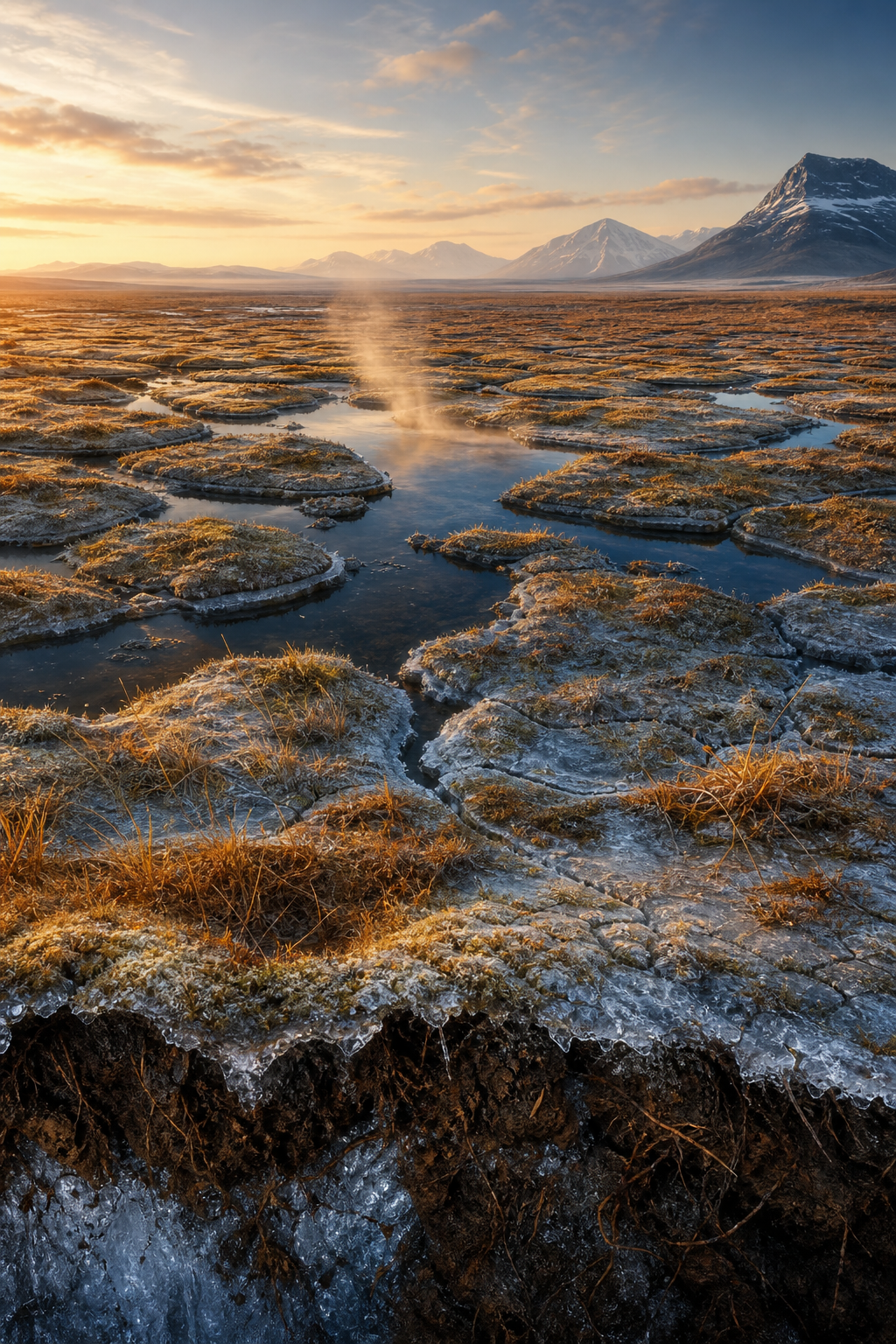
Woodwell Climate Research Center · Arctic Program
Susan M. Natali
Arctic Program Director · Woodwell Climate Research Center
Susan Natali trained as an ecologist, earning her doctorate at the University of Florida and conducting postdoctoral research that took her into the high-latitude field sites that would define her career. She is now a Senior Scientist and Arctic Program Director at Woodwell Climate Research Center, and one of the world's foremost experts on permafrost carbon feedback.
"最重要的问题,往往藏在最冷的地方。"
不是因为那里远,而是因为那里记录着最长的时间。
What drives her? By her own account, it is the feeling that climate science has a communication gap — the findings are clear, the urgency is real, but the distance between scientific data and public understanding (and policy action) remains vast. She co-founded the Permafrost Pathways project, a collaborative initiative connecting science to Indigenous communities, policymakers, and the broader public. Science that stays only in journals, she believes, does not do its full work.
Her research has been funded by the National Science Foundation, NASA, and the Department of Energy, among others — a sign of how central her questions have become to our collective understanding of where the climate system is heading. She has published more than 100 peer-reviewed papers, led field campaigns across Alaska and Siberia, and has testified before US Congress on the urgency of permafrost carbon monitoring.
The Science · 科学解读
What exactly is Permafrost?
永久冻土——不只是冰,是地球自己的时间胶囊
Ancient Plants & Moss
Thousands of years of vegetation — mosses, grasses, roots — frozen before they could fully decompose. In some Siberian samples, plants frozen 30,000 years ago have been revived in laboratory conditions. Time paused in the cold.
Megafauna Remains
Woolly mammoths, cave lions, ancient horses — recovered nearly intact from Siberian permafrost. Their DNA, their gut contents, their last meals: preserved in frozen silence. The permafrost is also a natural museum.
Microbes & Pathogens
In 2016, a thawing patch of Siberian permafrost released anthrax spores dormant for 75 years, killing reindeer and hospitalizing people. Ancient viruses — 48,500-year-old "zombie viruses" — have been revived in 2023 research. The past is not always safe.
Organic Carbon
The single most consequential thing locked in permafrost. An estimated 1,500 gigatons of organic carbon — nearly twice what is currently in the atmosphere — sits frozen in Arctic soils. When microbes thaw and digest it, they exhale CO₂ and methane.
Climate Signal
Permafrost is one of Earth's most sensitive thermometers. At the depth of 20 metres, ground temperatures in parts of the Arctic have risen more than 3°C since the 1980s — a sign the warming reaches deep, and the stored carbon is moving closer to the tipping edge.
The Feedback Loop
This is Natali's core concern: warming thaws permafrost → thaw releases carbon → more carbon warms climate further → more permafrost thaws. A self-reinforcing cycle that current climate models have, until recently, dramatically underestimated.
Research Methodology · 研究方式
How Susan Studies a World Beneath the Ground
科学不只在实验室里完成——它也在泥泞、寒冷与孤独的野外中诞生
Field Work · 01
Arctic Field Campaigns
Natali and her team conduct multi-year field experiments across Alaska and Siberia. They instrument permafrost monitoring towers — measuring soil temperatures at multiple depths, gas flux at the surface (how much CO₂ and methane the ground is exhaling), and active layer depth (the part that thaws and refreezes each year). In some sites, the active layer has deepened by centimetres per year — small numbers with vast consequences.
Remote Sensing · 02
Satellite + Drone Observation
Because permafrost landscapes are vast and remote, Natali's group uses satellite imagery and drone surveys to track landscape-scale change: thermokarst (the collapse of ground as ice melts), lake formation, and vegetation shifts. NASA has been a key funder here — satellite data allows the team to observe changes across millions of hectares that no field team could visit.
Modeling · 03
Carbon Accounting & Climate Models
A major contribution of Natali's work is pushing permafrost carbon into Earth system models. For years, the models used by the IPCC either omitted or underestimated permafrost feedbacks. Her data — from field measurements and synthesis studies — has helped correct that blind spot. She co-led a landmark study synthesising data from hundreds of Arctic sites to quantify the permafrost carbon feedback.
Policy Bridge · 04
Permafrost Pathways — Science to Action
Perhaps most unusually for a research scientist, Natali leads Permafrost Pathways (permafrostpathways.org) — a collaboration that brings together Arctic Indigenous communities, scientists, and policymakers. The premise: communities living on permafrost are already experiencing its collapse (roads sinking, buildings tilting, coastlines eroding). Their knowledge and their political voice are essential for any meaningful response. Science that doesn't reach the people affected isn't complete science.
Funding · 05
How the Work is Supported
Her research has been funded by the National Science Foundation (NSF), NASA, the Department of Energy (DOE), and private philanthropic sources including the Woodwell Climate Research Center's own endowment. The interdisciplinary breadth of the work — ecology, biogeochemistry, remote sensing, Indigenous partnerships — requires diverse funding streams. Each grant represents a bet that the questions she keeps asking are among the most important questions of this century.
Susan's Thinking Loop · 思维回路
The question that drives a lifetime of research
What is remarkable about Natali's intellectual life is how tightly this loop closes. She does not separate "basic science" from "applied impact." Each field season informs the models; each model reveals new questions for the field. Each time she communicates findings — to Congress, to a community in Alaska, to a journalist — she returns with sharper understanding of what the world actually needs to know.
她的研究不是单向的传播——而是一个真正的闭环:
从土地开始,回到土地;从数据开始,回到行动。
A Note to Navi · 给纳维的话
Living in the Heat, Thinking About the Frozen
有时候,最远的问题,才是最真实的问题
You live somewhere hot, and the Arctic feels like another planet. Your children told you something wise: you cannot simply go there and understand. They are right — and also not quite right. The Arctic is not understood by standing in it any more than you understand the ocean by wading in the shallows. What you can understand, from anywhere, is this: the system is connected. The permafrost thawing in Siberia is linked to the heat you feel outside your window. They are expressions of the same imbalance, at opposite ends of the Earth.
Your instinct about the Forest as Earth's memory is beautiful — and now you have a new word: Permafrost. Not just frozen ground, but a vault. A record. A library written in carbon and cold that took ten thousand years to compile, and that we are now beginning to accidentally delete. You don't have to be a scientist to understand why that matters.
这不是遗憾——这是一个邀请。
苏珊·纳塔利自己也是从某个问题开始的:
"如果土地开始解冻,它会说什么?"
找到你自己的那个问题,
然后不要停止问它。
What draws me most about Susan Natali's life is not the data — it is the internal power that keeps a person in frozen bogs, year after year, measuring gases escaping from soil that most people never know exists. That power is curiosity combined with consequence: she knows that her questions matter for everyone, including your family in a hot city, including the children who will live long after both of you. The question is never "can I afford to care about this?" It is always "can I afford not to?"
Permafrost is, in the end, a perfect metaphor for great questions themselves: they can remain frozen and intact for a very long time. But once they begin to thaw in your mind — once you allow them to — they release something that changes the atmosphere around you.
不是冰本身,
而是冰里保存了几千年的——
那些原本应该消失、却没有消失的生命痕迹。
好的问题也是如此。
它不怕被搁置,只怕永远不被打开。