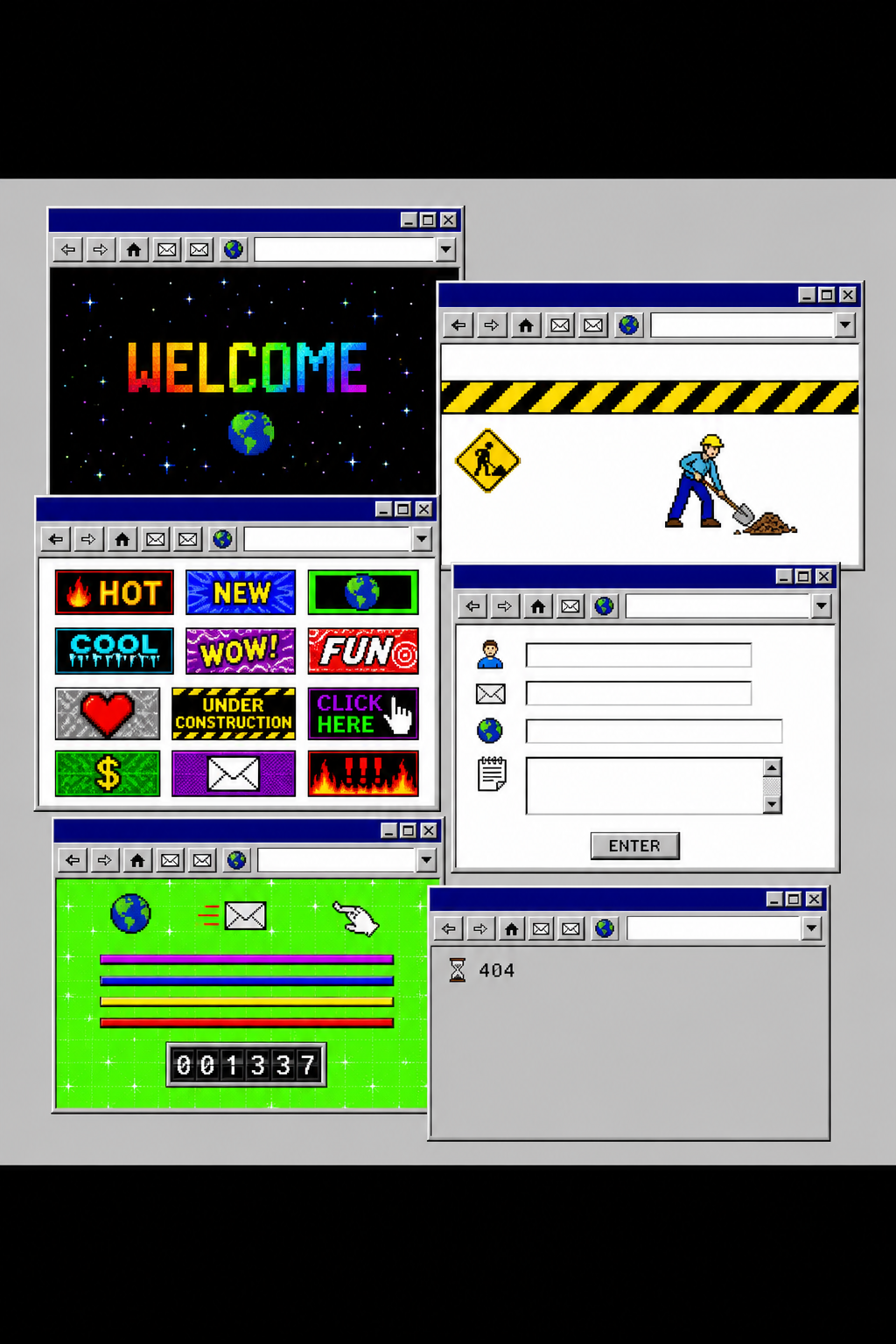
WEB 1.0
The era was named backwards, by the thing that replaced it.
Web 1.0 is the look of the personal web between the first website and the arrival of the social platforms, when anyone with an internet account got a folder on a server and decorated it themselves.
| Period | Roughly 1989 to 2004. The name arrives afterwards. |
| Coined | A retronym. "Web 2.0" came first, from Darcy DiNucci, January 1999. |
| Power | The personal homepage. An ISP account came with server space and nobody checked what you put in it. |
| Materials | Tiled GIF backgrounds, animated GIFs, 88 by 31 pixel buttons, table layout, guestbooks, hit counters. |
| Palette | Interface grey, navy title bars, link blue, visited purple, and whatever the author liked. |
| Places | GeoCities neighbourhoods, university servers, the free space that came with a dial-up account. |
Darcy DiNucci, an information architecture consultant, used "Web 2.0" in an article called "Fragmented Future" in January 1999. Tim O'Reilly and Dale Dougherty put it in front of an industry at the first Web 2.0 Conference in 2004, and it stuck.
"Web 1.0" is a retronym. It did not exist while it was happening. The years from roughly 1989 to 2004 acquired a name only once something arrived to be version two, and the name was supplied by the successor.
Every other aesthetic in this family was named late by the people who grew up inside it. This one was named late by the thing that replaced it.
The web was proposed at CERN in 1989 and the first website went online in 1991, on a NeXT computer sitting on a desk. Someone stuck a handwritten label on the case: This machine is a server. DO NOT POWER IT DOWN!!
The whole thing was small enough, and physical enough, that a cleaner unplugging one box was a real risk worth writing on it in marker pen.
The first web server. Tim Berners-Lee's NeXT computer at CERN, 1990. Photo: Wikimedia Commons, CC BY-SA 3.0.
Look at the Netscape Navigator window. Under the location bar there is a row of buttons, and two of them read What's New? and What's Cool?
A browser vendor maintained an editorial list of interesting websites, as a permanent feature of the software, because the web was small enough that a handful of people could look at a useful fraction of it and pick out the good ones. That row of buttons is a measurement. It says how big the web was.
NCSA Mosaic, 1993. The browser that put pictures on the same page as the text. Screenshot: Wikimedia Commons, CC0.
Netscape Navigator 1.22, 1995. Screenshot: Wikimedia Commons, CC0.
Netscape Navigator 3.04 Gold, 1997. The directory buttons read What's New? and What's Cool? Screenshot: Wikimedia Commons, CC0.
GeoCities opened in November 1994 as Beverly Hills Internet, renamed itself Geopages, and became GeoCities on 15 December 1995.
It organised the web as a city. You chose a themed neighbourhood — SiliconValley for computing, Hollywood for entertainment, RodeoDrive for shopping — and you were given a numbered address inside it. Your site lived at geocities.com/RodeoDrive/1234. You had neighbours, and their addresses were the numbers next to yours.
Yahoo bought GeoCities on 28 January 1999 for 3.57 billion dollars in stock. By that year it was the third most visited site on the web, behind AOL and Yahoo itself.
Yahoo closed the American GeoCities on 26 October 2009. At least 38 million pages went off the web on one day. The Japanese service ran on until 31 March 2019.
Archive Team, a loose group of volunteers, had spent the months before the shutdown copying as much of it as they could reach. On 29 October 2010 they released roughly 900 gigabytes of rescued GeoCities as a torrent. Mirrors followed.
The largest amateur archive of the twentieth-century web was deleted by its owner and is now maintained by strangers with no legal claim to it and no funding.
The revival runs on hand-written HTML: Neocities, personal sites with tiled backgrounds and 88 by 31 buttons, webrings that link one small site to the next, guestbooks that work. The people building them are largely too young to have used the thing they are rebuilding. They are working from screenshots.
The look survives for a reason that is structural. A page in this style is a single file that one person wrote, hosted somewhere they control, linking outward to other people's pages. Every design decision follows from that. The grey came from the browser default. The counter existed because there was no analytics. The guestbook existed because there were no comments. The 88 by 31 button existed because you linked to your friends by hand.
A folder on a server, decorated by whoever rented it, and the name for it arrived fifteen years late from the company that replaced it.
you are visitor number