Taula de fragments — workshop table · res no està resolt
Alguna cosa es va aturar aquí.
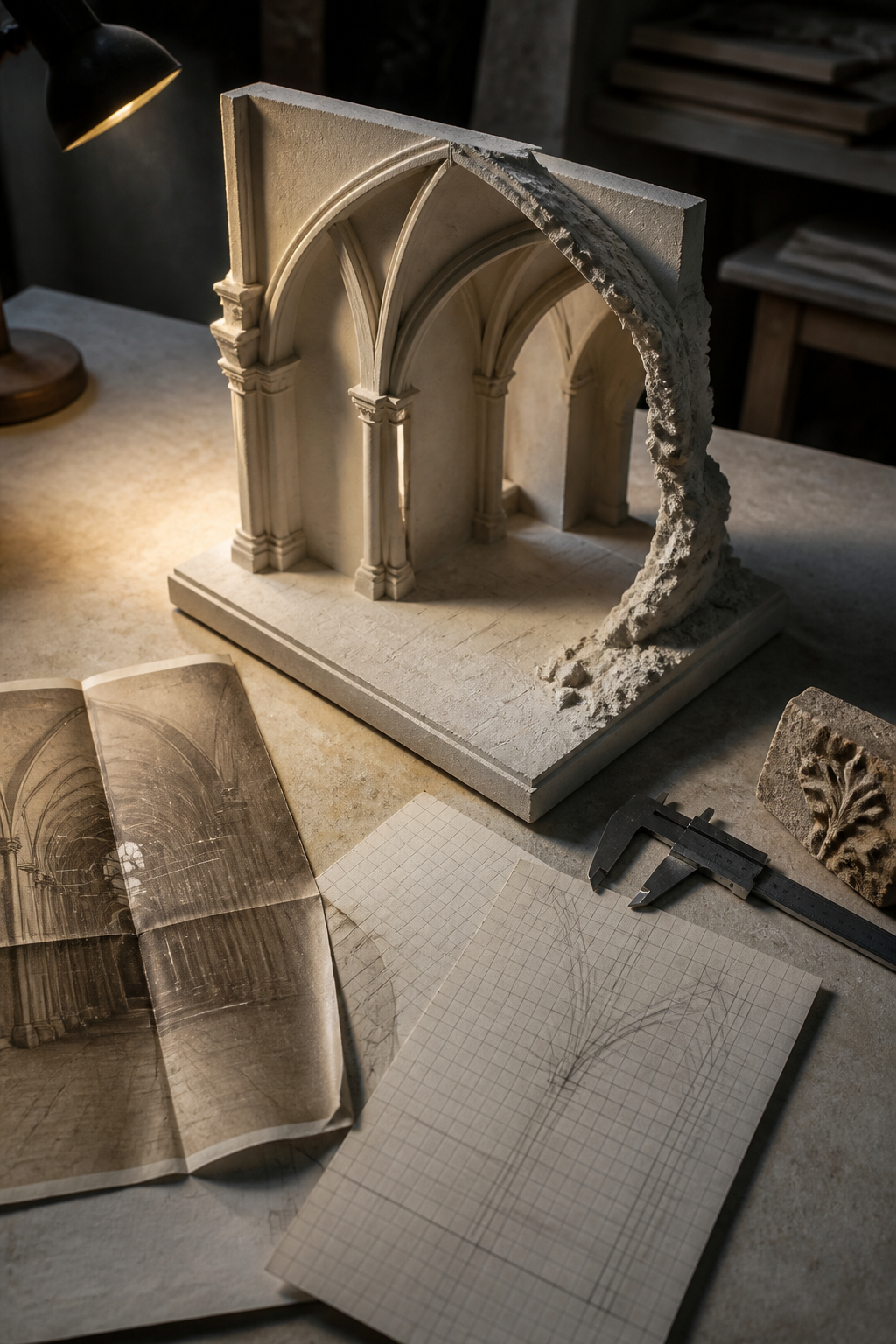
Something stopped here. On this table: broken plaster, a photograph, a measured line, a cast made later by someone else, and a machine that will cut any surface you can describe. None of it tells you what comes next. That part is yours — and you will do it with your hands, on the model itself.
Two working voices run through this table. They are not translations of each other: català is the voice of the workshop — short, material, addressed to the plaster. English is the voice of the person deciding. Choose which one leads. The marks, the tools and the names of things stay in Catalan either way.
Encontre I
La trencadura
the break
The shaft stops mid-height. The break is damage, not a decision. Put traces on the model, then push it up with one finger.
El fust s'atura a mitja alçada. La trencadura és un dany, no un projecte. Posa traces al model i empeny-lo amunt amb un dit.
Traces — toca per col·locar-les al model
Què sostéA physical piece of the original plaster: one curved face, worked and finished, with two broken edges.
Què no pot dir-teWhere it ended. A broken edge is loss, not information — it records the accident, not the intention.
Què sostéA photograph of the same model on its stand, taken before the damage. It fixes a moment: the piece existed, roughly like this.
Què no pot dir-teOne angle, one light, no scale. It gives you no depth, no far side, and no way to check what it flattened.
Què sostéThe surviving face can be measured. Its curvature is regular enough that a ruled surface can be fitted to it and extended by calculation.
Què no pot dir-teA rule can always be extended. That it was extended, and how far, is a different claim entirely.
Què sostéA cast made later, by other hands, from fragments and judgement. It is useful: it shows how someone before you read this material.
Què no pot dir-teIt is a reading, not a source. It already contains decisions — possibly ones you would make differently. Copying it does not make them older.
Què sostéToday a described surface can be modelled, tested and cut to a tolerance no hand could hold.
Què no pot dir-teCapability is not permission. The same machine will produce, with equal confidence, a convincing mistake.
Toca la part que has afegit i deixa-hi una marca petita. Hi quedarà.
Touch the part you added and leave a small mark on it. It stays there.
Les marques no s'esborren. La decisió queda escrita al registre.
Encontre II
La junta
the joint · where old meets new
Where you stopped, the model now has a boundary. Push upward to fill it — a little, or until nothing shows.
On t'has aturat, el model té un límit. Empeny amunt per omplir-lo: una mica, o fins que no es vegi res.
Traces — toca per col·locar-les al model
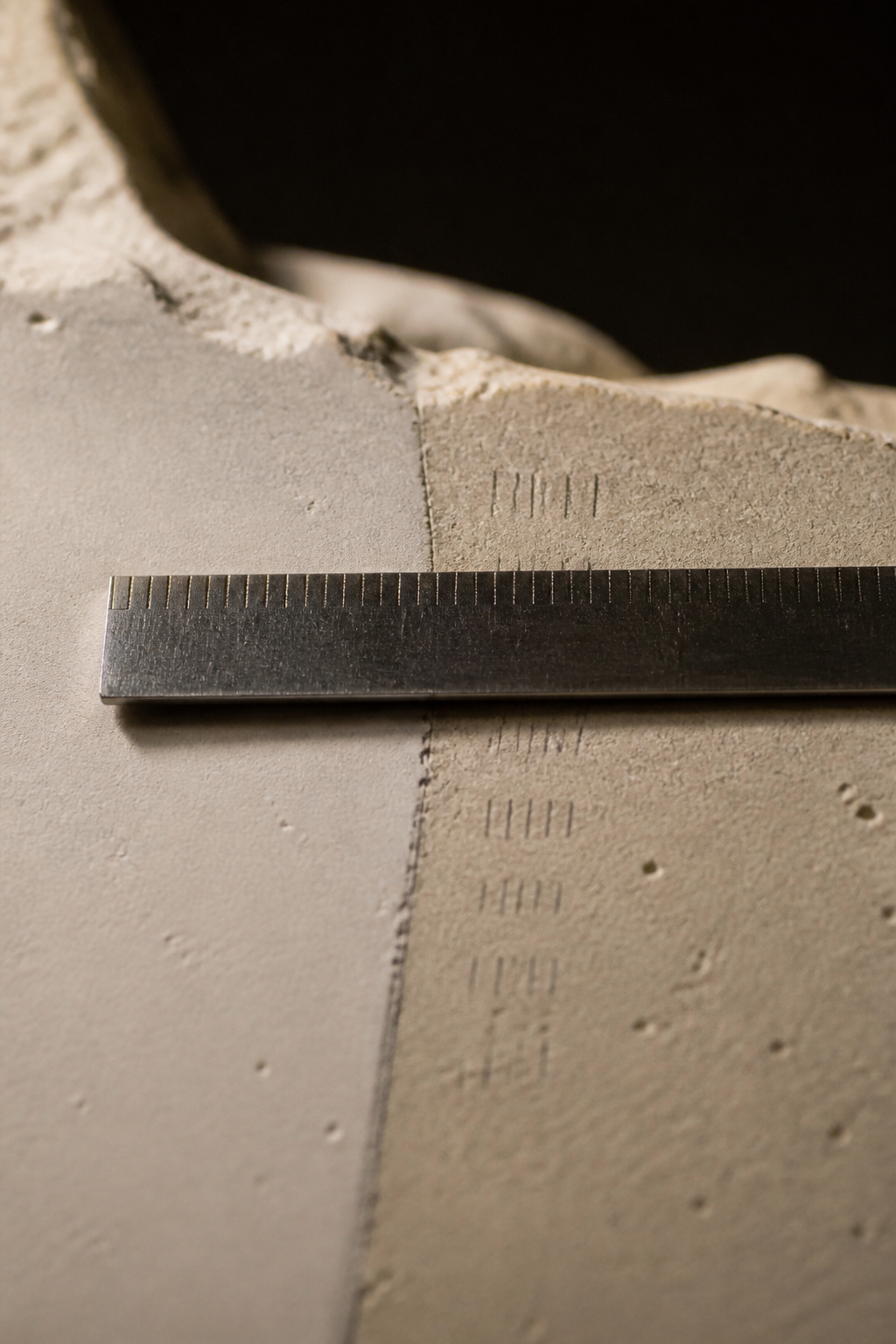
Detall · el moment en què el guix conservat troba l'afegit
Què sostéAt this distance the difference is plain: grain, tone, the edge of a break against a poured face.
Què no pot dir-teNothing about which side is right. It only shows that, today, the two can still be told apart.
Què sostéA written record of what has been added here, and by whom. It is the only place where an invisible joint can still be found.
Què no pot dir-teThis log begins with you. It is not old, it is not archival, and paper is lost more easily than plaster.
Què sostéFresh plaster, either matched to the old tone or deliberately shifted a shade.
Què no pot dir-teWhich is more honest. Matching respects the eye; shifting respects the next reader. You cannot have both surfaces.
Toca la part que has afegit i deixa-hi una marca petita.
Touch the part you added and leave a small mark on it.
Les marques no s'esborren.
Encontre III
La geometria que puja
the geometry that rises
Above the last measured section the material says nothing; the geometry keeps answering. Watch the line change register as you push.
Per sobre de l'última mida el material ja no diu res; la geometria continua responent. Mira com canvia el traç mentre empenys.
Traces — toca per col·locar-les al model
Què sostéReal dimensions, taken from real material, at one height. Everything below it is checkable.
Què no pot dir-teWhether the rule held above this line. Sections change; that is often the point of them.
Què sostéOther surviving pieces from the same body of work follow related families of surface. Similarity is a real observation.
Què no pot dir-teSimilarity is not identity. A family of rules is precisely the kind of thing whose members differ.
Què sostéThe fitted surface can be built, tested for structure, and cut. It is a genuine instrument.
Què no pot dir-teIt has no gaps. It will render a clean, confident, buildable answer exactly where the plaster has none — and the render will look like knowledge.
Toca la part que has afegit i deixa-hi una marca petita.
Touch the part you added and leave a small mark on it.
Les marques no s'esborren.
Encontre IV
El tancament
closing the volume
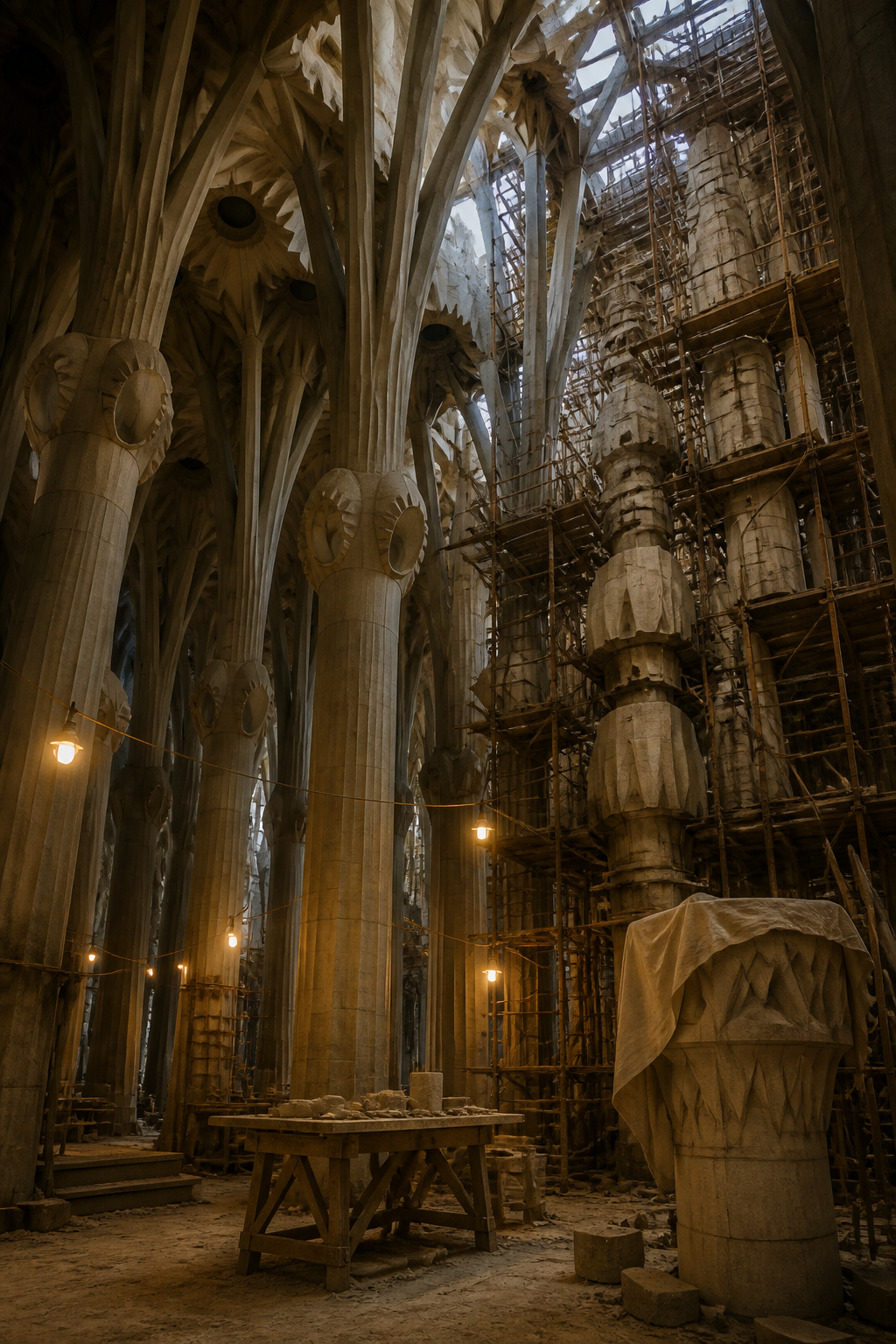
Above what you raised there is a hole in the sky, and nothing survives from up there. Push upward: the gap gets measured, an arch springs, then something plainly of our time.
Sobre el que has aixecat hi ha un forat al cel, i de dalt no en sobreviu res. Empeny amunt: es mesura el buit, arrenca un arc, després una cosa clarament d'avui.
Traces — toca per col·locar-les al model
Què sostéThe strongest statement on the table at this height is that nothing survives here. That absence is itself well documented.
Què no pot dir-teWhether nothing was ever made, or whether it was made and lost. Absence does not distinguish between the two.
Què sostéStone can be cut by machine, loads calculated, tolerances held. Almost any closing you can draw can be raised.
Què no pot dir-teWhich closing belongs. The easier it becomes to build anything, the more the choice becomes purely ours.
Què sostéPeople stand under this. Weather comes in. Decisions here have consequences that are not scholarly.
Què no pot dir-teThat urgency is a form of evidence. It is a reason to decide, not a reason to believe.
Toca la part que has afegit i deixa-hi una marca petita.
Touch the part you added and leave a small mark on it.
Les marques no s'esborren.
Estat final del plat · the plate as you leave it
Four marks. Nothing found.
There was no complete original under this table waiting to be matched. There was material that stops, and a point at which you kept going. What stands now is a state: continuous in some places, deliberately broken in others, signed throughout. Some of it will be read as fact by whoever comes next, because you left it that way.
No hi havia cap original complet sota aquesta taula esperant que l'encertessis. Hi havia material que s'acaba, i un punt on has continuat. El que queda és un estat: continu en uns llocs, trencat expressament en d'altres, signat de dalt a baix. Una part es llegirà com a fet, perquè tu l'has deixada així.
No has trobat cap original. Has signat.
You did not find an original. You signed.
The person who made the first part cannot review the second. No amount of care changes that; care only changes how honestly the difference is declared. That is the whole condition of continuing a work. Buildings carry more than one signature — the ones who were there, and the ones who kept going after.
Qui va fer la primera part no pot revisar la segona. Cap cura no ho canvia; només canvia amb quina honestedat es declara la diferència. Aquesta és tota la condició de continuar una obra. Els edificis porten més d'una signatura: la dels qui eren allà, i la dels qui van continuar.
What follows is not your work and not the interpretive model above. It is the historical record of a real building where exactly this problem is unresolved and ongoing — and the record itself is damaged, partial and argued over.
Registre històric — sourced material, separate from everything above
01 · the author and the condition of the record
Antoni Gaudí and the Basílica de la Sagrada Família
Antoni Gaudí i Cornet directed work on the Basílica de la Sagrada Família in Barcelona from 1883 until his death in June 1926, after being struck by a tram. The building was unfinished — by a very large margin — when he died.
He worked to an unusual degree through three-dimensional plaster models, full-scale studies and hanging chain models rather than through a complete set of finished construction drawings. Much of what he intended existed as material in a workshop, not as a document that could simply be read off later.
This is the crucial point for everything above: even at the moment of his death, the record was a workshop, not an instruction manual. The basilica's own published history confirms this way of working.
02 · documented loss
1936: the workshop burns
In July 1936, at the outbreak of the Spanish Civil War, the temple's crypt and workshop were attacked and burned. Drawings were destroyed and the plaster models were smashed. This destruction is acknowledged in the basilica's own published history of the works.
In the decades that followed, surviving fragments of the plaster models were collected and painstakingly reassembled — work that continued across generations of the model workshop. Those reassembled models are the basis of much later construction. The basilica's heritage catalogue records specific surviving model objects, showing both what was preserved and the gaps that remain.
A reassembled model is not an untouched original. Reconstructing a shattered plaster surface from fragments requires judgement at every missing edge. The reconstruction is evidence of a serious reading; it is not the same thing as the thing it reads.
03 · continuation, and its gaps
Later hands, openly named
Work was directed after 1926 by Domènec Sugrañes i Gras, Gaudí's documented collaborator, until his death in 1938. The record then passed — with gaps and interruptions — through Francesc de Paula Quintana, Isidre Puig Boada and Lluís Bonet i Garí. Jordi Bonet i Armengol became chief architect in 1985; Jordi Faulí i Oller has held that role since 2012. Some of these transitions are well documented; others are not, and the gaps are not filled here.
Sculptural work has been openly contemporary rather than restorative. Josep Maria Subirachs worked on the Passion façade from 1987, in a declaredly modern idiom — a decision that has been publicly contested for decades. Etsuro Sotoo has carved on the building since the late 1970s. The basilica's own documentation describes how sculptures for specific chapels are made today, including the interpretive decisions involved.
From the 1980s onward, Professor Mark Burry and colleagues applied digital and parametric modelling to recover and continue the ruled-surface geometry found in the surviving plaster models. Burry's work on the project spanned several decades and is documented in his published research. The geometry recovered this way is real; whether it represents what Gaudí intended above the last surviving section is a question the geometry cannot answer about itself.
The Sagrada Família crypt and part of the Nativity façade are listed as a UNESCO World Heritage Site. That designation covers what survives of Gaudí's own work; it does not resolve which later additions belong to that inheritance.
This is not an unbroken chain of succession. Work halted, funds failed, the record burned, roles changed hands across nearly a century, and the legitimacy of continuing at all has been publicly argued throughout. The responsibility for decisions made after 1926 — and after 1936 — rests with whoever made them, not with Gaudí.
Fonts · sources — click each to verify
Supports: history of the building, 1926 death, workshop method, 1936 destruction, later directors
Junta Constructora del Temple Expiatori de la Sagrada Família — official history of the temple: sagradafamilia.org/en/history-of-the-temple
Supports: surviving model objects, the condition of the heritage record, what was preserved and what was lost
Sagrada Família heritage catalogue — a specific surviving sacristy model object: patrimoni.sagradafamilia.org — Maqueta de la Sagristia
Supports: UNESCO listing covering Gaudí's own surviving work
UNESCO World Heritage List — Works of Antoni Gaudí (inscribed 1984, extended 2005): whc.unesco.org/en/list/320/
Supports: Mark Burry's role in digital/parametric reconstruction of the ruled-surface geometry
Swinburne University profile of Professor Mark Burry, referencing his Sagrada Família work: swinburne.edu.au — Professor Mark Burry
Nothing above this record — no fragment, tone, joint, section, branch or machine — is a historical source. The interpretive model above is this page's own construction, built so that the problem of continuation could be handled rather than read about. No instruction, dimension, plan or quotation has been attributed to Gaudí anywhere on this page.
Buildings carry more than one signature
A Basilica Continued by Others
Una basílica continuada per altres
Still being decided. Still legible, in places, as more than one hand. The only thing anyone can honestly finish is their own mark.