Limestone karst cave mouth at dusk — where the overlooked world stirs

Earth LinC · People Who Keep Great Questions Alive · Indonesia

Who speaks
for the
overlooked?

谁为那些被忽视的物种发声?

Tony Whitten spent decades in limestone caves, underground rivers, and the quiet margins of ecosystems that almost nobody thought to study. This is a student's record of why that matters.

Scroll
The Person

Tony
Whitten

1953 — 2017

Zoologist Conservation Asia-Pacific Cambridge

Tony Whitten was a British zoologist and conservation biologist who made Southeast Asia his life's work. Where colleagues pursued tigers and rhinoceroses, Whitten turned his attention to limestone karst landscapes, cave ecosystems, freshwater fish, beetles, and snails — the quietly essential, chronically ignored.

He led conservation programmes across Asia and the Pacific for Flora & Fauna International and the World Bank, where he served as Senior Biodiversity Specialist. He was a founding contributor to the Ecology of Sulawesi, Java, and Sundaland — encyclopaedic books still used by researchers today.

He did not simplify. He did not chase headlines. He kept returning to the question that defined his work: If nobody is paying attention, what happens to these things?
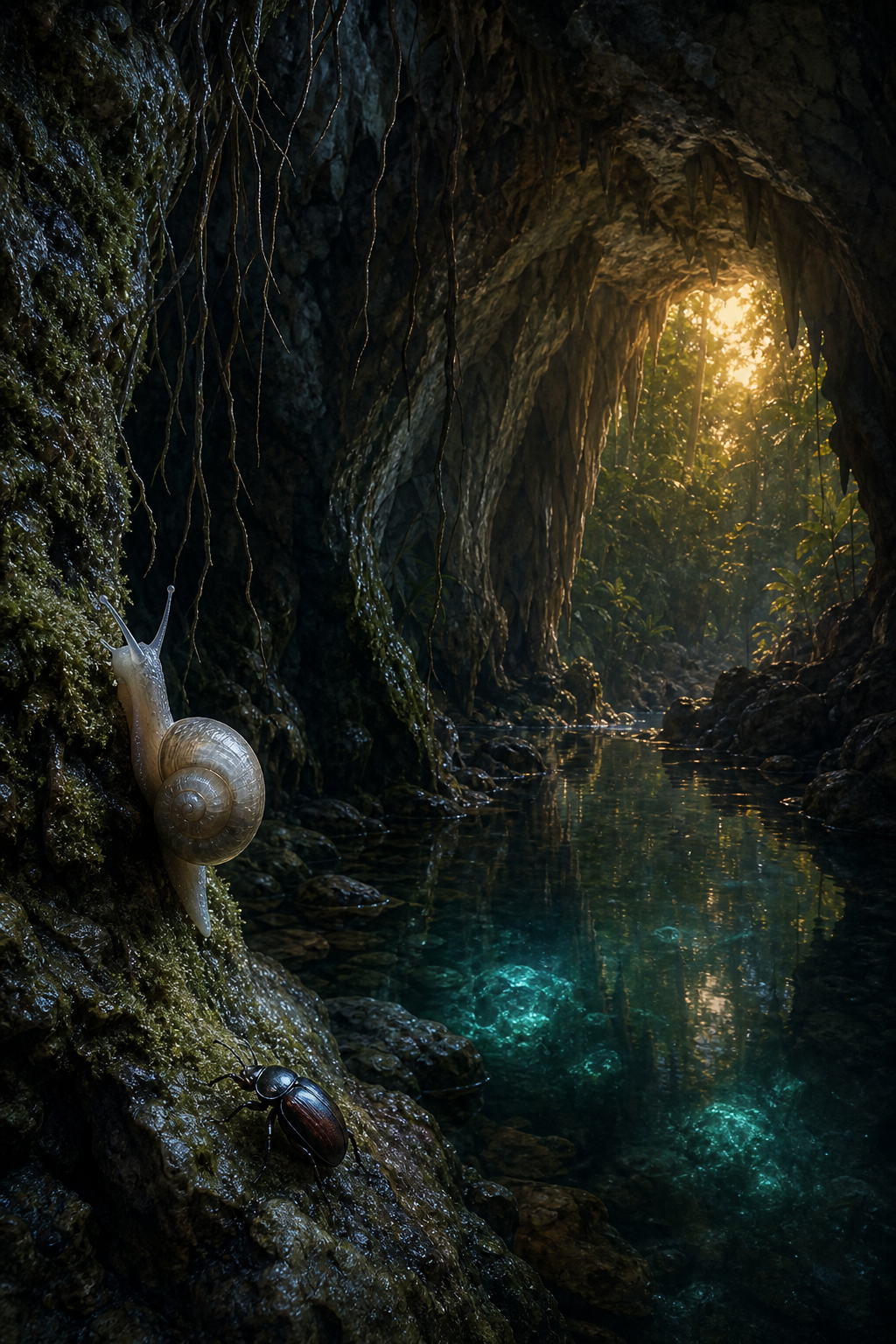
Can we learn to care about what almost nobody notices? Those almost-invisible systems — the ones beneath the stone, beneath the water — are holding everything else up.

— Animated by Tony Whitten's life question · 那些几乎没有人注意的,是否同样值得被看见

What He Studied

Five Worlds Beneath
the Visible

The territories Tony Whitten mapped, named, and insisted upon

🪨

Limestone Karst

喀斯特地貌

Whitten documented karst landscapes as distinct ecosystems, not merely geology. The porous limestone hosts communities of highly localised, often endemic life — found nowhere else on Earth. He argued for karst to be treated as a habitat type in conservation planning, not terrain.

Sulawesi Maros, South Sulawesi Java Sumatra Guizhou, China
🕳️

Cave Ecosystems

洞穴生态系统

He surveyed cave fauna across Indonesian islands, cataloguing species that had evolved in permanent darkness: depigmented fish, eyeless crabs, cave swiftlets whose nests define entire economies. Maros-Pangkep karst in South Sulawesi — one of the world's largest — received particular attention.

Maros-Pangkep Borneo Nusa Tenggara Maluku
🐌

Land Snails

蜗牛

Snails on karst limestone are extraordinarily site-faithful — a single hill can hold a species found nowhere else. Whitten recognised them as precision indicators of habitat loss. When a limestone outcrop is quarried, its entire snail community is erased. He helped put this on conservation records.

Sulawesi Java Hills Sabah
🪲

Beetles & Insects

甲虫 / 昆虫

The "star animals" of Tony Whitten's world were not charismatic megafauna. He catalogued beetles and cave-adapted invertebrates as keystone indicators — their presence or absence reading the health of entire subterranean webs. Many species he encountered remain formally undescribed.

Sulawesi caves Sumatra Kalimantan
🐟

Freshwater Fish

淡水鱼

Whitten worked extensively on freshwater biodiversity in Southeast Asia — particularly cave-dwelling and karst-spring species. Several blind or depigmented fish species in Sulawesi's underground rivers were documented through his surveys. He understood rivers as corridors that link surface and underground worlds.

Sulawesi rivers Sumatra highlands Borneo streams
🌊

Underground Rivers

地下河流 / 地下生物

Karst landscapes hide entire river systems flowing through limestone chambers. Whitten mapped these as biologically distinct zones — where nutrients enter through bat guano, cave swiftlet nests, and flood pulses. He traced how surface deforestation and quarrying collapse these invisible economies.

Maros underground Central Sulawesi Java karst springs
What Was Watched — What Is Emerging

Decades of Watching,
Questions Still Open

Tony Whitten's observations were not conclusions. Many were the beginning of questions that researchers are only now beginning to pursue.

Long Observed · Sulawesi

Maros-Pangkep Karst as a Living System

Over decades, Whitten documented how the 2,000 km² Maros karst in South Sulawesi functions as a network — caves, rivers, forest patches, and surface streams forming one interconnected organism. Guano from millions of bats fertilises underground pools; swiftlet colonies shift pressure on cave microhabitats seasonally. This system sustained communities and species found nowhere else.

Long Observed · Indonesian Islands

Snails as Precision Witnesses

Land snails on isolated limestone hills evolve in place over thousands of years, becoming genetically distinct from snails on the next hill 2 km away. Whitten consistently raised the alarm: these hills are quarried for cement without biological survey. A species disappears before it is ever named. He pushed this into World Bank environmental assessments.

Long Observed · Sulawesi & Sumatra

Cave-Adapted Fish in Underground Rivers

Several fish species in Sulawesi's karst springs and underground channels showed signs of ongoing cave adaptation — reduced pigmentation, altered lateral line sensitivity. Some populations remain formally undescribed. Whitten flagged these as evidence that active speciation is occurring in cave systems that exist above ground on no map.

Emerging Now

DNA Barcoding of Cave Invertebrates

Researchers are now applying environmental DNA and metabarcoding to karst cave water — retrieving species presence from water samples without direct observation. Early results from Southeast Asian caves are revealing communities far larger than visual surveys suggested. The unseen world is finally legible. Whitten's baseline surveys make this possible.

Emerging Now

Karst Under Climate Stress

Karst aquifers — which supply drinking water to hundreds of millions across Asia — are showing altered recharge patterns as rainfall seasonality shifts. The biological communities Whitten mapped in karst springs are early indicators: changes in invertebrate assemblages are signalling hydrological stress before it appears in water measurements. His question — if nobody watches, what happens? — is now urgent.

Emerging Now

The Tony Whitten Conservation Prize

Established through the Cambridge Conservation Initiative in partnership with Lee Kong Chian Natural History Museum, Singapore, the prize is awarded to researchers working on overlooked, under-studied taxa — exactly the species Whitten championed. It is activating a new generation of scientists willing to work in the gaps.

🏅
In His Name

The Tony Whitten Conservation Prize

Awarded by the Cambridge Conservation Initiative and the Lee Kong Chian Natural History Museum to researchers working on neglected species and ecosystems — creatures that would otherwise vanish without a record. The prize carries his question forward.

Lee Kong Chian Natural History Museum
A Student's Note

Why I keep this record

I can spend a whole afternoon by a river, walking slowly, watching nothing in particular — and come away feeling that something important happened.

The world feels very fast. I am learning that some things — the best things, maybe — are not fast. Tony Whitten spent decades asking who cares about a cave snail. Nobody told him to. He just kept asking.

I am not sure yet what I love to do. But I am keeping a record, the way you keep a record of a river: not to capture it, but to know that you were there, and that you paid attention.

Perhaps there are others like this. Perhaps we find each other slowly, the way water finds limestone — and makes a cave.

Further Reading

Where to Go Next