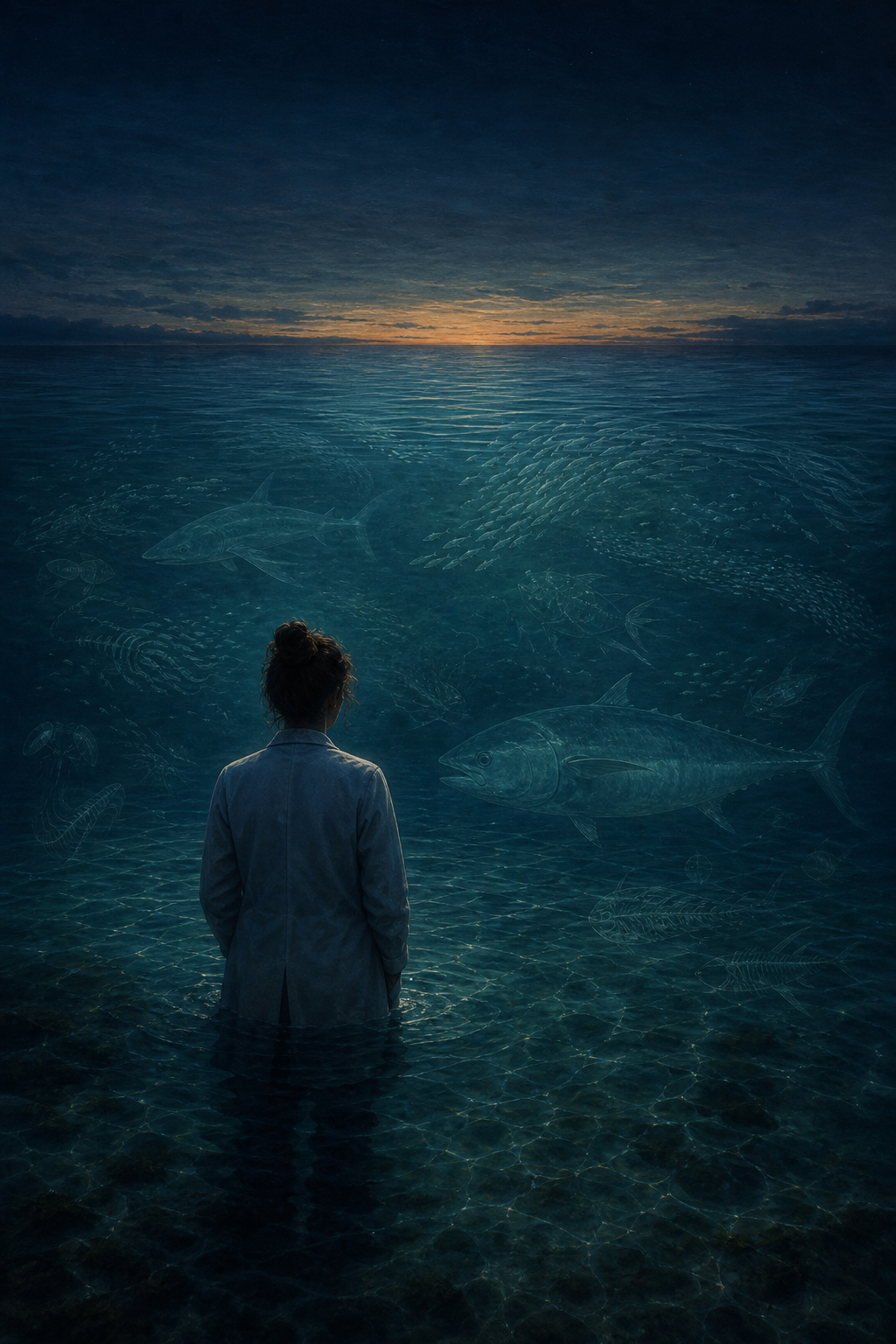
Daniel Pauly is not studying fish.
He is studying memory.
I remember the first time I stood at the water's edge as a teenager and thought: this is the most alive thing I have ever seen. Tide pools flickering with color. The salt smell that hit my chest like a promise. I didn't have the language for it yet, but something in me decided — quietly, permanently — that the ocean was my direction.
Years later, studying marine science at the University of Miami and now at UCSD for my master's, I came across a concept that rearranged how I saw everything I thought I knew. It is called Shifting Baseline Syndrome, and it was named by a fisheries scientist named Daniel Pauly in a one-page paper published in 1995. The idea is disarmingly simple. The implications are geological in their weight.
"Each generation of fisheries scientists accepts as a baseline the stock size and species composition that occurred at the beginning of their careers, and uses this to evaluate changes. When the next generation starts its career, the stocks have further declined, but it is the stocks at that time that serve as a new baseline."
每一代科学家,都把自己入行时看到的海洋,当作"正常"的起点。
— Daniel Pauly, Anecdotes and the Shifting Baseline Syndrome of Fisheries, 1995
The ocean is not declining dramatically in one person's lifetime. It is declining across lifetimes, quietly, so that no single generation notices the full collapse — only their own small increment of it. What we think of as "the ocean" is always already a diminished version. And the diminishment continues, invisibly, because no one holds the original picture long enough.
Pauly 并不是在研究鱼。他在研究记忆(Memory)——以及记忆的消失如何允许灾难在不被看见的情况下发生。
How forgetting becomes policy
The syndrome operates through a feedback loop that is almost elegant in its cruelty. Each generation of scientists, fishers, and citizens inherits a degraded ocean — but they don't experience it as degraded, because they have nothing older to compare it to. Their baseline is already shifted. When they become the experts, the managers, the voters, they calibrate targets and recovery benchmarks to what they remember as normal. The ocean shrinks, and so do our ambitions for it.
The Shifting Baseline Loop — A Cognitive-Ecological Feedback
Ecological Decline
Fish populations, reef cover, and megafauna abundance decrease measurably across decades — but slowly enough that no single season looks catastrophic.
Generational Memory Reset
A new cohort of scientists, fishers, and citizens begin their careers or lives. They have no lived experience of the prior, richer state. Their reference point is what currently exists.
Lowered Ambition
Policy targets, catch limits, and conservation goals are set against this new, diminished baseline. Recovery is defined as returning to a state that is itself already impoverished.
Accelerated Loss
Because "recovery" targets are too low, actual ecosystem health continues to decline. The next generation inherits an even more diminished ocean as their new normal. Loop repeats.
What makes Pauly's contribution so consequential is that he named this mechanism before most people felt it. Naming a thing gives you a place to stand when you push against it. Before 1995, scientists noticed the decline — but they lacked a precise language for the forgetting that makes the decline invisible. Pauly gave them that language. And language, in science as in everything else, is where action begins.
How I found the ocean, and what the ocean found in me
I was a teenager the first time I volunteered at a coastal monitoring site. What I remember most vividly is not the data — it's the feeling of placing my hand in a tide pool and knowing, wordlessly, that I was in the right place. The ocean didn't feel like a subject to me. It felt like a conversation I had been meaning to have my whole life.
High school sharpened that. Onsite volunteer work on the coast confirmed it: this was not a passing enthusiasm. It was a direction. I followed it to Miami — the University of Miami's Rosenstiel School of Marine and Atmospheric Science — where for the first time I studied the ocean not just as a presence but as a system. Nutrient cycles. Fisheries dynamics. The thermocline. The way the deep ocean breathes on timescales that dwarf human memory.
And now at UCSD, in my master's work, I keep returning to Pauly's question — because it turns out to be my question too. How do we recover something we have forgotten we lost? What does good ocean governance look like when every generation thinks the depleted present is the abundant past? These are not just scientific questions. They are questions about how we perceive, remember, and act.
我还是个很新的学者。每天都在学习。但我越来越清楚地感到:我的问题,就藏在 Pauly 这个概念的某个折叠处——关于记忆,关于数据,关于如何让历史的海洋重新变得可见。
The growth curve of a great question
Great scientific careers are not designed — they accumulate. Each experience adds a layer of sensitivity to the world, until something crystallizes into a question you can spend a decade on. Here is where I honestly am.
Phase 01 · Instinct
The Teenager at the Water's Edge
Raw affinity. No framework yet — only the undeniable pull of the ocean as home territory. Volunteering. Watching. Feeling the question before knowing its name.
Phase 02 · Formation
Miami: Ocean as System
Undergraduate training converts feeling into method. Marine science, oceanography, ecology. Learning that "the ocean" is a complex adaptive system with memory problems of its own.
Phase 03 · Sharpening
UCSD: Finding the Question
Master's work at Scripps and the broader UCSD ecosystem. Encountering Pauly's concept as more than history — as a live methodological and ethical challenge. The question comes into focus.
Phase 04 · Open
The Career Ahead
Still unwritten. Possibly: historical ecology, computational reconstructions of past ocean states, fisheries policy. The task is to pick a door and go all the way through it.
What Pauly actually built, and why it matters
Beyond the concept, Pauly's most enduring institutional contribution is the Sea Around Us project at the University of British Columbia — a long-running effort to reconstruct the history of the world's marine fisheries using catch data, historical records, scientific literature, and anecdote. It is, in essence, an attempt to recover the baselines that have been lost. To give future generations a picture of what the ocean once held.
The numbers are not comforting. Sea Around Us data suggests that reported global fish catch peaked in the late 1980s and has been declining since — while fishing effort has continued to increase. We are working harder for less. The ocean is not bouncing back between seasons. It is being asked to produce what it no longer has.
"When you have a system that is degrading slowly, and the baseline shifts with each generation, you can have a catastrophe that nobody ever decided to have."
— Paraphrase of Daniel Pauly's core argument, TED Talk: The Ocean's Shifting Baseline
What I find most scientifically thrilling about Pauly's program is its insistence on historical data as a legitimate and necessary tool. Museum specimens. Old catch logbooks. Fishermen's oral histories. Colonial-era naturalist notes. These are not anecdotes — they are data about a world that no living scientist observed firsthand. Recovering that world requires methodological humility and creative rigor in equal measure. That combination is what I want to build in my own work.
How a scientist stays honest in a shifting world
One of the underappreciated aspects of Pauly's work is that Shifting Baseline Syndrome is not just an ecological problem — it is a cognitive and behavioral problem. It describes how humans think, remember, and set goals. Understanding it requires both ocean science and an honest look at how our own minds work. Here is the loop I am trying to build as a young researcher:
The Counter-Loop — A Thinking + Behavior Practice for Ocean Scientists
Seek Historical Depth
Deliberately look for data that predates your own observation window — logbooks, archives, specimens, oral histories. Your career's starting point is not the world's starting point.
Name Your Baseline
Be explicit about what you are comparing against, and why. Peer-review your own reference points. Is "recovery" defined against 1990 or 1890? The difference is not a detail — it is the entire target.
Communicate Across Time
Science that stays inside journals cannot arrest cultural forgetting. Write for fishermen, for schoolchildren, for legislators. Pauly's greatest tool was accessibility — his ideas traveled far because he let them.
Stay Fresh, Stay Honest
The most dangerous moment is when you stop being surprised by your own data. A young scientist's gift is the willingness to be unsettled. Protect that. Curate mentors who still ask "why" out loud.
I am still very new. And that is the best thing I have.
I want to be honest about where I am: I am a fresh scholar. I do not have a publication yet. I do not have a fully formed research program. I have a master's degree in progress, a lot of curiosity, and a very clear sense that the ocean matters in a way that I cannot walk away from.
What Pauly's work taught me is that it is okay — necessary, even — to keep a great question alive longer than feels comfortable. The temptation in early career is to specialize quickly, to narrow, to produce something defensible. And I will do that. But I want to hold the bigger question underneath: What is the ocean supposed to be? Not what it is now. Not what it was when I first went into the water as a teenager. But what it can genuinely be — if we refuse to lower our ambitions as it degrades.
Pauly 花了几十年问同一个问题,用不同的数据、不同的语言、不同的平台。这不是固执——这是对一个伟大问题的忠诚。我希望我能培养出同样的忠诚。
Do we know what the ocean is? Or only what is left of it?
我们了解的,是海洋?还是只是它的残余?
— The question I am carrying forward
A short history of Pauly's great question
1979
Pauly Joins WorldFish
Pauly begins serious fisheries research, focusing on tropical fisheries in developing countries — regions where data is sparse and decline is fastest.
1995
One Page That Changed Everything
"Anecdotes and the Shifting Baseline Syndrome of Fisheries" published in Trends in Ecology & Evolution. One page. The concept spreads across disciplines within a decade.
1999
Sea Around Us Founded at UBC
The long-running research program begins reconstructing global marine catches — attempting to recover what the ocean held before the baselines shifted.
2010
TED Talk: The Ocean's Shifting Baseline
Pauly brings the concept to a global general audience. The talk anchors "Shifting Baseline Syndrome" in public environmental literacy.
2016
Global Catch Reconstruction Published
Pauly & Zeller publish in Nature Communications: actual global catch is approximately twice what FAO reports — and has been declining since the late 1990s.
Now
The Question Passes to a New Generation
Young marine scientists at Miami, UCSD, and institutions worldwide carry the question forward. The ocean is still declining. The baseline is still shifting. The work is not finished.
For those who want to go deeper
- Anecdotes and the Shifting Baseline Syndrome of Fisheries Concept Overview →
- The Ocean's Shifting Baseline — TED Talk Watch on TED →
- Shifting Baselines: The Past and the Future of Ocean Fisheries Oceanography Review →
- Sea Around Us — Global Fisheries Data & Reconstruction seaaroundus.org →
- Daniel Pauly — Fisheries & Ocean History Archive fisheries.ubc.ca →
The ocean's memory is longer than ours.
The work is to close that gap.
Daniel Pauly's question is still open. The baselines are still shifting. If you are finding your way toward ocean science — or if the ocean has always been your direction — the most important thing is to begin, to stay curious, and to resist the comfort of low ambitions.