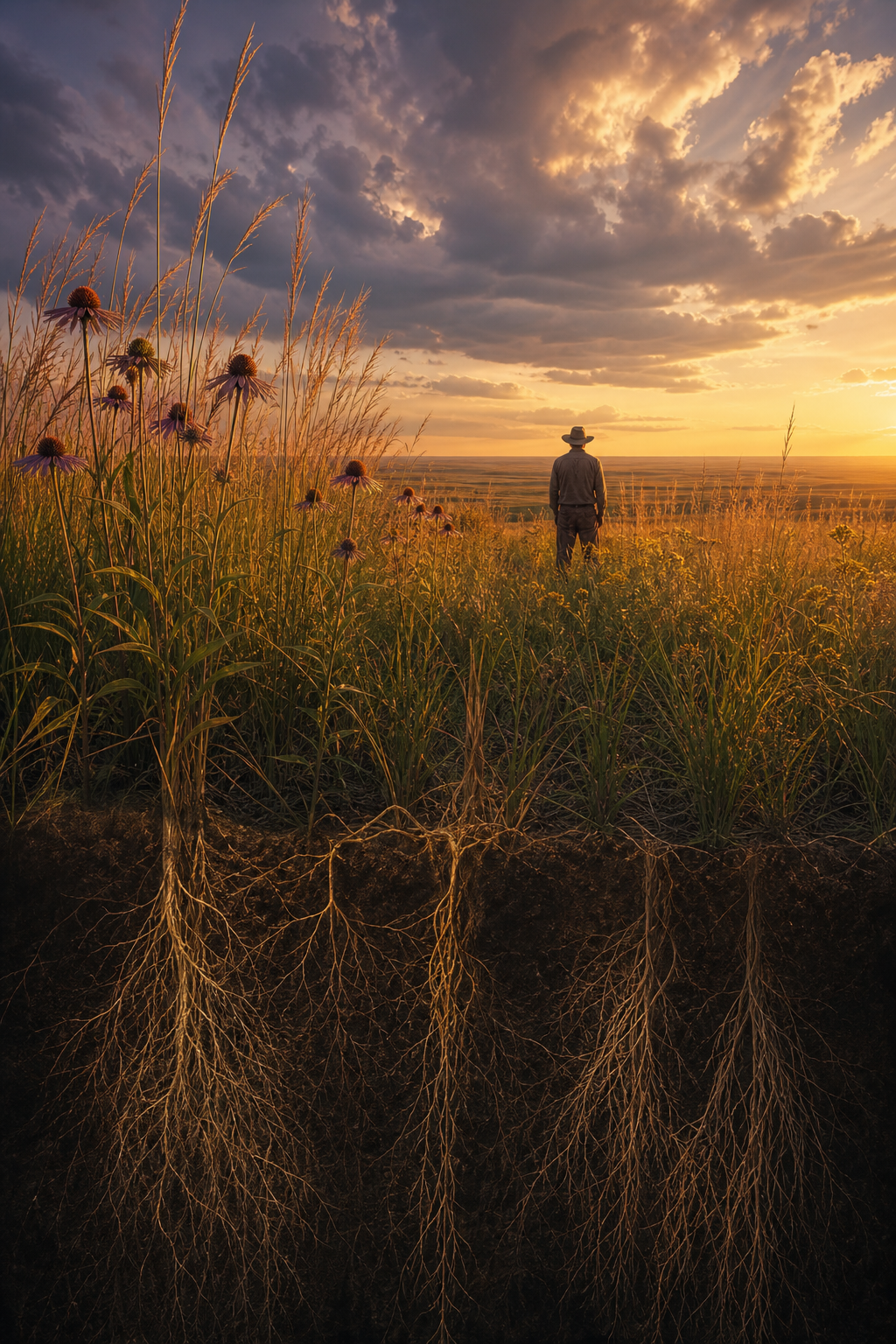
The living Kansas prairie — deep-rooted grasses under a vast sky, patient and self-renewing

The Great Question

Can agriculture function like a natural ecosystem? 农业能否像自然生态系统一样运转?

People Who Keep Great Questions Alive · Earth LinC

Wes Jackson
& the Prairie
That Never Forgot

Fifty years. One landscape. A question that changed what agriculture could mean.

Why this question is not philosophical. It is urgent.

10,000+
Years — prairie's unbroken run
North American grasslands maintained fertility, biodiversity, and ecological balance without any external inputs — ever.
50–100
Years — before topsoil exhaustion
Modern annual-grain agriculture depletes topsoil at a rate 10–40× faster than it can form. Many fields are already marginal.
24B
Tonnes of topsoil lost per year globally
UN Food and Agriculture Organization estimate. Each centimetre of topsoil takes roughly 1,000 years to form naturally.
70%
Of global freshwater used in agriculture
Annual-crop systems require irrigation that natural grasslands do not — because perennial roots reach 2–5 metres underground.
1976
Year — The Land Institute founded
Salina, Kansas. Jackson chose to begin where the problem was most visible: at the edge between prairie and ploughed field.
50+
Years of continuous observation
Jackson did not pivot. He stayed with the same question on the same land — a form of intellectual courage that is almost extinct.

He looked at the same place for fifty years. That was the method.

Most scientists study many places briefly. Wes Jackson studied one landscape with extraordinary patience. The Kansas prairie. He watched it through drought and rain, through political administrations and agricultural fashions. And the prairie kept doing what it had always done — sustaining itself.

No fertiliser was applied. No pesticide was sprayed. No tractor broke the surface. No irrigation pipe was laid. Yet the soil deepened. The diversity held. The system replenished.

Meanwhile, a few miles away, the Kansas farms — running on petroleum-based inputs and annual tilling — were slowly consuming themselves. Jackson noticed the contrast. He refused to look away.

🌾
Prairie Grasslands
Self-sustaining for millennia. Root systems sequester carbon and prevent erosion at a depth no annual crop achieves.
🌱
Kansas Farmland
Adjacent, but ageing rapidly. Topsoil loss visible decade by decade — the contrast was impossible to ignore.
🏘
Rural Communities
As soil health declined, so did community resilience. Jackson saw agriculture as a social contract, not just a production system.
🪱
Soil Systems
A tablespoon of healthy prairie soil holds more living organisms than there are people on Earth. The prairie's wealth lives underground.

"Wes Jackson did not spend fifty years trying to make nature more productive. He spent fifty years asking why nature was already productive enough."

— The question itself, as observation


The Land Institute — a different kind of ambition

1976
The Land Institute is founded
Jackson and his first wife Dana founded the institute in Salina, Kansas — deliberately located on the prairie, not in a city university. The land itself was the laboratory and the teacher.
1980s – 1990s
Kernza® begins — perennial wheat research
The team begins developing Kernza, a perennial grain crop derived from intermediate wheatgrass. The goal: a grain that regrows each year without replanting, with roots 3–5× deeper than annual wheat, holding soil and water through seasons.
2000s
Perennial agriculture gains scientific traction
Peer-reviewed studies confirm what Jackson observed intuitively: perennial systems dramatically reduce runoff, improve carbon sequestration, and restore soil microbiology. The "crazy idea" enters mainstream agroecology.
2010–2020
Kernza® reaches commercial scale
Kernza is grown by licensed farmers. Patagonia brews a beer from it. General Mills partners with the institute. A perennial grain enters the food supply — slowly, but irreversibly.
2023 →
The question lives on
The Land Institute continues research into perennial sorghum, silflower, and mixed polycultures. Jackson, now in his eighties, remains affiliated. The prairie is still there. The question is still open. landinstitute.org ↗

The Wow Moment

Most people thought Jackson was breeding better wheat. He was actually asking: what if wheat behaved like prairie grass? What if we stopped replanting every year entirely?

Annual Agriculture (Current Standard)
Replant every single year
Roots 15–30 cm deep — topsoil only
Bare soil each winter → erosion, runoff
Requires 1.5–2 kg nitrogen fertiliser per kg grain
High irrigation dependency
Soil carbon decreases over time
Perennial Agriculture (Jackson's Vision)
Regrows each season from same root system
Roots 1–5 metres deep — whole soil profile
Living root cover year-round → erosion halted
Self-fertilising through mycorrhizal networks
Dramatically lower water demand
Net carbon sequestration — building soil

Prairie grasses are perennial. They do not die each winter — they retreat, and return. Their root networks can reach two to five metres underground, tapping moisture and nutrients annual crops never touch. These roots build and hold soil across centuries. They shelter microbial communities that annual tillage destroys.

Jackson's insight was elegantly simple and radically demanding: stop trying to force nature to fit the industrial model. Instead, ask what it would mean to make agriculture more like nature.


How Jackson's mind actually worked — a loop, not a ladder

What strikes me most, reading everything I could find about Jackson, is that his process was not linear. He did not move from problem → hypothesis → solution. He moved in a loop — one that deepened each cycle, never completing, always returning.

The Jackson Loop

Observation → Question → Constraint → Build → Return to Observation

STEP 01
Observe, slowly
Stay with one landscape long enough to see what it actually does — not what you expect. Fifty years of watching the same prairie.
STEP 02
Ask backwards
Instead of "how do we produce more?", ask "why does the prairie produce sustainably without our intervention?" Reverse the premise.
STEP 03
Accept constraints
Perennial grain development takes decades. Jackson accepted that. He rejected the quarterly mindset that ruins most environmental projects.
STEP 04
Build anyway
Founded The Land Institute before the science was complete. Built the institution around the question, not around a confirmed answer.
STEP 05
Return, humbler
Each experimental result sent him back to the prairie to watch again. The loop never ends. That is the design, not the failure.

What makes this loop unusual is the role of constraint. Jackson did not try to speed up nature — he let nature set the tempo. When perennial grains took thirty years to develop commercially viable yields, he did not quit. He understood that the timeline was the point: any solution that could be built faster was probably not engaging with the real depth of the problem.

This is a lesson I find difficult. I am twenty-something, and the world is moving fast, and I want to find the answer this year. Jackson spent fifty years on one question. The patience itself is the methodology.


I came looking for answers. He gave me permission to sit with the question longer.

I love nature — but I have treated that love as a feeling, not a method. Jackson shows me that caring about the land is not enough. You have to stay with it, observe it, let it teach you the question it is answering. The prairie was not a metaphor for him. It was data. It was the standard.

The thing I keep returning to: he was not trying to make agriculture greener. He was trying to make agriculture more honest — honest about what a biological system can sustainably produce, honest about time horizons, honest about the gap between what we want and what the soil can actually give.

I sometimes feel like I need to have a clear direction before I can act. Jackson's life is evidence against this. He had a question — one clear, honest, impossible question — and he built an institution, a career, a lifetime around holding it open. The question was the direction.

My question, the one I am borrowing from this station until I grow my own: What would it mean to design human systems the way the prairie designs itself — with patience, with polyculture, with deep roots?

I do not have the answer. I am not supposed to. Not yet.

Go deeper — these are the real sources


Earth LinC · People Who Keep Great Questions Alive

The prairie has been answering for ten thousand years. We just need to learn how to ask.

— Navi, still finding direction, grateful to have found the question.