People Who Keep Great Questions Alive
People Who Keep Great Questions Alive
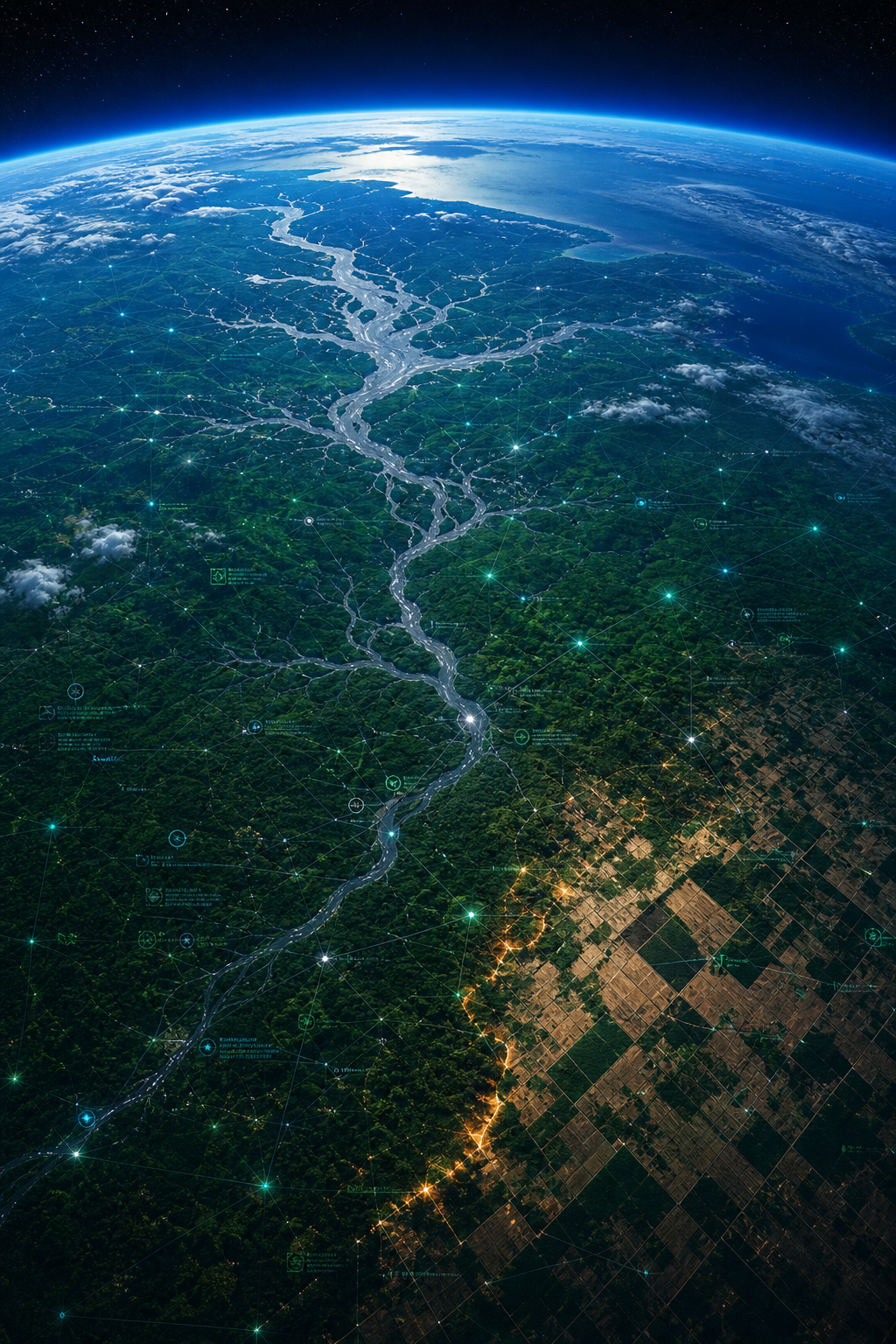
The Earth is speaking in data we have barely begun to decode. Lucas Joppa has spent two decades insisting that the gap between what we observe and what we understand is not a scientific failure — it is a design challenge.
I came to Joppa's work the way most young scientists do — through a citation trail that kept circling back to the same uncomfortable claim: we do not have a coherent, machine-readable model of planetary health. Not one that updates in near-real-time. Not one that any decision-maker at scale can actually use. And Joppa has spent the better part of his career engineering toward exactly that.
This article is my attempt to reconstruct his thinking, trace the institutional scaffolding behind it, and understand why the question he keeps asking — can we understand Earth well enough? — is still, stubbornly, open.
Lucas Joppa trained as a conservation ecologist, earning his PhD with a focus on the geographic patterns of biodiversity and their relationship to human land use. But his intellectual restlessness led him out of field ecology and into the systems question: if conservation is a resource-allocation problem, then you need a computational model of what you're trying to conserve — and that model needs to be grounded in current, empirical Earth observation data.
He joined Microsoft Research in 2010, and within a few years was building the institutional case that artificial intelligence — specifically deep learning applied to satellite imagery, species distribution models, and climate sensor networks — could become the nervous system of planetary stewardship. By 2017, he was named Microsoft's first Chief Environmental Scientist, a role that placed him at the intersection of cloud infrastructure, AI research, and global conservation partnerships.
"The natural world is generating more data than at any point in human history. The tragedy is that most of it vanishes without ever being understood."Lucas Joppa — Microsoft AI for Earth Program Context
What distinguishes Joppa from many tech-adjacent conservationists is his refusal to treat AI as a solution. For him, it is a detection instrument — and the question of whether it can detect enough, fast enough, accurately enough to change decisions at scale is precisely what remains unresolved.
Joppa's intellectual framework is not a linear pipeline from data to action. It is a closed feedback loop — each stage refines the next, and the loop only improves planetary decisions if all four stages run at sufficient fidelity and speed. Here is how he structures it:
Satellite imagery, acoustic sensors, camera traps, citizen science, climate stations. The Earth generates ~2.5 exabytes of observational data daily — but coverage is deeply uneven, skewed toward wealthy geographies.
Deep learning on remote sensing data. Species distribution models. Land-cover change detection. This is where Joppa's AI work lives — turning raw pixels into ecological meaning at scale.
Conservation prioritization. Carbon accounting. Policy design. The model's output must be legible to decision-makers under time and budget pressure — Joppa calls this the "interface of use."
Did the intervention work? Ground-truth the model. Update the priors. This is the stage conservation science most often skips — and Joppa argues it is why the loop rarely accelerates.
"The bottleneck is not data collection anymore. It's not even compute. It's the translation layer between machine understanding and human action — and we haven't built that well enough yet."Joppa — Paraphrased from AI for Earth Program Materials
In 2020, Microsoft launched the Planetary Computer — Joppa's most tangible engineering contribution. It is, at its core, a bet that the "understand" stage of his loop can be industrialized. The platform aggregates petabytes of satellite imagery, climate reanalysis data, species occurrence records, and land-use datasets into a single, queryable, cloud-native environment available to any researcher.
This matters because historically, the single largest friction in conservation AI research was not algorithmic — it was data wrangling. A PhD student studying deforestation in Borneo might spend 70% of their project time downloading, reprojecting, and aligning satellite tiles. The Planetary Computer eliminates that cost. The Analysis-Ready, Cloud-Optimized (ARCO) data catalog brings users directly to the modeling stage.
The platform hosts STAC-compliant data collections including Sentinel-2, Landsat, MODIS, NAIP, ERA5 climate reanalysis, USGS 3DEP elevation, and dozens of species and ecosystem datasets. As of 2023, the open hub serves hundreds of research teams across 60+ countries.
"If every conservation scientist had to build their own telescope before doing astronomy, we would still be arguing about whether the Earth moves. Planetary Computer is about removing that friction from planetary science."Conceptual Frame — Joppa's Program Philosophy
Joppa's work has been possible because of a specific and unusual funding structure — corporate philanthropy married to research infrastructure investment, rather than traditional grant cycles. Understanding that structure helps explain both its strengths and its tensions.
| Program / Source | Scale & Scope | Mechanism | Type |
|---|---|---|---|
| Microsoft AI for Earth | $50M+ over 5 years (2017–2022); 800+ grants in 80+ countries | Azure compute grants + technical mentorship + open dataset access | Corporate Philanthropy |
| Microsoft Planetary Computer | Ongoing infrastructure investment; est. $10M+ annually in data hosting & engineering | Hosted open platform; STAC-native cloud compute free to researchers | Infrastructure |
| NSF / GBIF Partnerships | Variable; co-funding model for specific biodiversity informatics initiatives | Data sharing agreements; joint modeling projects | Public–Private |
| Nature Conservancy Collaboration | Multi-year; project-specific, not publicly disclosed | Conservation target identification using AI models; site prioritization | NGO Partnership |
| Microsoft Sustainability (Internal) | Joppa's team embedded in Microsoft's carbon-negative commitment ($1B Climate Fund) | Internal R&D; AI tools for Microsoft's own land & carbon accounting | Corporate Internal |
Key insight: Unlike traditional conservation funding, Joppa's model does not require grant renewal cycles for its infrastructure layer. The Planetary Computer is sustained as a strategic asset of Microsoft's cloud business — which means its continuity is tied to Microsoft's commercial interests, not peer-reviewed outcomes. This is a structural strength (durability) and a structural risk (mission alignment) that any honest assessment must name.
Joppa's publication record spans traditional ecology journals and high-impact interdisciplinary venues, with a consistent thread: the gap between data availability and decision-relevant knowledge.
The Population Ecology of the World's Mammals
Filling in Biodiversity Threat Gaps
A Global Safety Net to Reverse Biodiversity Loss and Stabilize Earth's Climate
Deep Learning for Real-World Conservation Challenges (AI for Earth Grant Research)
Planetary Computer: Analysis-Ready Earth Observation at Scale
Here is what I find compelling as a young scientist trying to assess impact honestly: the AI for Earth program demonstrably lowered the barrier to entry for conservation AI research in the Global South. Of its 800+ grantees, a significant share were researchers and NGOs in biodiversity-rich nations who previously had no access to cloud compute or curated satellite data. The program did not just fund projects — it created a capability transfer.
But Joppa's own publications hint at the harder problem. In his 2016 Science paper, he estimates that fewer than 6% of known species have range maps based on actual occurrence data rather than modeled extrapolation. Seven years later, despite enormous advances in deep learning for species identification, that figure has not shifted dramatically — because the bottleneck is not classification algorithms, it is field survey coverage and data-sharing incentives.
This is the tension at the heart of Joppa's question. Can we understand Earth well enough? The answer from his own data seems to be: we are getting much better at understanding the Earth where we are already looking. The places we do not observe remain opaque — and those tend to be exactly the places under the highest pressure.
"We are not in danger of drowning in data. We are in danger of mistaking the well-lit street corner for the whole city."Navi / Analytical Frame — Earth LinC Station
Joppa's Planetary Computer represents a genuine structural answer to this: by making existing data free and easy to use, it accelerates the models without necessarily expanding the observations. The next step — which his team is aware of — is closing the sensor gap itself, through low-cost satellite constellations, community sensor networks, and eDNA monitoring at scale.
The work lives across these nodes. Each is a door into a different layer of Joppa's practice — from personal thinking to planetary infrastructure.
"Can we understand Earth well enough to make better decisions?"
The question is still open. That is not a failure — it is an invitation. Lucas Joppa has spent two decades making the invitation harder to ignore.