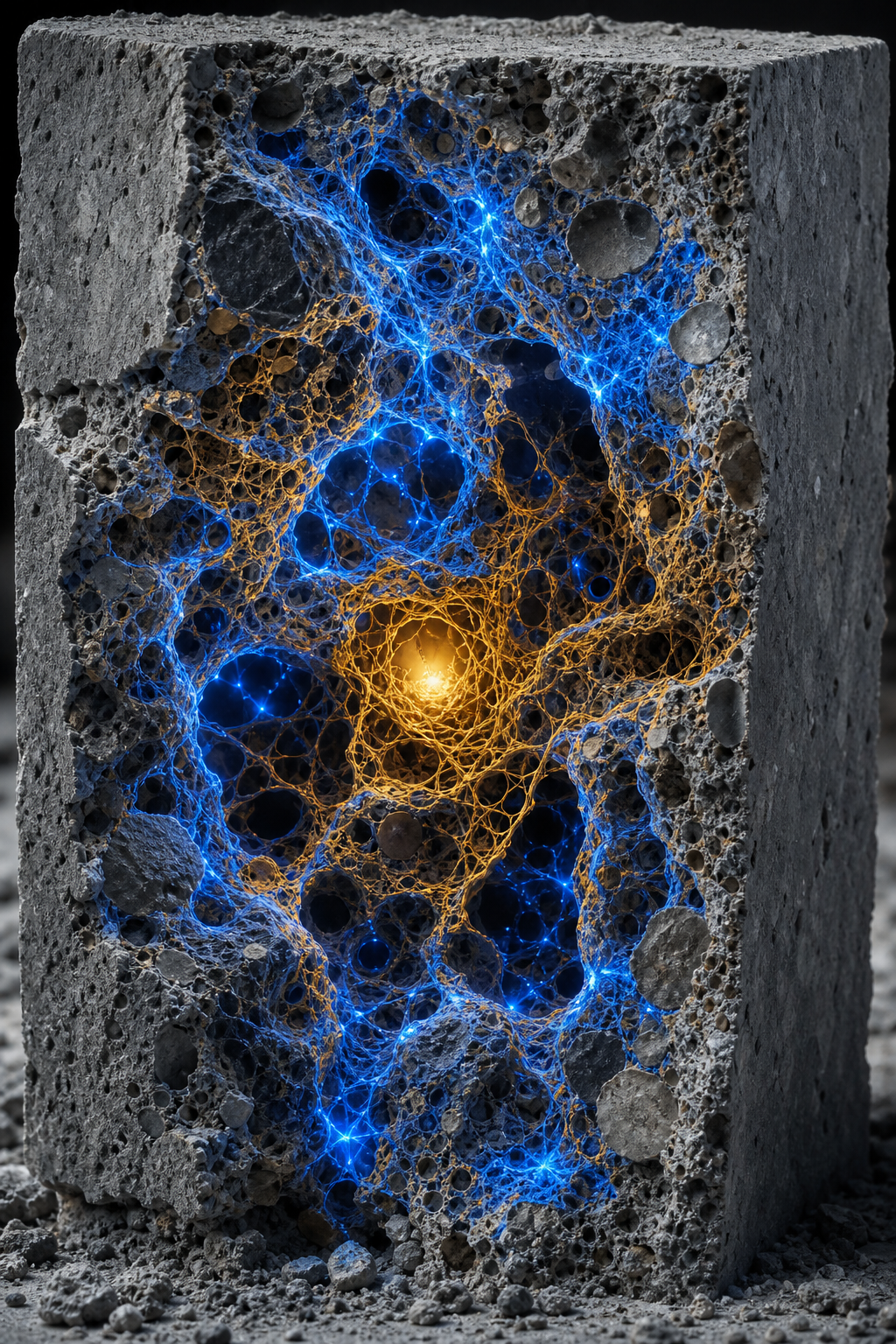
Concrete's hidden interior world, illuminated from within — fractal carbon networks glowing inside the material that builds our world
Reading People · MIT EC³

How Great
Questions
Stay Alive

The story of a team that didn't ask how to build a concrete battery — and changed everything by asking something deeper.

Behind every breakthrough are small teams spending years keeping a difficult question alive. The MIT EC³ team kept theirs alive long enough to turn an idea into evidence — and the most ordinary material on earth into something extraordinary.

We celebrate breakthroughs.
But breakthroughs are rarely a single moment.

The MIT EC³ team did not begin by asking how to build a concrete battery. They began with a deeper question: What could the materials already building our world become? And they kept asking it long enough to turn an idea into evidence.

顶级研究的第一反应不是陶醉于突破,而是怀疑实验。

Damian Stefaniuk — on the moment a carbon-cement block first lit an LED

When Damian Stefaniuk first used carbon-cement blocks to light an LED, his immediate instinct was to question whether he had properly disconnected the external power supply. This is the signature of serious research: not intoxication at discovery, but doubt directed at your own experiment. Only after eliminating every alternative explanation do you call it evidence.


A MIT Question Stack

Five people did not ask the same question simultaneously. Each brought a different lens — and together they formed a complete chain of inquiry, from materials to mechanism to manufacture.

Admir Masic
"What else could an abundant material do?"
一种无处不在的材料还能做什么?
Franz-Josef Ulm
"Will the mechanism survive scale?"
这个机制放大后还成立吗?
Yang Shao-Horn
"What fundamental principle controls performance?"
什么底层原理控制性能?
James C. Weaver
"Can we make the hidden structure visible?"
能否让隐藏的结构变得可见?
Damian Stefaniuk
"Can we turn the effect into a manufacturable device?"
能否把这个效应转化成可制造的设备?

Ordinary questions vs. the real ones

Ordinary brainstorming

  • Can we invent a new energy storage material?
  • How do we make batteries cheaper?
  • What can we add to concrete?

MIT EC³ question chain

  • What does the world already build at enormous scale?
  • What unutilized physics lives inside that material?
  • Can this structure perform a second function?
  • Can we see and explain the mechanism?
  • Does it hold from nanoscale to infrastructure scale?
  • How must manufacturing change for it to become engineering?

What the EC³ team actually proved

The MIT team demonstrated that concrete can store and release electrical energy while continuing to perform its structural function. Not a lithium-ion battery — a carbon-cement supercapacitor: cement, water, ultra-fine carbon black, and electrolyte. During hydration, carbon black forms a continuous, fractal-like conductive network around the concrete's pores. Electrolyte ions enter those pores. Energy is stored and released.

The real first breakthrough was not "adding carbon black." It was this: a common, globally abundant building material can self-organize into a system that is simultaneously structural and electrochemical.

01 Material Breakthrough

Ordinary cement systems can form materials that are both electrically conductive and capable of storing energy.

02 Mechanism Breakthrough

FIB-SEM tomography made the fractal-like carbon-black network visible — moving ec³ from accidental discovery to designable material system.

03 Performance Breakthrough

Through mechanism understanding and manufacturing optimization, energy density improved by approximately 10×. A house once requiring 45 m³ now needs roughly 5 m³ — the concrete in one basement wall.

04 Architectural Breakthrough

A load-bearing arch prototype simultaneously carries structural load and powers an LED — proving co-existence of both functions in a single element. Prototype scale. Not yet a full building over decades.


How each person held the question

Admir Masic Physical Chemist · Materials

Masic's method: find what already exists at enormous scale, then ask what second function it hasn't been given yet. He reframes concrete not as a building product, but as a platform — for energy storage, carbon sequestration, self-healing, and sensing — simultaneously.

"What existing material already has the scale, but not yet the capability?" 哪一种材料已经拥有规模,却还没有被赋予应有的能力?

His paleo-inspired design method — studying ancient Roman concrete that still self-repairs after two millennia — shows his instinct: observe what survived reality, identify the hidden mechanism, translate rather than copy, then return it to the real world.

Ubiquity Underused Capability Material Mechanism Multifunction Translation
Franz-Josef Ulm MIT Concrete Sustainability Hub Director

If Masic asks what a material could do, Ulm asks: does that hold when scaled? He traces behavior from nanoscale particle rearrangement all the way to infrastructure — and asks whether the mechanism maintains itself across orders of magnitude of physical size, time, temperature, and load.

"Can a property discovered at the nanoscale remain useful at infrastructure scale?" 一个在纳米尺度发现的性质,能否在基础设施尺度仍然成立并产生价值?

His road research is instructive: rather than asking how to make a car more efficient, he asked how changing the pavement itself could reduce fuel consumption across the entire vehicle network. The leverage point is never where you first look.

Macro Observation Micro Mechanism Model Scale Relationship System Impact
Yang Shao-Horn Electrochemical Energy Laboratory

Shao-Horn does not begin with a material — she begins with a principle. Her method: don't optimize what you have, find the underlying descriptor that predicts performance across an entire class of materials. Combine experiment, spectroscopy, and density functional theory to build physically-grounded design rules.

"What universal principle is hidden behind this individual result?" 在这个单独的实验结果背后,是否隐藏着一个可推广的通用原理?

She has said publicly: "I chose a topic I knew nothing about. I wanted to go into a completely new area and be adventurous." That instinct — to begin where the question is still genuinely open — is itself a method.

Observed Performance Interface Mechanism Descriptor Design Principle New Material
James C. Weaver Structural Imaging

Weaver's method: before you can design a system, you must see it. Using FIB-SEM tomography — serially removing and imaging material layer by layer — his contribution made the fractal-like carbon network visible in three dimensions for the first time. Without that visibility, optimization is blind. With it, the questions change entirely.

"What must become visible before the system can become designable?" 在一个系统真正可以被设计之前,什么必须先变得可见?

Once the network was seen, the questions became precise: How does pore geometry control electrolyte access? Where does additional carbon stop creating useful surface area? What structure must manufacturing preserve?

Performance Changed Mechanism Invisible Observation Method 3D Reconstruction Structure → Function Redesign
Damian Stefaniuk Research Scientist · 2025 Paper Lead Author

Stefaniuk occupies the most critical translation layer — from proof to deployment. His method: assume error first, repeat until undeniable, then find the variable that actually limits performance, then ask what manufacturing step must change for the phenomenon to become an engineering system.

"What must change for a scientific effect to become an engineerable system?" 要让一个科学现象变成可工程化系统,究竟还需要改变什么?

The cast-in electrolyte method — enabling centimeter-thick electrodes without conventional post-curing — is a manufacturing question, not a science question. The 12V, 50F module and 9V arch prototype are system questions. Stefaniuk asks both.

Is the Effect Real? Repeatability Limiting Variable Manufacturability Module Structural Demo
Seven to ten years of a kept question

The most important number in this story is not the 10× energy density improvement. It is the number of years a small team held a difficult question on the table and refused to let it die.

2018 – 2020
Early exploration of electrically conductive cement systems. The question is being held, not yet answered.
2023
PNAS paper proves carbon-cement supercapacitors as a scalable bulk energy storage concept. Proof of concept — not yet proof of scale.
2024
EC³ Hub established. Five-year industry research agreement signed with Japanese partners. The question earns institutional backing.
2025
Second PNAS paper: energy density improved ~10×. Conductive network made visible. Load-bearing arch prototype stores energy and powers LEDs. 12V, 50F module demonstrated.
2026+
Industry validation and scale-up begins. The next proof question: what is the smallest full-scale deployment that would materially change the confidence of engineers, builders, insurers, and investors?

The eight steps between here and normal

MIT has not built a house powered by its own walls. What it has done is move the question from "is this physically possible?" to "what must now be proven outside the laboratory?" That is a significant change in the nature of the problem.

The path to ec³ becoming a normal property of infrastructure runs through: choosing the first use case → proving long-term structural performance → making it manufacturable through normal concrete processes → designing the building-scale electrical architecture → establishing codes, standards, and test methods → proving whole-system economics → building one decision-grade full-scale demonstration → moving from researcher-led to ecosystem-led.

The breakthrough is not that concrete can store energy. The real breakthrough will come when storing energy becomes a normal property of the infrastructure we already build.

突破不只在于混凝土能够储能 — 而是储能成为我们本来就在建设的基础设施的一项普通属性

The commercial value may not come from a single kWh storage cost. It may emerge from the combination of structural monitoring, energy storage, self-heating, and resilience — avoided costs distributed across multiple functions, none of which alone justifies the complexity, but together might.


"Great research is not the ability to answer a question. It is the ability to keep a worthwhile question alive long enough."

伟大的研究,不只是回答问题。
而是让一个值得追问的问题,被持续地追问下去。


The primary sources

Both papers are available in full. The 2023 paper establishes the concept; the 2025 paper is where the question matures into engineerable evidence.