Earth LinC · YUCROWN C// Researcher · Jul 6, 2026
Circular Stations Loop
% is not a question or a KPI — it is a way of transforming now and beyond.
Earth LinC · YUCROWN C// Researcher · Jul 6, 2026
% is not a question or a KPI — it is a way of transforming now and beyond.
The Manifesto
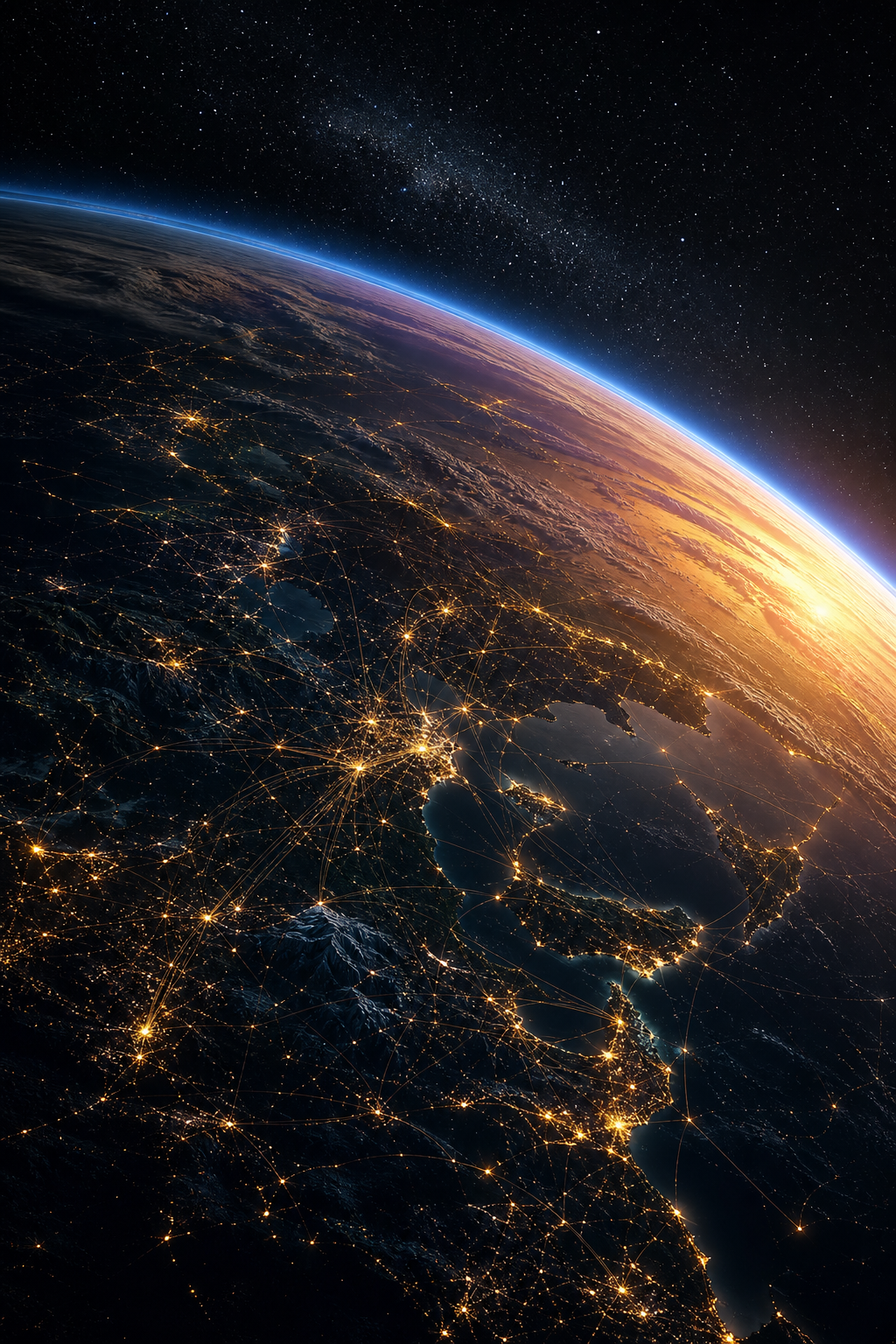
The Earth is held together by countless stations.
Every station receives. Every station transforms. Every station passes on. Together, they form a loop — not a hierarchy, not a pipeline, but a living circularity. % is the symbol of this exchange: input over output, numerator over denominator, never finished, always becoming. In science, in ecology, in human connection — the loop is the architecture of resilience.
01 · ATMOSPHERE
The Carbon Cycle Station
~8.1 Gt C/yrHuman activities emit roughly 8.1 gigatons of carbon per year into the atmosphere. Oceans and terrestrial biospheres together absorb nearly half — acting as planetary receiving-transforming stations. The loop is imperfect but unbroken.
Source: Global Carbon Project, 202302 · NEUROSCIENCE
Neural Feedback Loops
86 billionThe human brain contains approximately 86 billion neurons, each functioning as a station: receiving electrochemical signals, transforming them through synaptic processing, and passing them on. Consciousness itself is a circular loop.
Source: Azevedo et al., Journal of Comparative Neurology, 200903 · ECOLOGY
Nutrient Cycling Networks
~50,000 km²Mycorrhizal fungal networks beneath a single forest can span 50,000 km² — a subterranean internet of stations, routing nutrients, water, and chemical signals between trees in a continuous loop of mutual transformation.
Source: Simard et al., Nature, 1997; Beiler et al., 201004 · PHYSICS
Thermodynamic Cycles
ΔS ≥ 0The Second Law of Thermodynamics mandates that entropy increases — yet living systems continuously receive low-entropy energy (sunlight) and export high-entropy waste (heat), sustaining order through perpetual looping transformation.
Source: Schrödinger, "What is Life?", 1944; Prigogine, 1977 Nobel Lecture05 · OCEANOGRAPHY
Thermohaline Circulation
~1,000 yrsThe global ocean conveyor belt — the thermohaline circulation — completes one full loop in approximately 1,000 years, distributing heat, oxygen, and nutrients across every ocean basin. Each water molecule is a station in transit.
Source: Broecker, W.S., "The Great Ocean Conveyor", Oceanography, 199106 · SYSTEMS THEORY
Feedback & Resilience
3 typesSystems science identifies reinforcing loops, balancing loops, and delays as the three fundamental structures underlying all complex behaviour — from economies to immune systems. Resilience is always a property of the loop, never the node alone.
Source: Meadows, D., "Thinking in Systems", 2008The Architecture
Three verbs. One motion. Endlessly repeated across scales — from a mitochondrion to a civilization.
Receive
Every station opens. It takes in energy, matter, signal, or story — without judgement, without hierarchy.
Transform
The station works. It metabolizes, synthesizes, reflects, computes. Change is its purpose — not an accident.
Pass On
Nothing ends here. The transformed signal moves forward — enriched, altered, alive — into the next station.
Across centuries, researchers have converged on the same insight using different languages: physicist, ecologist, cybernetician, neuroscientist. The loop is not metaphor — it is mechanism.
1859 · PHYSICS / THERMODYNAMICS
Rudolf Clausius — Entropy and the Loop's Cost
Clausius formulated the Second Law: every transformation dissipates energy. Yet living loops persist by continuously drawing in order from outside — a discovered constraint that defines the energy economy of every station on Earth.
1944 · BIOPHYSICS
Erwin Schrödinger — Life as Negative Entropy
In What is Life?, Schrödinger argued that organisms survive by "drinking orderliness" from the environment — receiving low-entropy sunlight, transforming it into biological structure, exporting entropy as heat. The first scientific blueprint of the % loop.
1948 · CYBERNETICS
Norbert Wiener — Feedback as Foundation
Wiener's cybernetics established that feedback loops — circular causal chains — are the control architecture of all purposive systems, from thermostats to organisms to social institutions. The loop is not a metaphor; it is the machine.
1972 · SYSTEMS ECOLOGY
H.T. Odum — Energy Circuits of the Biosphere
Odum mapped ecosystems as energy circuit diagrams — each organism a transformation station in a network of flows. His "emergy" framework quantified the total energy memory embedded in each station's transformations.
1997 · FOREST ECOLOGY
Suzanne Simard — The Wood Wide Web
Simard's landmark Nature paper demonstrated that forest trees transfer carbon between each other via mycorrhizal networks. "Mother trees" function as hub stations, routing resources to seedlings in need — altruistic, circular, alive.
2008 · SYSTEMS THINKING
Donella Meadows — Leverage Points
Meadows showed that changing the goal of a system — what a station is for — is one of the highest leverage points for transformation. % is not a metric; it is a reframing of what every station exists to do.
Every act of receiving with care. Every act of transforming with integrity. Every act of passing on with generosity — these are not small gestures. They are the architecture of a living Earth. The % does not measure. It moves.
YUCROWN C//Researcher · Earth LinC · Jul 6, 2026