Walter Womacka, "Unser Leben" (Our Life), mosaic frieze, 1961–64, Haus des Lehrers, Berlin-Alexanderplatz. Photo: Wikimedia Commons, Free Art License.
Ostalgie is affection for the everyday objects, surfaces and institutions of the German Democratic Republic, felt after the state itself stopped existing.
| Period | The state, 1949–1990. The feeling, 1992 onward. |
|---|---|
| Coined | Uwe Steimle, East German stand-up comic, 1992 |
| Power | One-party state, planned economy. Consumer goods made in fixed ranges by state-owned combines. |
| Materials | Duroplast, precast concrete panels, mosaic tesserae, enamel, cream plastic |
| Palette | Concrete grey, signal red, signal green, mustard, brick red, cobalt |
| Places | East Berlin, Dresden, Leipzig, Halle-Neustadt, Marzahn |
Walter Womacka's mosaic frieze Unser Leben (Our Life) wraps the Haus des Lehrers on Alexanderplatz in Berlin. Seven metres high, 127 metres long, around 800,000 mosaic tesserae, made 1961–64 along with the building. It is one of the largest single works of European visual art by surface area. Womacka worked in the tradition of Mexican muralismo. The building came from the architect collective of Hermann Henselmann with Bernhard Geyer and Jörg Streitparth.
Read the figures across the frieze: a welder at a machine, a woman holding a camera, a young man sitting and thinking, a man standing with his hands at his sides, and at the end a girl's face with flowers in her hair. Work, science, study, youth, spring. This is the GDR's picture of its own citizens, fired into glass and bolted seven metres up.
The building behind it is now a glass office tower. The frieze is still on it.
The GDR was absorbed into the Federal Republic in October 1990. The Treuhandanstalt was set up to privatise state-owned enterprise; combines were sold, restructured or shut. Work disappeared in whole towns at once.
Along with the jobs went the kindergarten places attached to the factory, the holiday homes attached to the union, the brands on the shelf, the money in the pocket, the school curriculum, the street names and the traffic lights.
Ostalgie starts here, two years later, in a comedian's mouth.
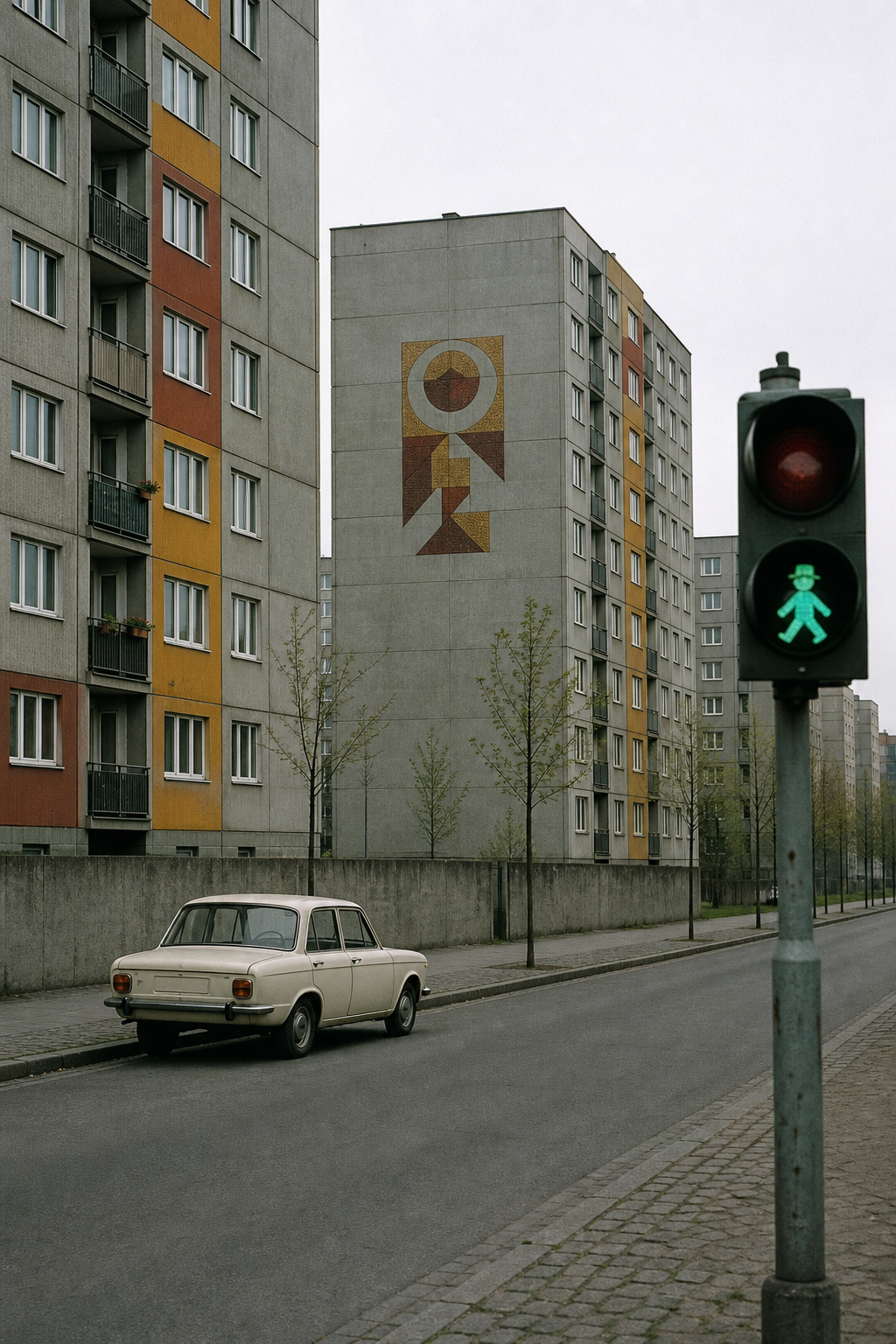
The green and red Ampelmännchen, designed by Karl Peglau, introduced 13 October 1961. Photo: Wikimedia Commons, CC BY-SA 4.0.
The Ampelmännchen was designed by Karl Peglau, a traffic psychologist, and officially introduced in Berlin on 13 October 1961. Peglau wanted a figure legible to children and to people with poor sight. The red man's thick outstretched arms make a barricade. The green man's pacing legs make an arrow. The hat came from a summer photograph of Erich Honecker in a straw hat; colleagues objected that the little figure looked petit bourgeois, and the hat stayed.
After reunification the East German lights were scheduled for replacement with the West German figure. Markus Heckhausen, a graphic designer from Tübingen in the west, started making indoor lamps out of the dismantled light covers and campaigned to keep the figure on the streets. Enough East Germans recognised what was being deleted that the campaign worked. He founded Ampelmann GmbH in 1995.
The lights stayed. The figure then crossed the other way, into the former West Berlin, where it had never been. Today it is a trademark with shops on Unter den Linden, printed on bags, mugs, socks and gummy sweets.
A state was dissolved and its pedestrian signal survived it, as a brand, sold to tourists on the ground the state used to hold.
Built June 1964 to July 1990. 2,818,547 made. Body panels of Duroplast, a resin composite reinforced with cotton waste, over a steel frame. A 594 cc two-stroke twin producing 25.6 hp. Buyers waited ten years and longer for one. Production stopped in July 1990, the month the two Germanies merged their currencies.
Trabant 601 S, VEB Sachsenring Automobilwerke Zwickau, built 1964–1990. Photo: Wikimedia Commons, CC BY 4.0.
The name comes from Seidel & Naumann of Dresden in the 1930s. After the war the works became state-owned, and the machines were later made by VEB Robotron Rechen- und Schreibtechnik in Dresden. Erikas furnished Eastern Bloc offices and typing classes through the 1970s and 1980s. The last ones were made in 1991, the year after the country ended.
Erika portable typewriter in its case, Dresden. Photo: Wikimedia Commons, CC BY 4.0.
Designed by Erich John, opened to the public on 30 September 1969. Ten metres high, a rotating drum carrying 24 time zones and 148 city names, with a steel model of the solar system turning once a minute on top. It still stands on Alexanderplatz. The signage now circling it reads Saturn, Galeria, Park Inn.
Urania World Clock, designed by Erich John, 1969, Alexanderplatz, Berlin. Photo: Wikimedia Commons, CC BY-SA 4.0.
Marzahn, on the eastern edge of Berlin: precast concrete panel blocks, built from the late 1970s, eleven storeys, with abstract ceramic tile emblems set into the blank gable ends. After 1990 the panels were insulated and repainted — red, yellow, blue, ochre. The GDR structure is underneath the West German colour scheme, and the tile emblems were kept.
Concrete panel housing with ceramic gable emblems, Jan-Petersen-Straße, Berlin-Marzahn, repainted after 1990. Photo: Wikimedia Commons, CC0.
Other retro feelings reach for an interface someone grew up with: an operating system, a plastic finish, a television signal. Ostalgie reaches for a country that was dissolved by treaty, whose borders no longer appear on a map, and whose government cannot be voted back.
The word has an argument inside it. People who use it are often missing their own youth, secure work, a kindergarten place, the neighbours in the stairwell, a specific cola. Critics answer that the same affection smooths over the Ministry for State Security, its network of informants, and a border where people were shot. Both of those are attached to the same objects — the same Trabant, the same traffic light.
That tension is what separates Ostalgie from every other kind of retro. Missing a decade is easy. Missing a state means deciding, every time, how much of the state comes with the memory.
The country is gone. The little man in the hat still tells Berlin when to walk.