Dead malls, empty plazas, night highways, hotel lobbies.
Marble head of Helios. CC BY 2.0.
Steeplegate Mall, central atrium. CC BY 2.0.
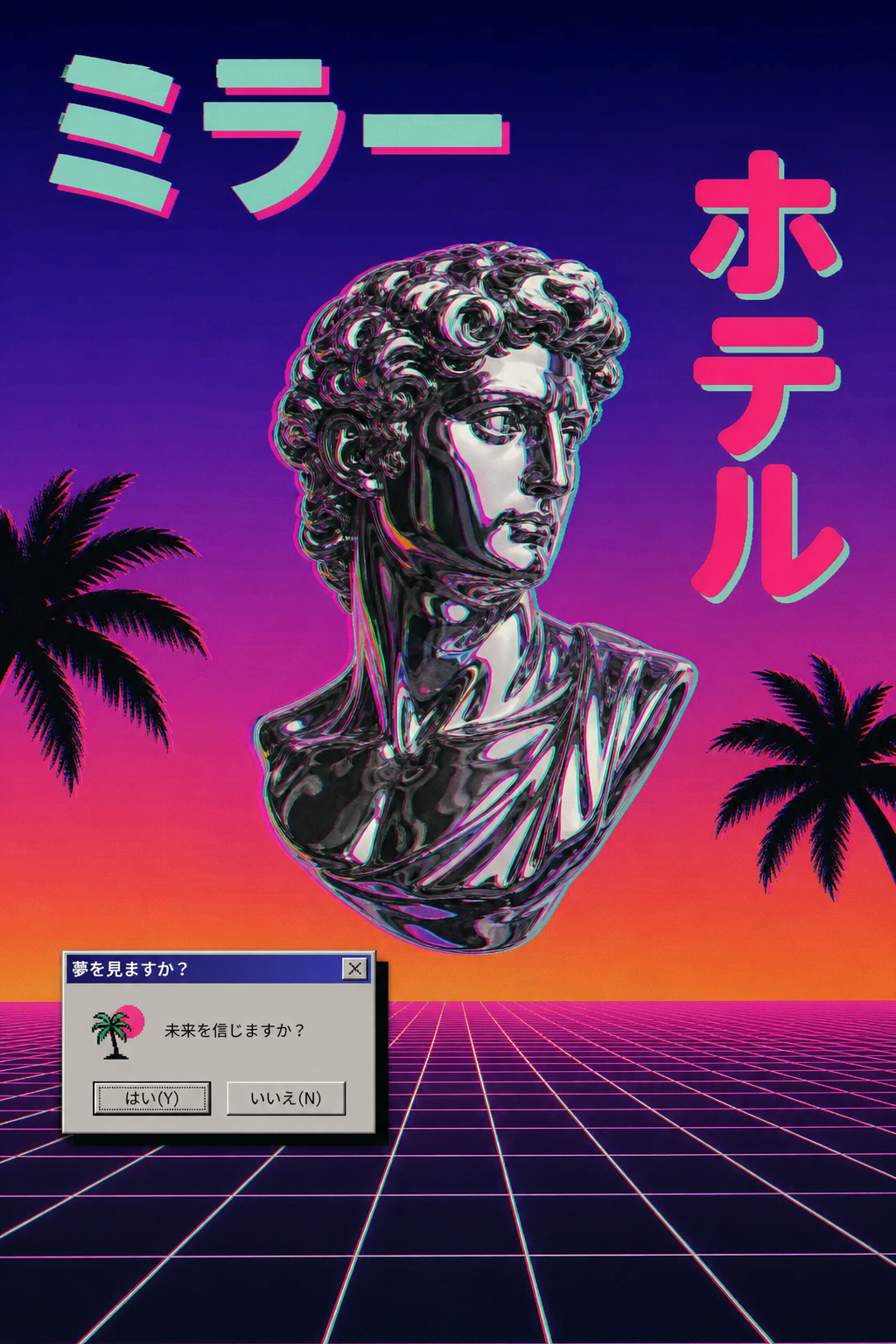
The marble head above is a real object in a real museum — eroded, on a plinth, lit against a purple wall. That image was there long before either of these words existed. Vaporwave found it.
02
Both Were Music Before They Were Pictures
Vaporwave begins with records. Chuck Person's Eccojams Vol. 1, released by Daniel Lopatin in 2010, then Macintosh Plus's Floral Shoppe and James Ferraro's Far Side Virtual in 2011. The word did not exist when those albums were made; it was applied afterwards, in online music writing, around 2011 and 2012.
Synthwave begins in the mid-2000s, largely out of the French house scene — College, Kavinsky, Lifelike, Anoraak — making new music in homage to 1980s film and game scores. Its sibling name, Outrun, is taken directly from Out Run, the Sega arcade racer of 1986.
In both cases the order is the same: sound first, name second, picture third. That is a different route from most of this family, where a word is coined in writing and the images follow it.
03
The Same Decade at Two Temperatures
Ferrari Testarossa. Public domain.
Vaporwave samples the late 80s and early 90s at their most commercial: mall music, smooth jazz, hold music, corporate video soundtracks, Japanese advertising, early Windows. It slows the material down, stretches it, and lets the tape degrade. The mood is ironic and mournful, and the subject is the machinery of selling.
Synthwave samples the same decade at its most cinematic: Miami Vice, Blade Runner, the arcade. It plays the material straight, loud and clean. The mood is sincere, and the subject is how good it felt.
The Testarossa belongs entirely to the second one. It is the car from the television programme, in the colour from the poster.
04
Why They Look Alike
Palms at sunset, Bali. CC0.
The two share a palette because they are working from the same physical sources. Magenta and aqua are what cheap 1980s four-colour printing and consumer video actually did to a sunset: the magenta plate ran hot, the cyan bled, the tape lost detail in the reds.
So the colour scheme is a reproduction artefact of the decade being sampled, adopted on purpose.
A palm tree at sunset is the same story. It was already a cliché in 1985, printed on airline brochures and album sleeves, and both aesthetics reach for it because it arrives pre-degraded.
05
The Empty Mall
Vaporwave's central scene is a shopping mall with nobody in it. Steeplegate, Puente Hills, Northland — American malls hollowed out by online retail, and photographed by the people who grew up walking around inside them.
The theoretical name for this feeling is hauntology, a term Jacques Derrida used and the critic Mark Fisher applied to popular culture: the sense of being haunted by a future that was promised and then cancelled. The mall is the clearest example available. It was built for a permanent middle-class afternoon that turned out to have an end date.
06
The Three Questions
MachineThe sampler, the VHS deck, and the shop's public address system.
PowerThe brands whose discarded material all of this is made from.
One of these two is a critique and the other is a tribute, and from ten feet away they are the same picture.
07
Why There Is Always Japanese Text
Shibuya at night, Tokyo, 2007. CC BY 2.0.
Katakana turns up constantly in both, and the reason is inherited. The source material includes Japanese advertising, city pop and consumer electronics, from the years when Japan was widely expected to own the future. Floral Shoppe put its title in Japanese. Half the cover art in the genre followed.
That expectation is the same one cyberpunk absorbed in the 1980s and never updated. Two aesthetics, thirty years apart, both carrying an assumption about which country tomorrow belonged to.
Two ways of remembering one decade, and from a distance, the same picture.