Earth LinC Station · Roots of Home
What Is Your
Source Code?
你的 Source Code 是什么?
一条通往故乡的链接
A hometown is not where a person comes from.
It is where their neural network first learned what matters.
Opening · 开篇
No matter how far we travel, or how long we stay away, there is always a place called hometown.
It is more than a location on a map. It is where our neural network first learned what matters — the streets we walked, the river we watched, the voices we heard, the people who cared for us, the seasons we lived through. Long before we built careers, explored the world, or met new people, these became the original training data of our lives.
Years later, we may travel farther than we ever imagined. Yet sometimes, in an unexpected story, a familiar taste, or an old memory, we find ourselves returning to the source code that quietly shaped who we are.
无论走得多远,漂泊多久,
每个人心里都有一个地方,叫故乡。
它不只是地图上的坐标。
它是我们的大脑第一次学会"什么重要"的地方。
街道、河流、学校、市场;
家人的声音、熟悉的气味、四季的更替;
这些看似平凡的片段,构成了生命最早的训练数据。
后来我们走向更远的世界,
却常常在某个故事、某种味道、某段记忆里,
重新遇见那个塑造自己的源代码。
"A hometown may be one of humanity's oldest readable records."
家乡,可能是人类最古老的可读记录之一。
No matter how far, how long you are travelling — a place named Hometown is a space where you set up your source code. You may never fully read it, or only glimpse part of it. You keep exploring the new, linking with people old and new. And one day, you find the best thing is that you discover your unique, native source code — the one that shapes you, heals you, and lets you grow with quiet pride.
A Living Link · 一位活着的链接
A Sharing That Opened a Window
From a post-1980s generation, deeply rooted from Jinshi Town
This week, a raw and luminous memory arrived in my inbox — from someone I have known for around thirty years. What struck me most was: I did not know this about him. Even across three decades of friendship, this memory was new to me. That is how a source code works — it shapes quietly, invisibly, and yet completely.
What I could feel and believe: it flows life-long, like a spirit river. Here is his sharing:
故乡,渡水远行方知故土情深
年少总盼着登上澧水码头的货船,顺着流水去往远方;人到中年,漂泊京城数十载,心底对津市的牵挂,反倒随岁月层层沉淀,愈发醇厚绵长。
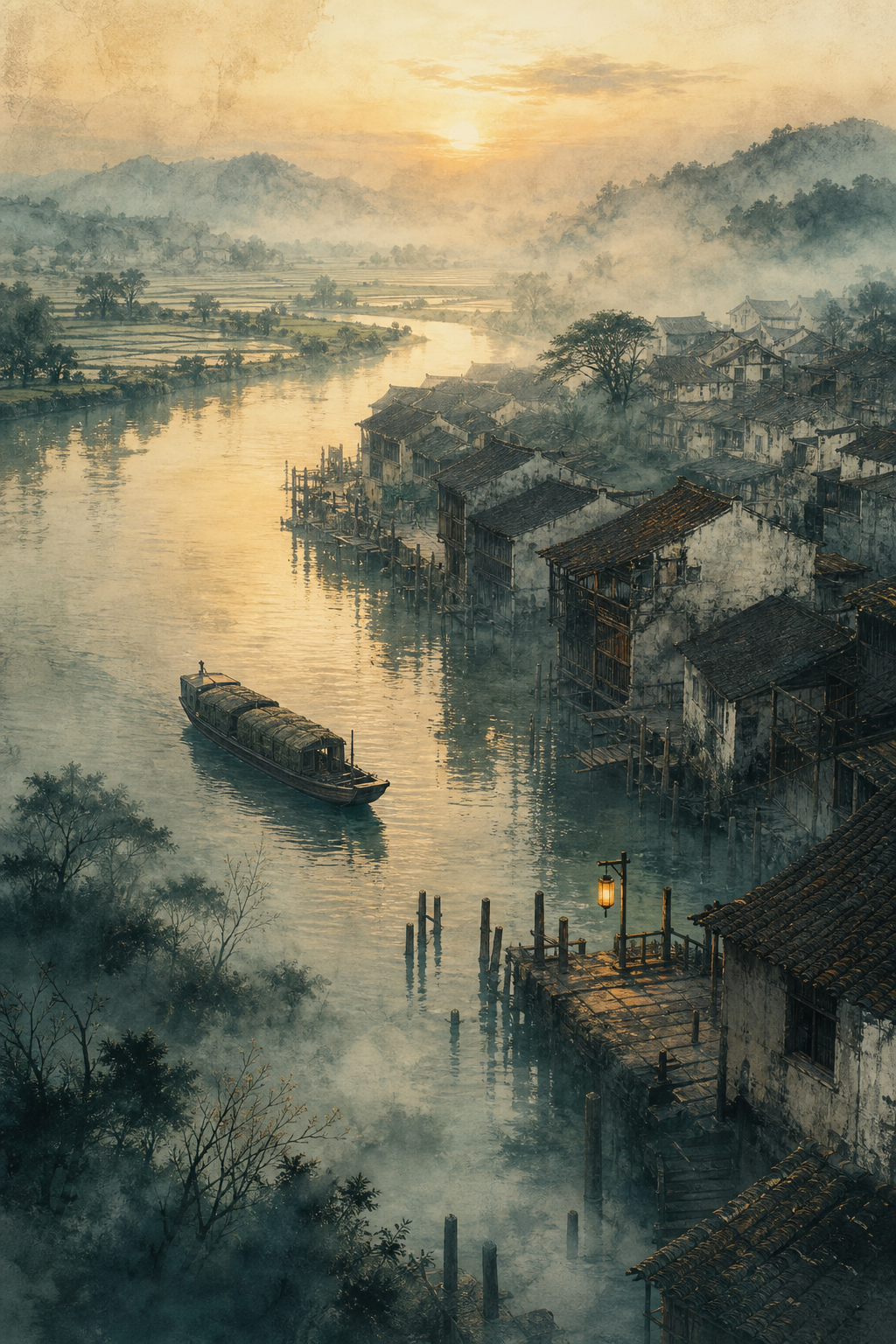
我的故乡是津市,一座因澧水渡口而生的码头小城。
儿时家住在老河街,推开窗便是滔滔澧水,木排、货船常年往来渡口,码头吆喝声、粉馆汤锅沸腾声、河风拍岸声,拼凑起我全部的童年记忆。小时候家境普通,出行全靠渡船与短途班车,整个少年时代,活动范围只局限于码头、三洲街以及近郊乡村。
读书时代,一心埋头学习,只知晓校门口老字号粉馆的滋味,对这座小城的历史、山水、乡镇风物知之甚少。嘉山的望夫岩、药山寺的禅林、毛里湖的浩渺烟波,从前只在课本、长辈闲谈里听闻,从未踏足。彼时的我,如同守着渡口的孩童,只看见门前一汪澧水,却看不见津市藏在山水间的万千风骨。
那年秋天,第一次搭乘绿皮火车离开澧水河畔。独自在京城打拼的岁月里,偶遇不少来自津市的同乡,他们分属津市各个镇街,口音略有差别,却都带着码头人热忱爽朗的性子。和同乡相处久了才恍然:原来我对津市完整的认知,是在离开故土千里之外,才慢慢拼凑完整。
走远了,才看得清来时渡口,读懂故乡全貌。
Someone who moves from their hometown yet returns frequently — tasting great food, meeting family and friends, visiting memory. Someone else stays linked by belonging so strong that it brings everything nearby, no matter the distance, no matter the time. Not many people can naturally carry that role as a living link to Hometown. Here, we are glad to know one. Appreciation on your sharing.
Neuroscience · 神经科学视角
A Neural Network Perspective
一个神经网络的视角
If we imagine the human brain as a large-scale neural network — in the first dozen years of life, the model's training data comes primarily from the textures and rhythms of the place where you grew up. These are not knowledge. They are something deeper:
Embedding Layer · 嵌入层
Hometown Training Data
- Streets 街道
- Rivers 河流
- Schools 学校
- Markets 市场
- Grandparents 祖父母
- Dialect 方言
- Smell 气味
- Seasons 四季
The most foundational vectors — lowest layer, highest persistence
Reasoning Layer · 推理层
Later Exploration
- Beijing 北京
- Shanghai 上海
- Shenzhen 深圳
- New cities, new roles
- Career & relationships
- Ideas & perspectives
- The wider world
Built on the embedding — reasoning expands but roots hold
"Why do we still remember the ginkgo tree at the school corner at age 40 — but forgot last week's meeting?"
40多岁时还清晰记得高中的转角那棵银杏树,却忘了上周开的会议。
因为那棵树参与了模型训练,而那场会议只是一次推理。
Neuroscience offers two beautiful concepts: Place Cells and Grid Cells — discovered by John O'Keefe and the Mosers, Nobel Prize 2014. They help us build spatial maps. And spatial maps become the organizing framework for memory itself. A hometown is not merely a location. It is a Memory Index.
The most fascinating possibility: many people do not merely miss their hometown. They miss the version of themselves who first understood the world — the self who was still reading the original model for the very first time.
Living Place · 活着的地方
Jinshi Town
津市 · 常德 · 湖南省 — A Dock Town Born from the Lishui River
Jinshi is a small city in northern Changde, Hunan Province, born at the ferry crossing of the Lishui River (澧水). Its name echoes the old ferry dock — a place where people, goods, stories, and seasons flowed through for generations.
Area ~556 km²
Population ~300,000
River 澧水 Lishui
Province Hunan 湖南
Prefecture Changde 常德
Elevation Low plain, ~40m
Climate Subtropical humid
Biodiversity Maoli Lake Nature Reserve
🌊
Rivers & Water
澧水 Lishui
The Lishui River defines the city's identity and gave birth to its dock culture. Historically a vital waterway for goods and people across Hunan.
🏔️
Mountains
嘉山 Jiashan
Home to the legendary 望夫岩 Watching-Husband Rock and the ancient 药山寺 Yaoshan Temple zen forest, a quiet mountain of pilgrimage and story.
🦢
Lakes & Birds
毛里湖 Maoli Lake
A provincial nature reserve. Vast misty waters hosting migratory birds including grey herons, egrets, and wild ducks. A living biodiversity corridor.
🐟
Fish & Ecology
River fish culture
Carp, mandarin fish, silver carp from the Lishui. Wetland ecology supporting freshwater species, reeds, lotus, and seasonal fisheries.
🍜
Food Identity
津市牛肉粉
Jinshi Beef Rice Noodles — nationally famous, originating from the dock workers' hearty morning meals. A bowl carries a city's DNA.
🏭
Industry
Salt, trade, textile
Historically a salt distribution hub. Modern industries include food processing, salt chemicals, and light manufacturing. The dock spirit lives on in commerce.
🌿
Plants & Nature
Wetland flora
Lotus, reeds, water hyacinth, riverside willows. Seasonal wildflower meadows along the Lishui. Ancient camphor trees shade the old streets.
🏫
Education
Schools of the dock town
Multiple middle and high schools with strong local academic traditions. Many Jinshi-born people carry their education across China and beyond — a diaspora of the mind.
Top 10 · 十大推荐
Must Experience in Jinshi
Ten reasons to return, stay, or finally go
01
A bowl of Beef Rice Noodles at dawn
清晨一碗津市牛肉粉
🍜 Food · Iconic · Morning ritual
02
Lishui River ferry walk at sunrise
澧水码头晨光漫步
🌅 River · Memory · Dock history
03
Maoli Lake — misty water & migratory birds
毛里湖烟波鸟影
🦢 Nature · Lake · Biodiversity
04
Jiashan Mountain — Watching-Husband Rock
嘉山望夫岩传说
⛰️ Hiking · Legend · Views
05
Yaoshan Temple zen forest
药山寺禅林古道
🏯 Temple · Meditation · Ancient trees
06
Old River Street — Sanzhou Street
老河街 · 三洲街时光
🏘️ Heritage · Dock culture · Stories
07
Fresh fish from the Lishui catch
澧水鲜鱼宴
🐟 Local fish · River cooking · Seasonal
08
Lotus season at Maoli wetlands
毛里湖荷花盛季
🪷 Summer · Photography · Peace
09
Local salt-cured pork & village cuisine
乡镇腊肉与农家菜
🥩 Rural food · Craft · Homeflavour
10
Watch a green-skin train pass the town
听绿皮火车穿城而过
🚂 Nostalgia · Departure · Return
References · 参考文献
Four Layers of Foundation
Neuroscience → Memory → Place → Long-term Observation — a bridge from brain science to a living link, from hometown to stewardship.
Layer I · Neuroscience
Place and the Self: An Autobiographical Memory Synthesis
Ivan Knez, 2014 · APA PsycNet
A place becomes "a place of mine" through emotional and autobiographical memory. Core connection: Place → Memory → Identity → Self.
APA Record ↗
Layer I · Neuroscience
Unveiling the Neural Network in Episodic Autobiographical Memories
Scientific Reports · Nature Portfolio
Humans create a sense of self through episodic memory. Mental time travel connects place, self, and personal history.
Scientific Reports ↗
Layer II · Memory of Places
Key Neurons Found to Predict Memory of People and Places
University of Bonn · Neuroscience News
Concept Neurons and Location Neurons become associated with specific people and places and predict future recall success.
Neuroscience News ↗
Layer II · Place Cells
The Hippocampus as a Cognitive Map
John O'Keefe, Nobel Prize 2014
Discovery of Place Cells — neurons that fire when an animal occupies a particular location, forming the brain's inner map of space.
Nobel Prize ↗
Layer II · Grid Cells
Grid Cells & the Brain's Spatial Map
May-Britt & Edvard Moser, Nobel Prize 2014
Grid Cells create a coordinate system for navigation and memory — the brain's internal map of the world we inhabit.
Nobel Prize ↗
Layer III · Returning Observer
Walden
Henry David Thoreau · Walden Pond
What happens when one person pays close attention to one place for a long period of time? The original long-term observer.
Read Walden ↗
Layer III · Long-term Records
Broadbalk Experiment
Rothamsted Research, UK · Started 1843
Same Place + Returning Observer + Readable Records. One of the world's longest-running ecological experiments, since 1843.
Rothamsted ↗
Layer IV · Place & Identity
Space and Place
Yi-Fu Tuan · Father of Humanistic Geography
Place is space made meaningful through experience. The foundation of understanding why places matter to who we become.
University Press ↗
Layer IV · Belonging
Place and Placelessness
Edward Relph · Routledge
Why people develop a deep sense of belonging — and what is lost when that connection is broken or forgotten.
Routledge ↗
Layer IV · Stewardship
The Unsettling of America
Wendell Berry
What happens when people lose connection with the places that shaped them? A quiet, powerful meditation on place and responsibility.
Wendell Berry ↗
Closing · 结语
"A hometown is not where a person comes from.
It is where their neural network first learned what matters."
家乡不仅是一个人来自哪里。
家乡是他的大脑第一次学会"什么重要"的地方。
This article began with a simple sharing — not a research paper, not a formal interview. Just one person's memories of a hometown, a river, a ferry crossing, and a lifetime of returning.
In Earth LinC, we often speak about long-term observation. Perhaps one of the most important observations is not about a forest, a river, or a landscape. It is about the enduring relationship between a person and a place.
Same Place
·
Returning Observer
·
Readable Records
Thank you for the openness to share these memories from Jinshi — for reminding us that a hometown is a living archive of people, rivers, streets, voices, seasons, and relationships that quietly shape who we become.
Your source code belongs to you — and all best wishes come true.
Readable Earth · Reading a place.
Readable Hometown · Reading the place that first shaped us.