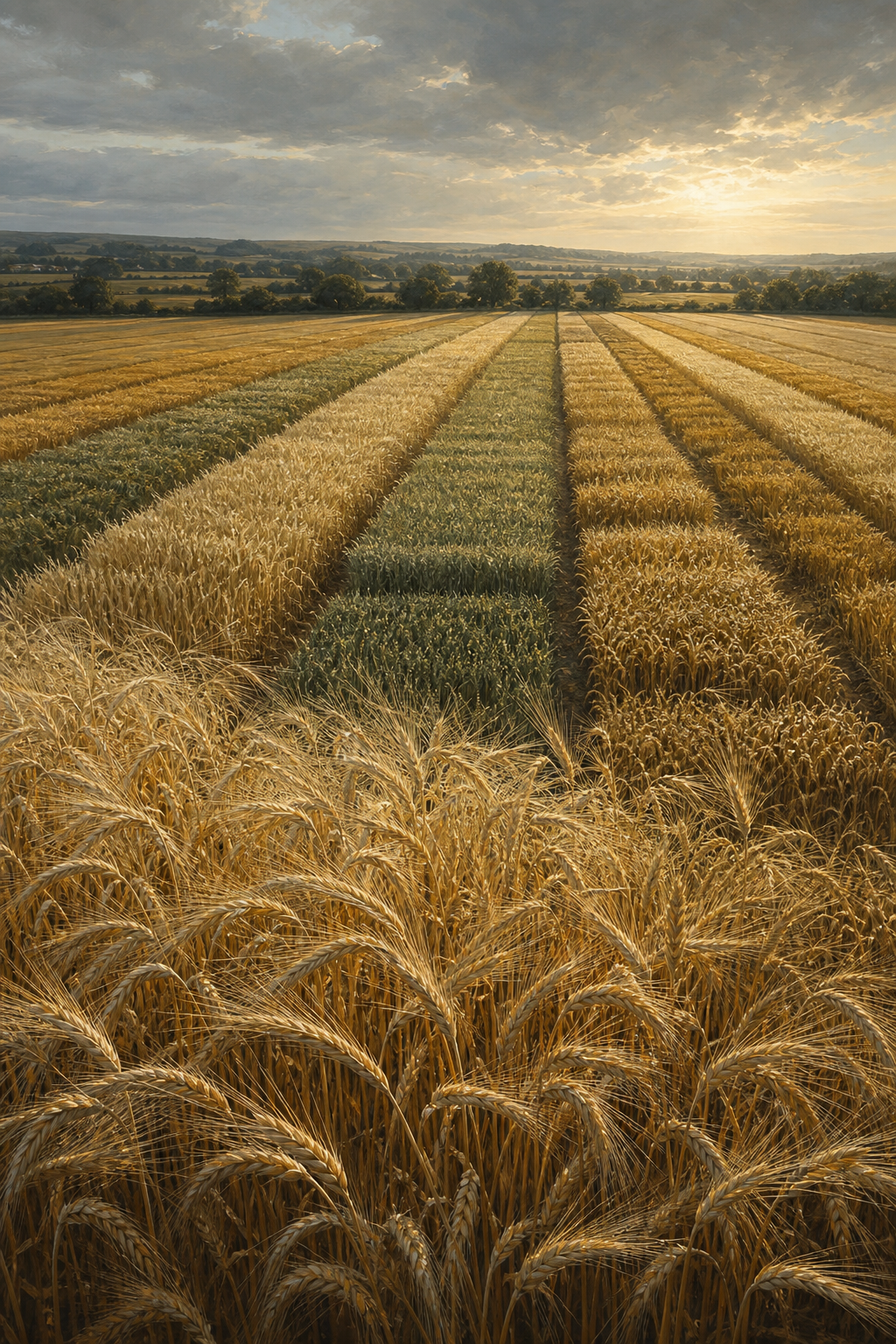
Broadbalk wheat field experimental strips under cool English light, Rothamsted Research

Broadbalk · Rothamsted, England · 1843 – Present

Reading a
Wheat Field
Through 180 Years

This is not a field that has simply been watched for 180 years.
It is a controlled comparison that has been kept readable for 180 years.

它不是一块被看了 180 年的麦田。它是一组被维护了 180 年、至今仍然可以比较的实验。

Open e-RA Dataset →

"Broadbalk is not the story of a wheat field. It is the story of how a community, an institution, and generations of scientists made one question readable for 180 years."

Broadbalk 不是一块麦田的故事。它是一个群体、一个机构、以及一代又一代科学家,让同一个问题在 180 年里持续可读的故事。


实验究竟怎么设计?
How was the experiment designed? · Comment l'expérience a-t-elle été conçue ?

No
fertilizer
N
only
N + P
+ K
Farm
manure
Wheat
rotation
Continuous
wheat

Broadbalk was established in 1843 by John Bennet Lawes and Joseph Henry Gilbert. The field was divided into 20 long-term treatment strips, each receiving a different combination of nitrogen, phosphorus, potassium, and other mineral nutrients — or none at all. One strip has received farmyard manure continuously since 1843; another has received no fertiliser or manure since the experiment began, serving as the permanent baseline.

No Fertilizer不施肥 · Aucun fertilisant — permanent control since 1843
Nitrogen Only单施氮 · Azote seul — effect of N without P or K
N + P + K氮磷钾组合 · Combinaisons N P K — multiple levels tested
Farmyard Manure长期农家肥 · Fumier — organic N, P, K, carbon
Continuous Wheat连续种植小麦 · Blé continu — no break crop
Wheat in Rotation轮作体系 · Blé en rotation — introduced from 1968

Key principle: Broadbalk is not frozen at 1843. From 1968 onward, short-straw winter wheat varieties were introduced, rotations added to some sections, nitrogen rates tested up to 288 kg N/ha, herbicides applied — while long-term reference strips and full management records were preserved. Each change was documented so the long-term comparison remained legible. 每次调整均有记录,长期对照得以保留,实验的可比性才能跨越 180 年。


他们到底收集了哪些数据?

What did they collect? · Qu'ont-ils collecté ?

A — Crop Data | 作物数据

  • Wheat grain yield per plot · 籽粒产量
  • Straw yield · 秸秆产量
  • Fertiliser inputs · 肥料投入量
  • Wheat variety used · 小麦品种
  • Continuous vs. rotation system · 连作或轮作
  • Weeds, pests, disease · 杂草与病害
  • Changes in agronomic practice · 管理方式变化

The real value: compare the same treatment at 1 year vs. 10 years vs. 50 years vs. 100 years.
同一处理 1 年、10 年、50 年、100 年后的对比。

B — Soil Chemistry | 土壤化学

  • Soil organic carbon (SOC) · 土壤有机碳
  • Total soil nitrogen · 土壤总氮
  • Soil pH · 土壤酸碱度
  • Olsen phosphorus · 有效磷
  • Exchangeable potassium · 交换性钾
  • Exchangeable cations · 交换性阳离子
  • SOC & total-N stocks · 碳氮储量
  • Full fertiliser/manure history · 施肥历史

Soil samples archived from 1865; dataset extends to 2021, with estimates back to 1843.
土壤样品档案自 1865 年起保存,数据集延至 2021 年。

C — Physical Archive | 实物样品

Rothamsted holds over 300,000 archived crop, soil, fertiliser, and manure samples — alongside 170 years of meteorological records and the e-RA electronic database.

This allows today's researchers to apply methods that did not exist when the samples were taken:

  • Radiocarbon tracing · 放射性碳示踪
  • Metagenomics · 宏基因组学
  • Metabolomics · 代谢组学
  • Microbial community analysis · 微生物群落分析

Future analytical optionality.
未来重新分析和重新提问的能力。


The question changed more than the field.

麦田几乎没有移动。问题不断变化。
Le champ n'a presque pas bougé. Les questions, elles, n'ont cessé d'évoluer.

1843

"How much wheat can we grow with different fertilisers?"

肥料怎样影响小麦产量?· Comment les engrais influencent-ils le rendement ?

c. 1900s

"Which nutrients become limiting over time?"

哪些养分逐渐成为长期限制因素?

c. 1960s

"How do variety, rotation, weeds, and disease interact with yield?"

品种、轮作、杂草和病害,怎样共同影响产量?

c. 1990s

"How do long-term treatments alter soil carbon and cause nutrient losses?"

长期处理怎样改变土壤碳,并带来养分流失?

2020s

"How do microbes transform plant inputs into stable soil carbon? What can 180 years of data teach us about climate, resilience, and sustainability?"

微生物如何把植物投入转化为稳定土壤碳?180 年数据对气候与可持续性意味着什么?

What truly happened was not the same question studied for 180 years — it was the same long-term reference system, allowing each generation of scientists to pose entirely new questions. 真正发生的是:同一套长期参照系统,让每一代科学家能够提出当代的新问题。


得到了一些什么结果?

What Did We Learn? · Qu'avons-nous appris ?

RESULT 01

Yield can be sustained — but not by fertiliser alone.

产量可以长期维持,但不能只靠肥料。

Long-term unfertilised plots serve as a low-input baseline, clearly showing that mineral fertiliser or organic manure — both — can sustain or increase wheat yields across nearly two centuries. But only when soil acidity, weeds, and disease are also managed. 土壤酸化、杂草和病害,必须与养分问题一起处理,单独施肥不足以维持长期产量。

RESULT 02

Short-straw varieties roughly doubled grain yield — but only with the right conditions.

矮秆品种使籽粒产量约翻倍——但前提是配套管理到位。

After 1968, short-straw winter wheat varieties increased grain yield approximately two-fold, with some plots exceeding 12 t/ha in favourable years. Broadbalk shows that genetic potential only converts to yield when nutrients, soil pH, weed and disease control are all present together. 品种潜力只有在养分、土壤 pH、杂草与病害控制同时到位时,才能转化为实际产量。

RESULT 03

Continuous wheat and rotated wheat need different nitrogen inputs.

连作小麦与轮作小麦,对氮的需求不同。

Continuous wheat often requires up to 240–288 kg N/ha for peak yield. The first wheat in rotation after a two-year break reaches maximum yield at lower N rates. 前几年的管理,仍然存在于今天的土壤里。The previous years remain present in the soil.

RESULT 04

High productivity and environmental risk coexist on the same curve.

高投入可以高产,也可能增加养分流失风险。

More nutrients · 更多养分
Higher yield potential · 更高产量潜力
More biomass & residues · 更多作物生物量
But: higher nutrient loss risk · 但养分流失风险增加

Broadbalk tracks nitrate and phosphate movement into drainage, greenhouse gas fluxes, and atmospheric N and S deposition. Yield-per-hectare is never the whole story.用每公顷产量作为唯一 KPI,会漏掉农业系统的一半结果。

RESULT 05

Long-term nutrient inputs reshape soil carbon — in measurable, mechanistic ways.

长期养分投入改变土壤碳——方式可量化、机制可辨识。

A 2025 study using Broadbalk archived samples found that plots receiving both N and P long-term had up to 28% more soil organic carbon than unfertilised plots. Using radiocarbon tracing, metagenomics, and metabolomics, the study showed: 2025 年研究显示,长期同时施氮磷的地块,土壤有机碳最多比未施肥地块高 28%。

  • P alone: boosts microbial activity, but less conversion to stable carbon · 磷单施:促进微生物活动,但稳定碳转化较少
  • N alone: improves microbial efficiency for mineral-bonded carbon · 氮单施:提高微生物将有机质转为矿物结合态碳的效率
  • N + P together: promotes plant growth AND accelerates short-term carbon → stable carbon conversion · 氮磷共施:同时促进植物生长并加速碳向稳定库转化

More soil carbon does not automatically equal a better environmental outcome — the same plot can simultaneously produce higher yield, more plant residue, higher SOC, and higher nitrogen-loss risk.更多土壤碳并不自动等于整体环境结果更好。这正是 180 年长期实验比单指标项目强的地方。

Broadbalk 最重要的五个科学结论

The five most important findings. · Les cinq conclusions scientifiques les plus importantes.

Yield can be sustained — but not by fertiliser alone.

产量可以长期维持,但不能只靠肥料。

Variety improvement, soil acidification control, weed and disease management, and rotation must all work together.

Soil remembers its management history.

土壤记得过去的管理。

Rotation, nutrient inputs, manure, and long-term unfertilised treatments each produce distinct soil states that continue to shape subsequent crops.

Productivity and environmental impact must be read together.

生产力与环境影响必须一起读。

High inputs support high yields — and may also increase the risk of nutrients entering drainage. No single metric captures the full system.

Archived samples can answer questions that did not yet exist.

保存的样品能够回答当年尚不存在的问题。

Metagenomics, metabolomics, and radiocarbon methods can be applied to samples taken a century ago. The archive is a research infrastructure for future generations.

Long-term continuity requires controlled change — not frozen methods.

长期连续性要求"有控制地改变",而非方法停滞。

Broadbalk persists not because it never changed, but because every change in variety, rotation, fertiliser, and management was documented — and long-term reference strips were preserved alongside the changes.


真正的 Broadbalk 数据逻辑

The real data logic · La logique réelle des données Broadbalk

PLACE 同一块田 · Same field since 1843
TREATMENT HISTORY 明确的长期处理历史 · Documented treatment strips
ANNUAL HARVEST 年度作物结果 · Grain & straw yield, every year
REPEATED SOIL SAMPLING 重复土壤采样 · 1865 → 2021, systematic from 1992
PHYSICAL ARCHIVE 实物样品档案 · 300,000+ archived samples
METADATA 管理与方法记录 · Every change documented
NEW ANALYTICAL METHODS 新的分析技术 · Metagenomics, radiocarbon, metabolomics
NEW QUESTIONS 新的科学问题 · Each generation asks what the previous could not

A field where inputs, outputs, side effects, and soil memory can still be connected after 180 years.
一块经过 180 年,仍然能够把投入、产出、环境代价与土壤记忆连接起来的田。

"The reference survived.
So every generation could ask a better question."

参照系保存了下来。
所以每一代人,都能提出一个更好的问题。

Data survived because institutions survived · Continuity is infrastructure


What sustained it?

什么让它持续?

Broadbalk 最令人震撼的数据并不是小麦。它是:一个机构在 180 年里持续存在,使每一批新科学家都能找到前人留下的参照系,并在此基础上提出新问题。

Caleb Scoville 关注的问题与此高度相关:环境知识为什么能够跨世代存活? Broadbalk 给出的答案不是"因为这个问题足够重要",而是"因为有人持续维护了一套可供后人重新提问的参照系统"。

Why does environmental knowledge survive across generations? Broadbalk's answer: not because the question was important enough — but because a community maintained a reference system legible to each new generation.


References

数据与文献来源,供分享与延伸阅读。
Sources de données et références, pour partage et lecture approfondie.

Primary data access: Broadbalk yield, soil chemistry, and management data are openly accessible via the e-RA database at Rothamsted Research. Researchers may apply to access physical archived samples through Rothamsted's sample archive programme.
主要数据通过 e-RA 数据库公开获取;实物样品可通过申请流程向 Rothamsted 研究站获取。