
A week inside the country's rising floor
When 27°C Started to Feel Cool
In Fukuoka, a woman posts her morning temperature like a diary entry. This week, 27°C stopped being news — it was just the number before the real heat arrived.
In Fukuoka, a woman posts her morning temperature like a diary entry. This week, 27°C stopped being news — it was just the number before the real heat arrived.
Between July 21st and 28th, Japan's weather accounts ran the same warning on a loop: 命に関わる危険な暑さ — heat dangerous enough to kill. Kyoto came within three-tenths of a degree of the country's official "extreme heat" threshold. A mountain town in Ōita crossed it for the first time in Kyūshū's recorded history. Two thousand kilometers south, a subtropical island set its own all-time record at a comparatively mild 34.4°C.
None of this arrived as a single storm or a single day. It arrived as a rhythm — the same forecaster posting the same sentence, five evenings running, while a Fukuoka commuter kept logging 27°C mornings like a weather-service intern too tired to editorialize. This is the record of that week: not a single alarm, but a baseline quietly moving underneath one.
From the Kantō plain to the shores of Kyūshū, the 40°C line kept redrawing itself across new prefectures almost every night, in near-identical language.

Central and western Japan, July 23 forecast. Magenta marks 35°C and above; the darker maroon patches push past 40°C. Map data: Japan Meteorological Agency, via 地理院タイル.


"Kyoto's high today was 39.7°C. It never technically crossed into an 'extreme heat day' at 40°C — but it was dangerous enough to kill."
— @katahira_tenki, Jul 23 · read the original post ↗ (translated)The furnace wasn't confined to the obvious cities. On July 27th, Kyūshū's mountain interior and a remote Pacific island broke their own historical ceilings within the same twenty-four hours.
A mountain basin two hundred kilometers from the coast, and an oceanic outpost a thousand kilometers from the mainland — both crossed lines they had never crossed before, on the same day. @wni_jp reported both records together, a small reminder that this week's heat didn't stay where anyone expected it to.
Two days after Gifu and Aichi first turned deep maroon on the forecast maps, the same corridor turned maroon again — some towns hotter the second time.
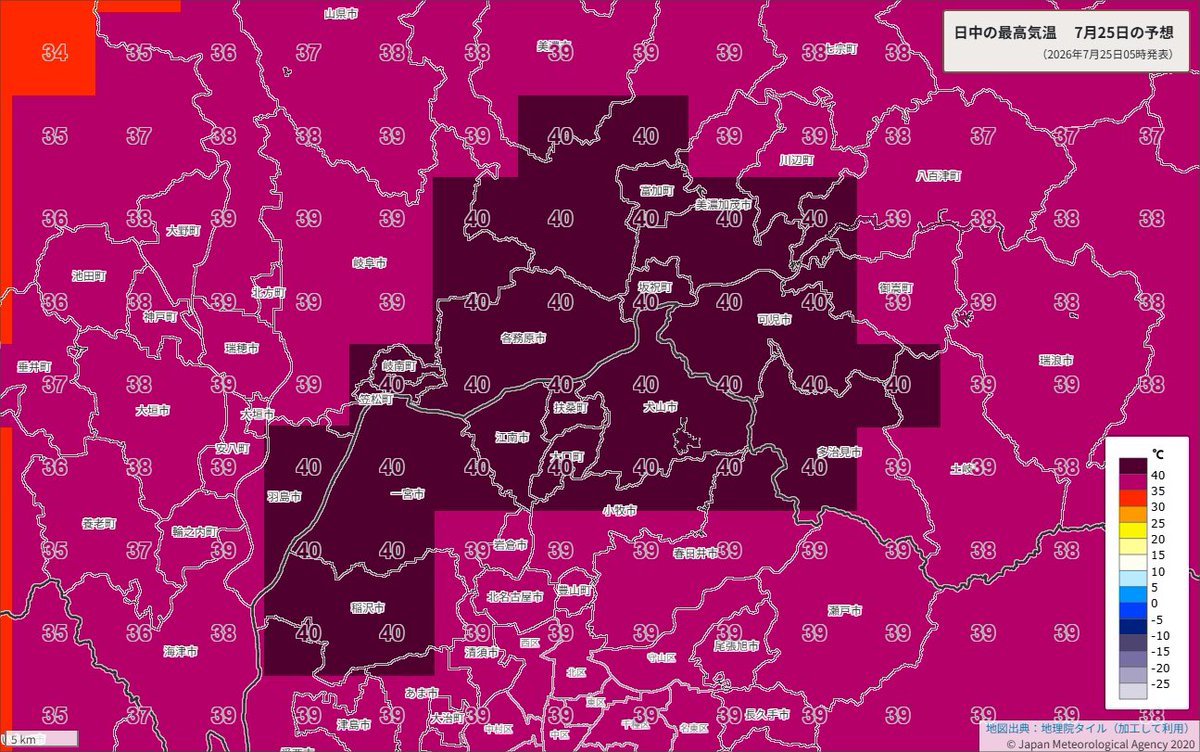
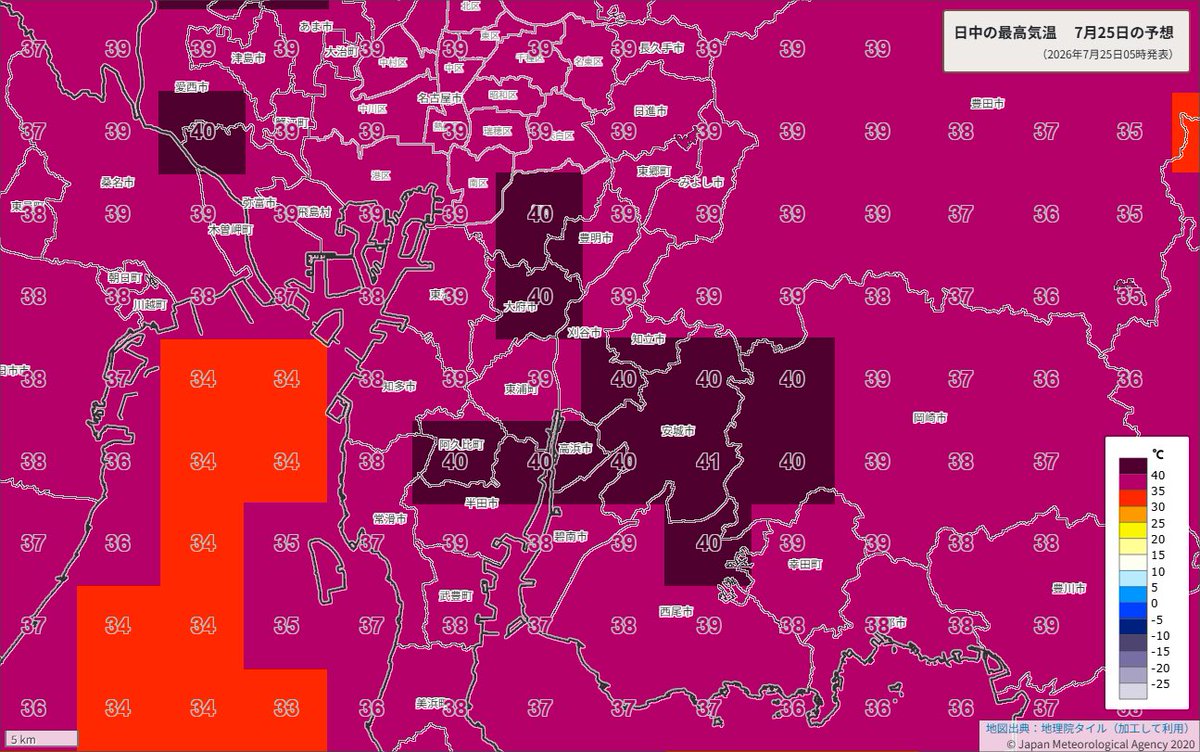
By the fifth consecutive advisory in four days, @arakencloud was warning about Yamanashi, Aichi, Gifu, Shizuoka and Okayama in almost the same sentence used three days before. The repetition itself became a kind of data — not a single freak afternoon, but a standing condition that forecasters, and the people rerouting their errands around it, had started planning around rather than reacting to.
Somewhere in the archive of daily posts, the tone shifts — not because the heat eased, but because the people describing it stopped being surprised.
"Good morning from Fukuoka 💟 Heatwave — 27°C this Wednesday morning. Today's high will be 37°C."
@VzHX2BYv588ESP8 ↗ (translated)"Good morning from Fukuoka 💟 Heatwave — 27°C this Thursday morning. No joke to share today — I just hope your area doesn't hit the 40°C extreme-heat line."
@VzHX2BYv588ESP8 ↗ (translated)Elsewhere the same week, @nobita777 posted a heatstroke warning for a forecast of 35°C-plus across the whole western half of the country — folded into the same post as a kanji quiz about kuzumochi sweets. The danger and the ordinary trivia sat in the same breath, because by then they belonged in the same breath.
This single week doesn't prove a changed climate on its own — it's one archive of dispatches from five accounts, over eight days. But inside that archive, the language of an ordinary morning had already moved: 27°C, once itself a temperature worth flagging, had quietly become the number people mentioned in passing, on the way to something worse.
"27°C, this Wednesday morning."
— @VzHX2BYv588ESP8, Jul 22 · read the original post ↗