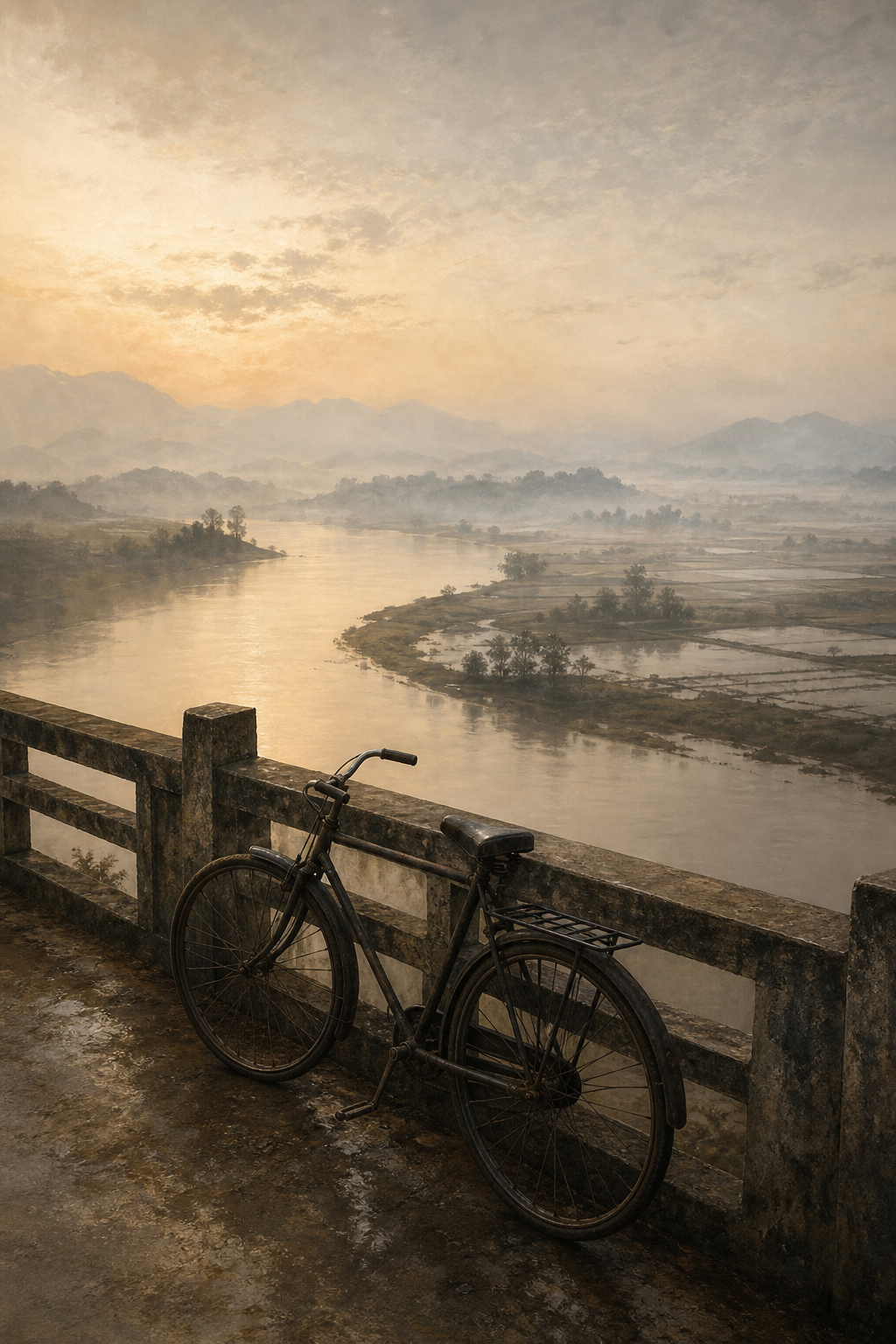
A life traced by water · 1980 – 2026
Shape
of River
From a bicycle crossing at dawn to reading rivers from orbit — one person's long journey from the bank to the system.
Earth LinC Station / July 2026
A life traced by water · 1980 – 2026
From a bicycle crossing at dawn to reading rivers from orbit — one person's long journey from the bank to the system.
Earth LinC Station / July 2026"I never saw the river curve from the sky — I only knew it in flooding season, when the water moved too fast and the farmland became the river's own breathing room."
There is a kind of knowing that only comes from living next to something for years. Not the knowledge of a textbook or a satellite pass, but the knowledge of a child on a bicycle who crosses the same bridge every morning and notices the waterline has changed overnight. That child grew up to study rivers, plan around them, and eventually — thirty years on — to teach machines how to read them.
This is not a career summary. It is a field note written from the bank of the same river, at a different elevation of understanding.
The current's path
The Bridge
A bicycle, a bridge, a river whose destination was unknown. Every flood season, a father left for the dam. The curve in the river — invisible from the ground — held the most pressure, the most risk, and the most mystery.
Choosing Environment
University. Environment as a major — not from certainty but from feeling. "I feel I love river, linked to me." That intuition, however unexplained, was a compass pointing true north for the next three decades.
Design, Planning & the Long View
Eleven years in design, planning and landscape — wrestling with the honest tension between commercial timelines and planetary ones. How to do good work for customers and for the earth at the same time. Not always resolved. Always attempted.
AI for Earth — A New Station
Microsoft AI for Earth. The question that drew the pivot: if high technology is moving this fast, how do I stay a learner, not a bystander? Sustainability in Supply Chain — a new craft built from recycled skills and new curiosity.
Hackathon — AI for Conservation
Leading a Hackathon: How AI empowers wildlife and water conservation. Partnering with Asia Center AI research for a proof-of-concept demo. Expensive, imperfect — and proof that it could work. First contact between an old love of rivers and a new set of tools.
Deep Dive, No Matter What
Focus years — relentless practice, even as supply chains shifted, people disagreed, and complexity multiplied. The anchor: a large, tractable area where the work could matter. Tools. Platforms. Real impact. GPT arrives and the gap between concept and capability narrows dramatically.
Simple Systems in Complex Waters
A new priority emerges: do simply, even when nothing is simple. Watch the system running. AI accelerates — information floods faster than understanding. The answer is not to fight the current, but to read it. One week in July: no email, no meetings. Just rest, books, and recorded thought. A reset from the bridge.
Reading River for River.
Reading Ocean for Ocean.
Reading Earth for Earth.
This is not metaphor. It is a research agenda — and it is just beginning.
What the data shows
01 / HYDROLOGY
Rivers as Living Systems
Global freshwater river systems cover ~500,000 km of monitored reaches. Yet fewer than 1 in 10 river bends — including curves exactly like the one described — have continuous real-time sensing. AI remote sensing is closing this gap at scale for the first time.
02 / CLIMATE RISK
Flood Frequency Shifting
Research from Global Flood Partnership (2023) shows that 100-year flood events now recur on 30–50 year cycles across Southeast Asian river systems. Floodplain farmland is not just a loss — it is the system's pressure valve, exactly as the narrator's river demonstrated in childhood.
03 / AI TOOLS
Foundation Models for Earth
Microsoft's Prithvi geospatial foundation model and NASA's equivalent can now classify river morphology, flood extent, and vegetation stress from satellite imagery with < 24hr latency. The 2021 hackathon vision is now production-ready infrastructure.
04 / SUPPLY CHAIN
Water Risk in Procurement
CDP Water Security (2024) reports that 72% of global supply chain disruptions trace upstream to watershed-level events — floods, droughts, sediment shifts. Sustainability in supply chain is inseparable from reading the rivers those chains depend on.
05 / CITIZEN SCIENCE
Individual Research at Scale
LLM-assisted research is lowering the barrier for deep-domain exploration by independent researchers by an estimated 60–80% in literature synthesis time (MIT, 2024). An individual who loves something can now build capability at a pace previously requiring a full team.
06 / COMPLEXITY
Simplicity as System Design
Donella Meadows' work on systems thinking (Thinking in Systems, 2008) remains the foundational text: high-leverage intervention points are almost always simpler and slower than they appear. The instinct toward simplicity in 2025–26 is not retreat — it is precision.
Open doors
If one individual loves something and wants to keep researching — this is the best time that has ever existed to begin.
Read the River
Build a personal dataset of the river you grew up on — historical flood maps, land-use records, satellite imagery from 1985 to now. Let it become a longitudinal study.
Open Earth Intelligence
Use Microsoft Planetary Computer, Google Earth Engine, or NASA Earthdata — all open-access — to begin reading river morphology change over time. No institution required.
Supply Chain ↔ Watershed
Write the case study that connects your 6+ years in supply chain sustainability to watershed risk. It is a paper that does not yet exist, and you are the person to write it.
The Field Notebook
Continue the July practice. One recorded reflection per week. Annotate with data. Share the best ones. A blog, a newsletter, or a GitHub of ideas — the medium matters less than the habit.