Earth LinC Station · Supply Chain Sustainability · A Personal Research
A summer garden. A fierce sun. A Cézanne painting. One question a sustainability practitioner asked in a one-week gap: where does my energy truly serve the Earth? A structured meditation toward 2050.
In the heat of this particular summer — hotter than any you remember — you stepped away from the global supply chain and sat with a small garden. Plants and birds thrived under that brutal sun. You were the only one uncertain.
The uncertainty was real and useful: Is the energy I put into sustainability practice actually in the right place? Not a crisis of faith — a scientist's honest question. The kind Cézanne asked before Mont Sainte-Victoire, painting the same mountain from the same plateau, season after season, until seeing itself became a method.
"He did not paint the mountain. He practiced the act of seeing it — until seeing and being seen became the same thing."
— On Cézanne's method, a reading noteThis station is that plateau. A structured place to return to, to look outward at Earth, Sun, Ocean, Moon — and to ask: what is the native running of this system, and how does a practitioner read it?
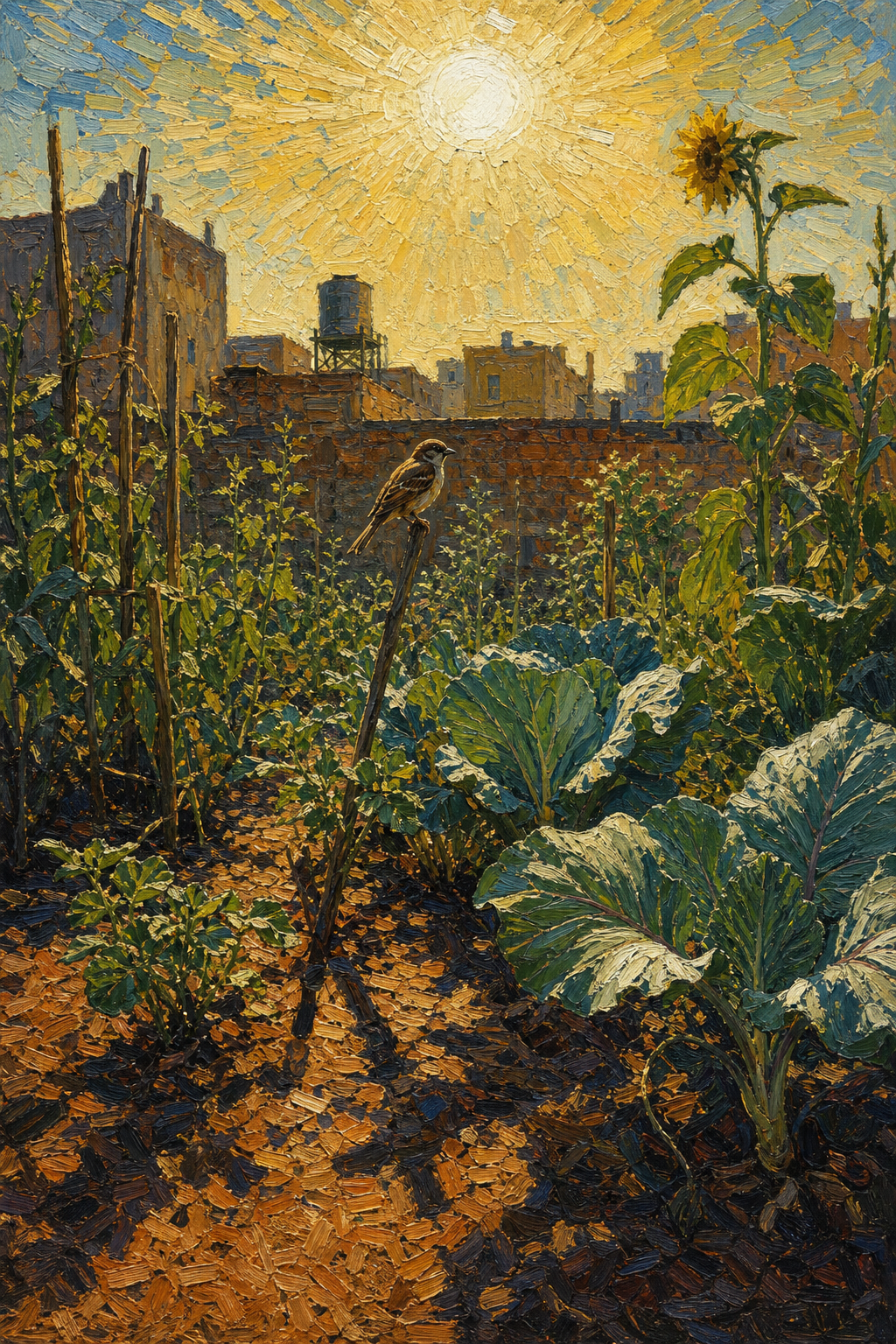
A summer garden under the sharpest sun in memory.
The Earth as seen by one who watches it professionally — and personally.
Before strategy, before targets, before KPIs — Cézanne insisted on looking first. Three questions ground every Earth-reading a sustainability practitioner must return to. These are not metaphors. They are measurable systems.
~173,000 TW of solar energy reaches Earth every second — 10,000× current human energy use. The whole of industrial civilisation runs on a fraction of what one star's photons already offer. The question is architecture, not scarcity.
Oceans absorb ~90% of excess heat and ~25–30% of CO₂ emitted. The moon governs tides that ventilate coastlines, seed clouds, regulate salinity gradients. Supply chains cross these systems invisibly — and make them visible through damage.
A teaspoon of healthy soil contains more organisms than humans on Earth. Soil sequesters ~2,500 GtC — more than atmosphere and all vegetation combined. The garden under fierce sun is this ledger, open on the table.
Cézanne always returned to the same coordinates. So must the practitioner. These are the coordinates of the current system — the mountain's current shape.
| System Layer | Signal | Current Reading | 2050 Trajectory (Baseline) |
|---|---|---|---|
| Atmosphere | CO₂ concentration | 423 ppm (2024) | ~500 ppm without deep intervention |
| Ocean | Surface temperature anomaly | +0.9°C above 20th-century avg | Coral bleaching becomes near-permanent at 1.5°C |
| Cryosphere | Arctic sea ice extent | −13% per decade (NASA) | First ice-free Arctic summer ~2040s |
| Biosphere | Intact ecosystems | ~15% of land remains intact | 30×30 target: protect 30% by 2030 (CBD) |
| Supply Chain | Scope 3 disclosure | ~70% of firms lack full visibility | EU CSRD mandates full chain disclosure by 2026 |
| Energy | Renewable share (electricity) | 30% globally (IEA 2023) | Must reach ~90% by 2050 for 1.5°C pathway |
Cézanne did not invent a new subject. He invented a new relationship to the subject: return, observe, record multiple views, resist the easy symbol, trust the structure beneath the surface. For a sustainability professional in 2024–2050, this becomes a concrete practice.
From this summer garden to 2050 is one practitioner's full career. The following are not projections of the world — they are waypoints in a professional's arc of deepening Earth-literacy, grounded in real policy and science timelines.
A hot summer. A garden. Cézanne's book open on the table. The moment of honest uncertainty: am I seeing clearly, or only measuring? This is not weakness — it is the scientist's most necessary instrument. Calibrate it.
EU Corporate Sustainability Reporting Directive (CSRD) requires Scope 3 disclosure
across the full supply chain for large firms. The mountain becomes legible on paper.
The practitioner who has already been watching will lead — not scramble.
Ref: EC CSRD, Regulation 2022/2464
The Kunming-Montreal Global Biodiversity Framework targets 30% of land and ocean
under protection. TNFD (Taskforce on Nature-related Financial Disclosures) becomes
a reporting norm. A supply chain's relationship to living systems is now
financially material. The practitioner who reads nature reads risk.
Ref: CBD COP15 · TNFD Framework 2023
Foundation models trained on Earth observation data (ESA, NOAA, NASA) begin
enabling real-time, site-specific ecological accounting integrated into procurement
systems. The practitioner's role shifts from data gatherer to interpreter —
the human who asks the right question of the planetary record.
Ref: ESA φ-lab · Google DeepMind GeoAI · NVIDIA Earth-2
IEA Net Zero by 2050 pathway demands 90% clean electricity, full electrification
of supply chain logistics, and near-complete forest protection. The practitioner
who began watching their garden in 2024 has by now drawn, revised, and re-drawn
the mountain many times — and in doing so, changed what the mountain is.
Ref: IEA NZE 2050 · IPCC AR6 Mitigation Chapter 12
Cézanne said: "I owe you the truth in painting, and I will tell it to you." The truth in sustainability is not a dashboard number. It is a living system transforming under a fierce sun — and a human being practicing the discipline of watching it honestly, season after season, career after career, until the watching itself becomes a form of care.
Deep Earth-literacy is not romanticism. It creates measurable competitive advantage for organisations willing to invest in it. Research from Harvard, MIT, and CDP consistently shows: firms with genuine nature and climate intelligence outperform on resilience, supplier retention, and long-term valuation.
| Capability | What the Practitioner Develops | Business Outcome | Evidence |
|---|---|---|---|
| Ecological Reading | Annual "mountain" monitoring of key ecosystem dependencies | Supply chain climate risk identified 3–5 years earlier than peers | CDP Supply Chain Report 2023 |
| Earth-System Literacy | Understanding solar, ocean, soil cycles as business context | Better resource hedging; renewable procurement optimisation | IPCC AR6 WG3 Ch.12 · IEA WEO 2023 |
| AI-Native Sensing | Integration of satellite + IoT + ecological AI into supplier assessment | Deforestation / land-use risk at supplier site level in real time | Global Forest Watch · Satelligence · Planet Labs |
| Regenerative Relationships | Long-term supplier partnerships grounded in shared nature-positive goals | Lower supplier churn; premium access to key raw materials | BCG "Nature Positive" Report 2022 · WBCSD |
| Narrative Depth | Communicating sustainability as genuine understanding, not compliance | Brand trust with Gen Z consumers + institutional investors (ESG) | Edelman Trust Barometer 2024 · BlackRock ESG Survey |
Cézanne kept no footnotes. We must. The following are the primary sources grounding this station's data and frameworks — all publicly accessible.