Une semaine de silence · A week of quiet
Cézanne's
Cézanne's
Realm
On AI Native, the patient mountain, and the difference between generating and seeing.
EN
FR
On AI Native, the patient mountain, and the difference between generating and seeing.
English
One week of annual leave. No travel booked, no shopping planned. Just home — sleeping, letting the noise drain from the brain, reading, and learning AI toward some next level that resists definition. No AI book opened, no shared articles. Only quiet conversation with Copilot when an idea surfaced.
Then, one morning, the question arrived: What is really AI Native? And if linked to a French artist of the 1880s — who would that be? Not a Copilot answer. A feeling. Paul Cézanne.
And so a good conversation began.
Français
Une semaine de congé annuel. Pas de voyage, pas de shopping. Seulement la maison — dormir, libérer le bruit du cerveau, lire, apprendre l'IA vers un prochain niveau que l'on ne peut pas encore nommer. Aucun livre sur l'IA ouvert, aucun article partagé. Seulement une conversation tranquille avec Copilot lorsqu'une idée surgissait.
Puis, un matin, la question est venue : Qu'est-ce qu'être vraiment AI Native ? Et si on la reliait à un artiste français des années 1880 — qui serait-il ? Pas une réponse de Copilot. Un sentiment. Paul Cézanne.
Et ainsi une belle conversation a commencé.
"Treat nature by means of the cylinder, the sphere, and the cone."Paul Cézanne · Letter to Émile Bernard, 15 April 1904
« Traitez la nature par le cylindre, la sphère, le cône. »
La Montagne comme modèle du monde
English
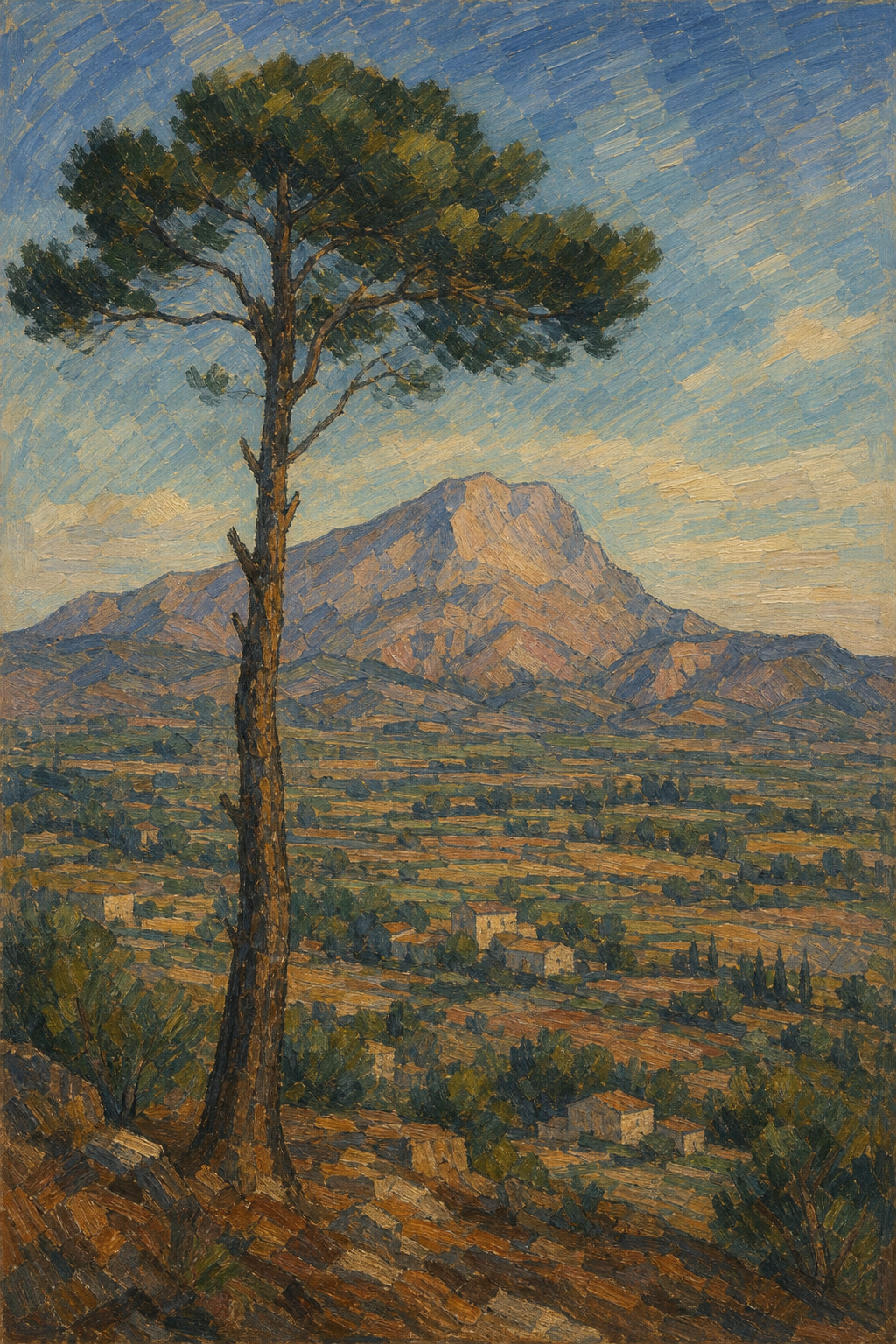
In 1878, Cézanne glimpsed Mont Sainte-Victoire from a train near Aix-en-Provence and wrote to his childhood friend Émile Zola two words: Beau motif — a beautiful motif. What followed was not a single painting but a two-decade obsession: roughly eighty canvases and watercolors of the same mountain.
From a contemporary perspective, this looks almost irrational. Why spend twenty years with one subject? The conventional answer is artistic obsession. A more interesting answer: Cézanne was not studying the mountain. He was studying perception. The mountain held still. The observer did not.
Each return to Sainte-Victoire became a recalibration. The mountain functioned as a constant reference point against which he could test and refine his understanding of reality. In the language of artificial intelligence — Mont Sainte-Victoire was Cézanne's benchmark. It was the lifelong dataset he used to train his world model.
Français
En 1878, Cézanne aperçut le Mont Sainte-Victoire depuis un train près d'Aix-en-Provence et écrivit à son ami d'enfance Émile Zola deux mots : Beau motif. Ce qui suivit ne fut pas une seule toile mais une obsession de deux décennies : environ quatre-vingts peintures et aquarelles de la même montagne.
D'un point de vue contemporain, cela paraît presque irrationnel. Pourquoi passer vingt ans sur un seul sujet ? La réponse conventionnelle est l'obsession artistique. Une réponse plus intéressante : Cézanne n'étudiait pas la montagne. Il étudiait la perception. La montagne demeurait relativement inchangée. L'observateur, lui, ne l'était pas.
Chaque retour à Sainte-Victoire devenait une recalibration. La montagne fonctionnait comme un point de référence constant contre lequel il pouvait tester et affiner sa compréhension de la réalité. Dans le langage de l'intelligence artificielle — le Mont Sainte-Victoire était le benchmark de Cézanne. C'était le jeu de données à vie qu'il utilisait pour entraîner son modèle du monde.
Que signifie vraiment « natif » ?
What information names. The label applied to a thing before perception has a chance to encounter it directly. Most AI today operates at extraordinary surface speed.
What Cézanne sought beneath each brushstroke — structure, geometry, the underlying reality that outlasts the play of light. Nature, he wrote, is more in depth than on the surface.
Not primitive. Not nostalgic. Reality before interpretation — before labels, theories, categories. The capacity to encounter the world before our assumptions do.
Au-delà de la génération
English
Many conversations about AI Native focus on increasing productivity — more automation, more content, more agents, more generation. These are important developments, but they may not be the deepest transformation.
The dominant question today is: What can AI generate? Cézanne would likely ask a different question: What can AI help us see?
Generation is about production. Perception is about realization. Generation creates new outputs. Realization uncovers what was already there. The future of AI Native may not be defined solely by systems that generate increasingly sophisticated content — it may also be defined by systems that help human beings recover attention, restore clarity, and perceive patterns hidden beneath noise.
In that sense, AI becomes less a content engine and more a technology of perception. A technology that helps us see depth beneath surface. Structure beneath complexity. Reality beneath abstraction.
Français
De nombreuses conversations sur l'AI Native se concentrent sur l'augmentation de la productivité — plus d'automatisation, plus de contenu, plus d'agents, plus de génération. Ce sont des développements importants, mais ils ne constituent peut-être pas la transformation la plus profonde.
La question dominante aujourd'hui est : Que peut générer l'IA ? Cézanne poserait probablement une question différente : Que peut nous aider à voir l'IA ?
La génération concerne la production. La perception concerne la réalisation. La génération crée de nouvelles sorties. La réalisation découvre ce qui était déjà là. L'avenir de l'AI Native ne sera peut-être pas défini uniquement par des systèmes qui génèrent du contenu de plus en plus sophistiqué — il sera peut-être aussi défini par des systèmes qui aident les êtres humains à retrouver l'attention, à restaurer la clarté, et à percevoir les structures cachées sous le bruit.
En ce sens, l'IA devient moins un moteur de contenu et davantage une technologie de la perception. Une technologie qui nous aide à voir la profondeur sous la surface. La structure sous la complexité. La réalité sous l'abstraction.
L'architecture de l'être
In The Large Bathers, Cézanne's final great ambition, figures and trees form the same geometric logic. Human bodies take on the mass of stone. Trees arch like cathedral vaults. The sky becomes structural — a weight-bearing element in the composition, not mere atmosphere.
"He did not paint what he saw. He painted what he understood about what he saw."
This is the deeper promise of AI Native: not the infinite generation of images, but the patient deepening of how we understand what is already before us. Seven years on a single canvas. Eighty returns to one mountain. A discipline of sustained attention that transforms perception itself.
« Il ne peignait pas ce qu'il voyait. Il peignait ce qu'il comprenait de ce qu'il voyait. »
La même promesse profonde de l'AI Native : non pas la génération infinie d'images, mais l'approfondissement patient de notre compréhension de ce qui est déjà devant nous.
Monet showed us the beauty of light.
The great AI systems of our era demonstrate the possibilities of generation.
Cézanne points somewhere else.
Toward realization. Toward the patient refinement of perception. Toward returning to the same mountain until we finally see it.
Perhaps the most profound AI Native future is not a world that generates infinitely more. Perhaps it is a world that notices infinitely better.
If Cézanne were writing to us today, he might not tell us to build larger models. He might simply say:
Stay with one mountain long enough. Reality reveals itself slowly.
Peut-être que le futur AI Native le plus profond n'est pas un monde qui génère infiniment plus — mais un monde qui remarque infiniment mieux.
Restez assez longtemps devant une seule montagne. La réalité se révèle lentement.