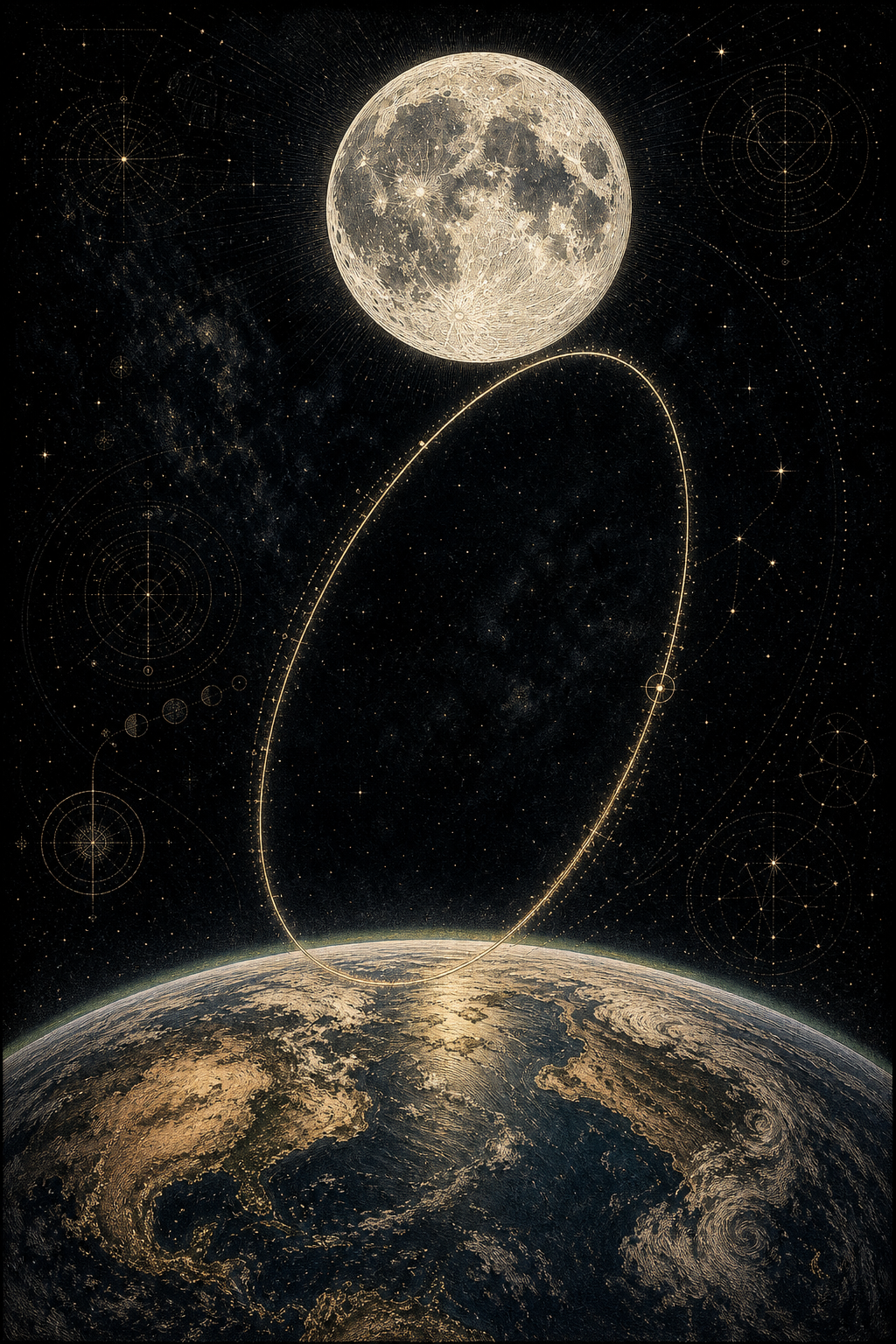
Earth LinC · Station ONE · Moon's Loop
Earth has been
reading the Moon
for 4.5 billion years.
Not superstition. Not poetry alone. A real, ancient, unhurried loop — and we are inside it.
Read
Earth LinC · Station ONE · Moon's Loop
Not superstition. Not poetry alone. A real, ancient, unhurried loop — and we are inside it.
The Premise
"不管我们知不知道 — whether we know it or not."
Every ocean on Earth is still answering the Moon's question. Every tide, every monthly bleed, every migratory bird navigating by reflected light is part of the same conversation that began when a body the size of Mars struck the young Earth and flung the Moon into being.
This is a station for that loop. To look at it clearly. To see it as a celestial scientist would — not as fortune, but as rhythm. As physics made visible across the sky every single night.
29.53 days · one synodic month · forever
Cycle 01
Synodic
29.53 days
New Moon to New Moon. The cycle the naked eye sees — the one that gave us the first calendars.
Cycle 02
Sidereal
27.32 days
One full orbit relative to distant stars. The Moon's true orbital period, unaffected by Earth's own journey around the Sun.
Cycle 03
Draconic
27.21 days
The cycle of eclipse potential — when Moon crosses Earth's orbital plane. Eclipses only happen here.
Cycle 04
Metonic
19 years
Every 19 years, lunar phases repeat on the same calendar dates. Ancient astronomers mapped this without telescopes.
Cycle 05
Saros
18.03 years
The eclipse prediction cycle. One Saros period after an eclipse, an almost identical eclipse occurs. The Babylonians knew this.
Cycle 06
Tidal
12 hrs 25 min
Two high tides per day. The ocean's memory of the Moon, written in water twice every rotation of Earth.
The same geometry, read from Earth's surface — light and shadow in an ancient relay.
What it means to read the Moon
"I am not reading fortune. I am reading the loop itself."
If you were an astronomer — and you don't have to be one to feel this — you would look at the Moon not as a symbol but as a clock. A clock that runs on gravity. A clock that has never missed a beat in 4.5 billion years.
The tides rise and fall because of it. The length of Earth's day is slowly growing because of it — the Moon acts as a brake, stealing rotational energy through tidal friction. When life first crawled onto land, an Earth day lasted only 22 hours. The Moon has been lengthening it ever since. Quietly. Without pause. In loop.
That is what it means to read the Moon. Not to predict what tomorrow holds — but to understand the rhythm you are already inside. The one that began before there were eyes to look up.
如果我是一个天体科学家 — 我不是在看风水,我是在凝视周期循环的 LOOP。
不管我们知不知道,地球一直在读月亮,长达四十五亿年。
4.5
Billion Years
The age of the Moon, born from the wreckage of the Theia impact
384
× 10³ km away
Current average distance — growing by 3.8 cm each year as tidal friction slows Earth
29.53
Days / Cycle
The synodic month — the original human calendar, still beating
1/6
Earth's gravity
Enough to raise our oceans by metres twice a day, every day, forever
Not because the Moon is magic — but because wishing is how humans enter the loop consciously. You notice a phase. You set an intention. You return to it a month later. That IS the synodic cycle. That is the loop working through you.
The Moon does not grant wishes. It gives you a structure ancient enough to hold them. Thirty days. Begin again. Thirty days. Begin again. Four and a half billion years of practice at exactly this.
Here is the loop for the Moon. Step in whenever you're ready.