蝙蝠的家 · 土壤碳匯 · 仙草的滋味 Bat Boxes · Soil Carbon · Xiancao Harvest コウモリの家 · 土壌炭素 · 仙草の味 Nhà Dơi · Carbon Đất · Hương Vị Xiancao
點擊每個站點,開啟獨特的生態故事 ✦ Tap each stop to unlock its story ✦ 各地点をタップして生態ストーリーを開く ✦ Nhấn vào từng điểm để khám phá câu chuyện sinh thái ✦
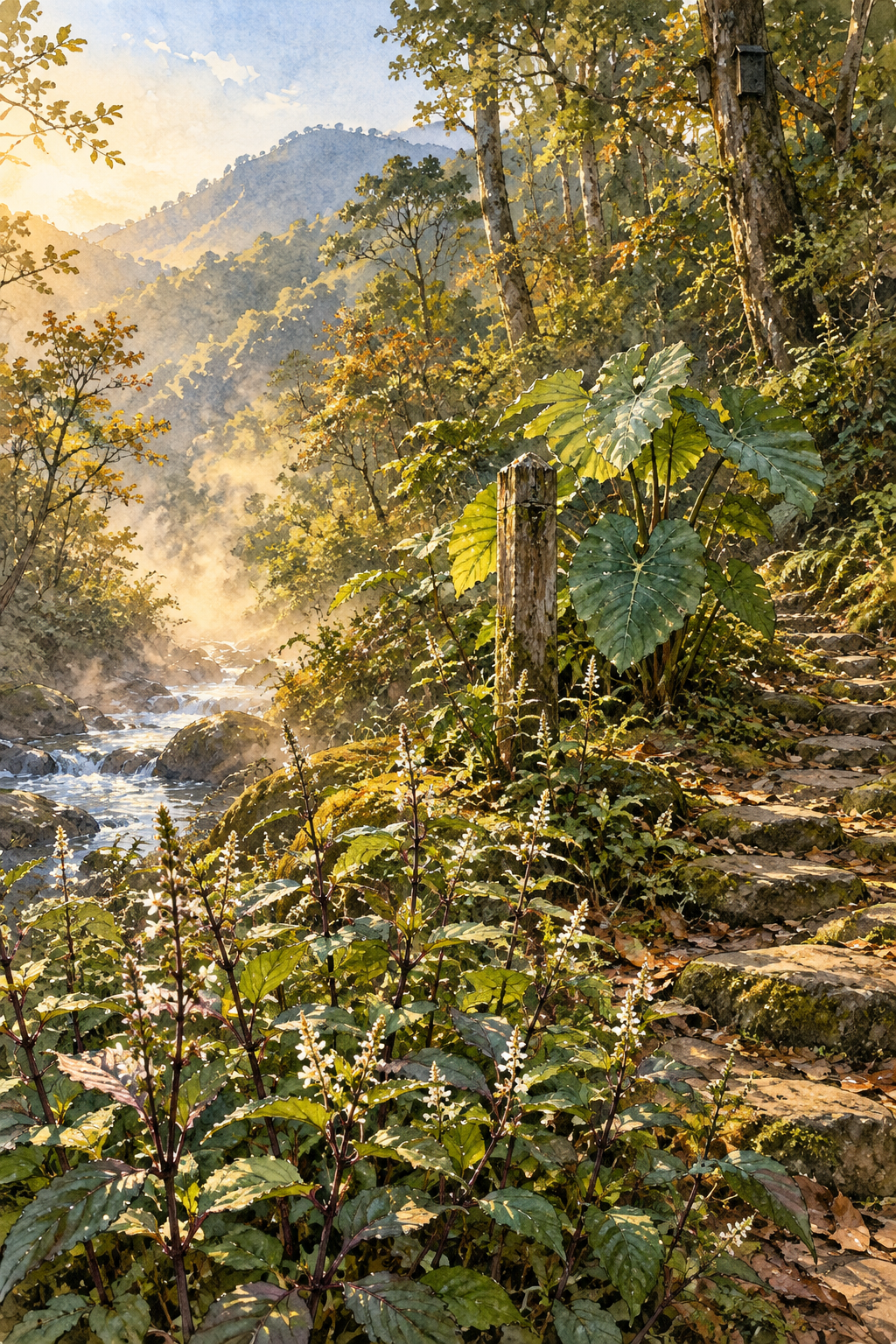
沿著石門水庫支流的雞籠坑步道,義工解說老師帶著我們走進這條富士可扶持的四季生態步道。在老師身旁那棵大樹的樹幹上方,掛著一個不起眼的黑色木盒——那是我們為蝙蝠精心打造的家。
蝙蝠為什麼重要? 蝙蝠是夜間的授粉者與害蟲控制者,一隻蝙蝠一夜可吃掉數百隻蚊子及蛾類幼蟲。保護蝙蝠,就是守護整個生態系的平衡。
姑婆芋 vs 芋頭:兩者葉形相似,但姑婆芋葉面有水珠效果(水滴會滾落),芋頭葉面則會讓水滴殘留擴散。姑婆芋有毒,不可食用;芋頭則是我們餐桌上的日常食材。
Walking along the Jilongkeng creek trail — a Foxconn-supported four-season biodiversity path beside Shimen Reservoir — our volunteer naturalist guided us past a seemingly ordinary tree. Look up at the trunk: a small black wooden box is quietly waiting. That is a bat house we built together.
Why bats matter: A single bat can consume hundreds of mosquitoes and moth larvae in one night. They are nature's pest controllers and nocturnal pollinators — invisible guardians of the forest's balance.
Colocasia vs Alocasia: Both have giant heart-shaped leaves, but on Alocasia (elephant ear, toxic) water beads and rolls off; on Colocasia (true taro, edible) water spreads and seeps. Never eat Alocasia — but do look closely at how water dances on each leaf.
📍 Location: Open on Maps
石門ダムの支流沿いにある鶏籠坑歩道は、富士康(フォックスコン)が支援する四季の生態歩道です。ボランティアのガイドとともに歩いていると、木の幹の上に小さな黒い木箱が目に入りました。これは私たちがコウモリのために作った「家」です。
コウモリの重要性: 1匹のコウモリは一晩で数百匹の蚊や蛾の幼虫を食べます。夜の受粉者であり、害虫のコントローラーでもあります。
クワズイモ vs サトイモ: 葉の形は似ていますが、クワズイモ(有毒)の葉では水が玉になって転がり、サトイモ(食用)では水が広がります。見た目に気をつけて!
Dọc theo suối Jilongkeng — một con đường sinh thái bốn mùa được Foxconn hỗ trợ bên hồ chứa Shimen — hướng dẫn viên tình nguyện dẫn chúng tôi đi qua một cây cổ thụ. Trên thân cây có một hộp gỗ đen nhỏ — đó là ngôi nhà chúng tôi xây cho dơi.
Tại sao dơi quan trọng? Một con dơi có thể ăn hàng trăm con muỗi và sâu bướm mỗi đêm. Chúng là người kiểm soát sâu bệnh và thụ phấn ban đêm của rừng.
Ráy voi vs Khoai môn: Lá trông giống nhau, nhưng trên ráy voi (độc) nước đọng lại thành hạt, còn trên khoai môn (ăn được) nước lan ra. Đừng ăn ráy voi!
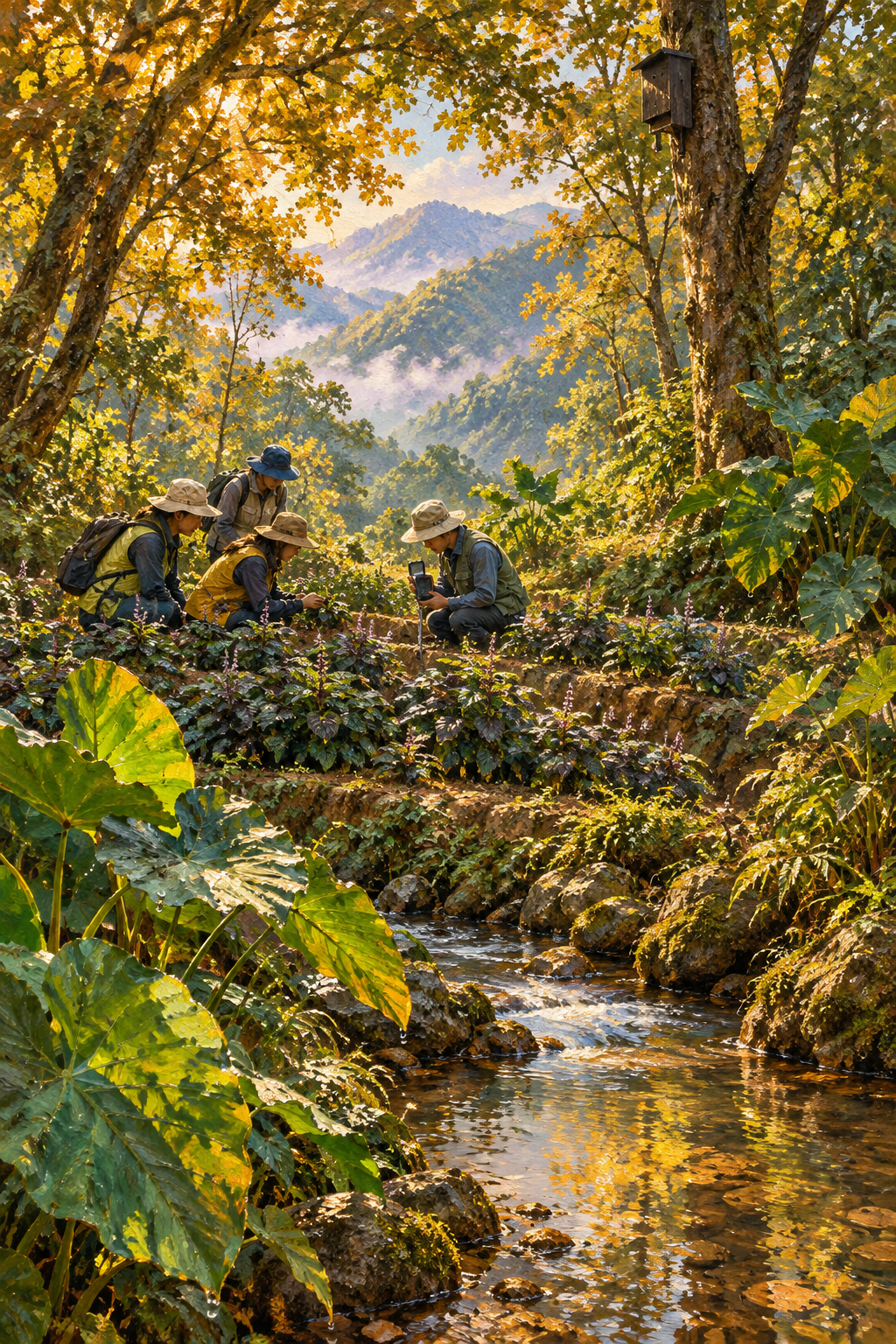
這塊土地是我們與台灣大學共同開展的土壤碳匯試驗場域。我們在此種植了本區域最具代表性的農作物——仙草(Platostoma palustre)。
仙草清明時節播種,中秋時節開花,生命僅僅半年,卻以其獨特的膠質滋養著這片土地與人們的味蕾。
碳匯實驗怎麼做? 我們在不同觀測點嘗試不同的施肥方式,用手持式探測設備精確測量地下15公分的土壤二氧化碳濃度,尋找最能增加碳匯的種植方案。
親手採仙草: 把仙草葉子反覆搓揉,你會感受到黏黏的膠質——這就是仙草凍的來源。把採到的仙草帶回家,就可以自己煮一鍋消暑的仙草凍!
This field is our soil carbon sink research site, established in collaboration with National Taiwan University. Here we grow Platostoma palustre — called Xiancao, or Immortal Herb — the region's most representative crop.
Sown at Qingming (early April), blooming at Mid-Autumn, its entire life lasts only half a year. Yet that short life produces extraordinary gel.
How the experiment works: At each monitoring point (15 cm depth), we apply different fertilizer methods and use portable sensors to measure CO₂ concentration precisely — identifying which approach builds the most soil carbon.
Rub it, feel it: Roll the leaves between your palms. That sticky, gelatinous feeling is exactly what becomes Xiancao jelly. Take your harvest home and boil it into a cooling summer dessert.
このフィールドは台湾大学と共同で設立した土壌炭素シンク試験地です。ここでは地域を代表する農作物「仙草(Platostoma palustre)」を栽培しています。
清明節(4月初旬)に種をまき、中秋節に花を咲かせます。たった半年の命ですが、その独特なゲル質で土地と人々の味覚を豊かにします。
炭素シンク実験の方法: 各観測点(深さ15cm)で異なる施肥方法を試し、携帯式センサーでCO₂濃度を精密に測定します。
葉を揉んでみよう: 仙草の葉を繰り返し揉むと、ねばねばしたゲル質を感じられます。これが仙草ゼリーの原料です。
Khu đất này là địa điểm thí nghiệm carbon đất phối hợp với Đại học Quốc gia Đài Loan. Chúng tôi trồng Platostoma palustre — còn gọi là Xiancao (Tiên Thảo).
Gieo hạt vào tiết Thanh Minh (đầu tháng 4), nở hoa vào Trung Thu — cuộc đời chỉ nửa năm, nhưng để lại chất gel kỳ diệu.
Thí nghiệm hoạt động thế nào? Tại mỗi điểm quan sát (sâu 15 cm), chúng tôi áp dụng các phương pháp bón phân khác nhau và đo nồng độ CO₂ bằng thiết bị cầm tay.
Hãy vò lá: Vò lá Xiancao nhiều lần — bạn sẽ cảm nhận chất nhầy nhụa. Đó chính là nguồn gốc của thạch Xiancao!
關西鎮的仙草是僅次於稻米、茶葉的第三大經濟作物,年產量驚人,養活了無數農家。
從田間到杯中的完整旅程:
①採收曬乾(10-14天)→ ②熬煮萃取(4-8小時)→ ③加入太白粉定型 → ④冷卻成凍(2-4小時)。整個流程通常需要兩到三天。而我們的一小時工作坊,只是踏入了最後的凝固環節——卻已足以讓我們感受到仙草的魔法。
仙草學名: Platostoma palustre(舊稱 Mesona chinensis)屬唇形科,原產於中國南方及台灣,是天然的消暑聖品,被稱為「仙人留下的草藥」。
In Guanxi Township, Xiancao is the third-largest economic crop, surpassed only by rice and tea.
The full journey from field to cup:
①Harvest & sun-dry (10–14 days) → ②Boil & extract (4–8 hours) → ③Add starch to set → ④Cool into jelly (2–4 hours). The full process takes 2–3 days. Our one-hour workshop captured only the final step — yet it revealed the quiet magic of this ancient herb.
Scientific name: Platostoma palustre (formerly Mesona chinensis), family Lamiaceae. Native to southern China and Taiwan. Called "the herb left by immortals," it has been used for centuries to cool the body in summer heat.
關西鎮では、仙草は米と茶に次ぐ第3の経済作物です。
畑から器まで:
①収穫・天日干し(10〜14日)→ ②煮出し(4〜8時間)→ ③でんぷんを加えて固める → ④冷やして完成(2〜4時間)。全工程は2〜3日かかります。私たちの1時間ワークショップは最終工程だけでしたが、仙草の魔法を十分に体験できました。
学名: Platostoma palustre(旧称 Mesona chinensis)、シソ科。「仙人が残した薬草」と呼ばれ、体を冷やす効果があります。
Tại thị trấn Guanxi, Xiancao là cây trồng kinh tế lớn thứ 3, chỉ sau lúa và trà.
Từ cánh đồng đến ly nước:
①Thu hoạch & phơi nắng (10–14 ngày) → ②Nấu chiết xuất (4–8 giờ) → ③Thêm bột để đông → ④Làm nguội thành thạch (2–4 giờ). Toàn bộ quy trình mất 2–3 ngày. Hội thảo 1 giờ của chúng tôi chỉ chạm vào bước cuối.
Tên khoa học: Platostoma palustre (trước đây là Mesona chinensis), họ Hoa môi. Được gọi là "thảo dược của tiên nhân," dùng để giải nhiệt trong mùa hè.
清明播種,中秋開花,仙草以半年的生命完成它的使命。用雙手搓揉它的葉片,你能感受到那黏稠的膠質——這正是仙草凍綿密口感的秘密。
仙草茶、仙草凍,是台灣夏日不可或缺的消暑飲食文化。在關西,它是農民賴以為生的第三大經濟命脈,也是連結土地、氣候與人情的一條深根。
今天,我們不只是品嚐了它,更親手採摘了它,親眼看見它如何從溪邊的田野走進博物館、走進我們的杯子。
Sown at Qingming, blooming at Mid-Autumn — Xiancao completes its entire life in half a year. Rub its leaves between your palms and feel the gel. That stickiness is the secret behind the smooth, cool jelly that cools Taiwan's summers.
In Guanxi, it is more than a crop — it is the third pillar of a farming economy, a bridge between seasons, land, and community. Today, we did not just taste it. We picked it. We felt it. We understood it.
清明節に種をまき、中秋節に花を咲かせる仙草。その半年の命で、私たちの夏を涼しくしてくれます。葉を揉むと感じるゲル質こそ、仙草ゼリーの秘密です。
關西では米と茶に次ぐ第3の経済作物として、農家の生活を支えています。今日、私たちはただ味わうだけでなく、自ら摘み取り、その文化に触れました。
Gieo hạt vào tiết Thanh Minh, nở hoa vào Trung Thu — Xiancao hoàn thành cuộc đời chỉ trong nửa năm. Vò lá bằng tay và cảm nhận chất nhầy — đó là bí mật của thạch mát lành.
Tại Guanxi, nó là trụ cột thứ ba của nền kinh tế nông nghiệp. Hôm nay, chúng tôi không chỉ nếm thử — chúng tôi tự tay thu hoạch và hiểu về nó.
點擊圖片放大欣賞 ✦ 2026.11.14 Tap any image to enlarge ✦ 2026.11.14 画像をタップして拡大 ✦ 2026.11.14 Nhấn để phóng to ✦ 2026.11.14
雞籠坑步道 · 石門水庫支流 · 24°50'18.3"N 121°10'48.0"E Jilongkeng Trail · Shimen Reservoir tributary · 24°50'18.3"N 121°10'48.0"E 鶏籠坑歩道 · 石門ダム支流 · 24°50'18.3"N 121°10'48.0"E Đường mòn Jilongkeng · Phụ lưu hồ chứa Shimen · 24°50'18.3"N 121°10'48.0"E
🗺 在地圖上查看 🗺 View on Maps 🗺 地図で見る 🗺 Xem Trên Bản Đồ