你好,黑白花狨Hello, pied tamarin
Pied tamarin · Saguinus bicolor
片尾資料 · 可慢慢讀After the film · read at your own pace
再認識牠一點Get to know it a little more
認識黑白花狨Meet the pied tamarin
怎麼認出牠How to recognise it
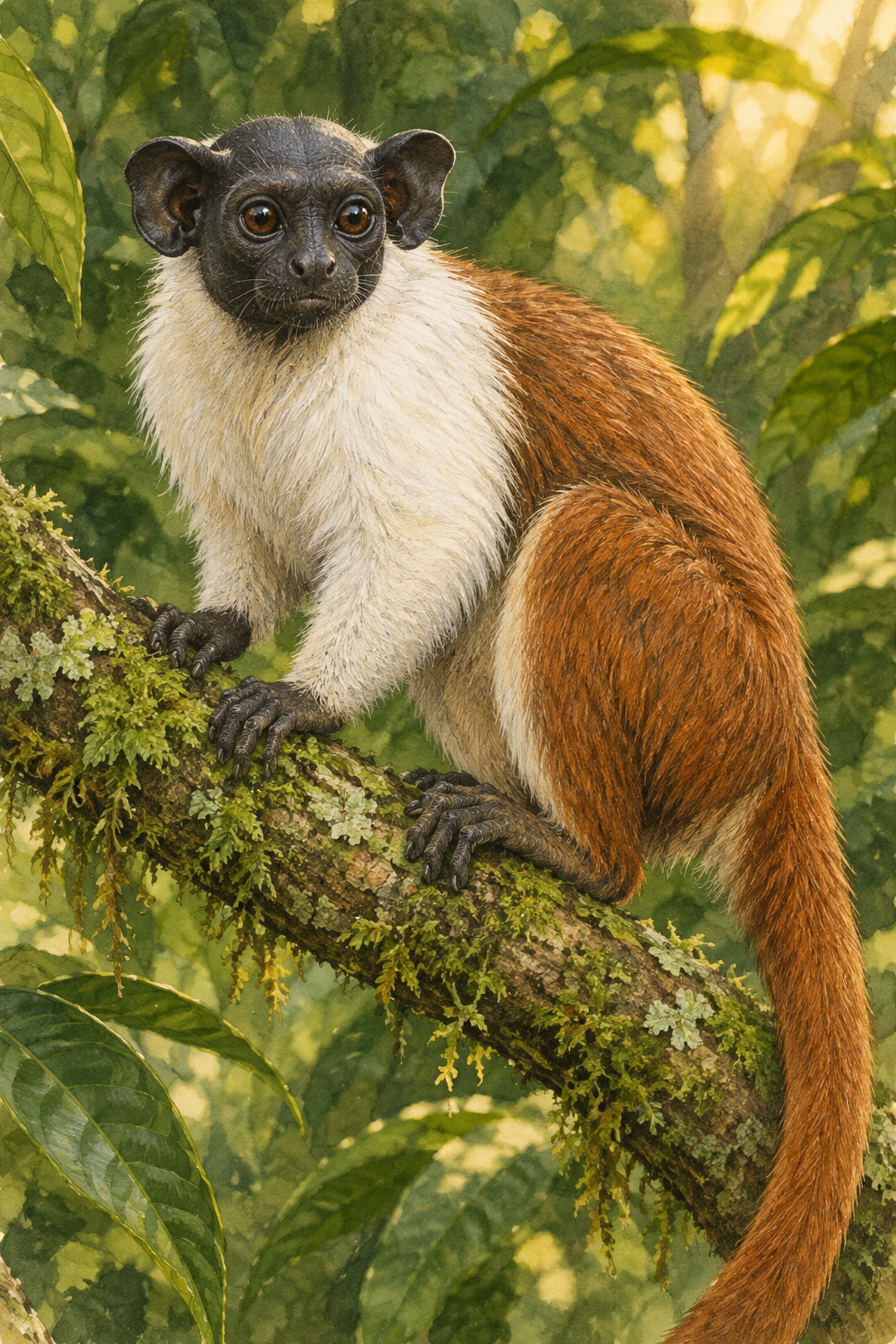
黑色、幾乎無毛的臉與頭,耳朵相對較大;頸部、胸前到前肢是白色;後半身與長尾巴偏棕褐色。牠是體型很小的新世界猴,屬於狨科。AE
A black, nearly hairless face and head with relatively large ears; white neck, chest and forelimbs; brownish hindquarters and a long tail. A very small New World monkey in the family Callitrichidae.AE
名字與命名來歷Names and naming history
1823 年,博物學家 Spix 正式描述這個物種,當時的學名是 Midas bicolor;模式產地(描述所依據的標本產地)記為 Manaus(Barra do Rio Negro)。今日學名為 Saguinus bicolor,巴西常稱 sauim-de-coleira,英文 pied tamarin。這是科學命名的紀錄,不代表牠在 1823 年才出現。A
In 1823 the naturalist Spix formally described the species as Midas bicolor; its type locality (where the described specimen came from) was recorded as Manaus (Barra do Rio Negro). Today it is Saguinus bicolor — in Brazil often sauim-de-coleira, in English the pied tamarin. This is a record of scientific naming, not of when the animal first existed.A
住在哪裡Where it lives
野生分布很有限,位於巴西亞馬遜州的 Manaus(瑪瑙斯)、Rio Preto da Eva 與 Itacoatiara 三個市一帶——不是整片亞馬遜。牠的森林就在一座大城市旁邊與裡面。BC
Its wild range is small: around the municipalities of Manaus, Rio Preto da Eva and Itacoatiara in Amazonas state, Brazil — not the whole Amazon. Its forest lies beside, and inside, a large city.BC
牠的森林,遇見城市Its forest, meeting the city
在森林中的角色Its role in the forest
吃果實時,種子會被帶到別處落下,有機會長成新的植物。牠是森林裡的種子傳播者之一,和其他動物一起參與森林更新。C
When it eats fruit, seeds can be carried and dropped elsewhere, where they may grow. It is one of the forest’s seed dispersers, alongside other animals.C
與城市相遇:「棲地破碎化」是什麼意思Meeting the city: what “habitat fragmentation” means
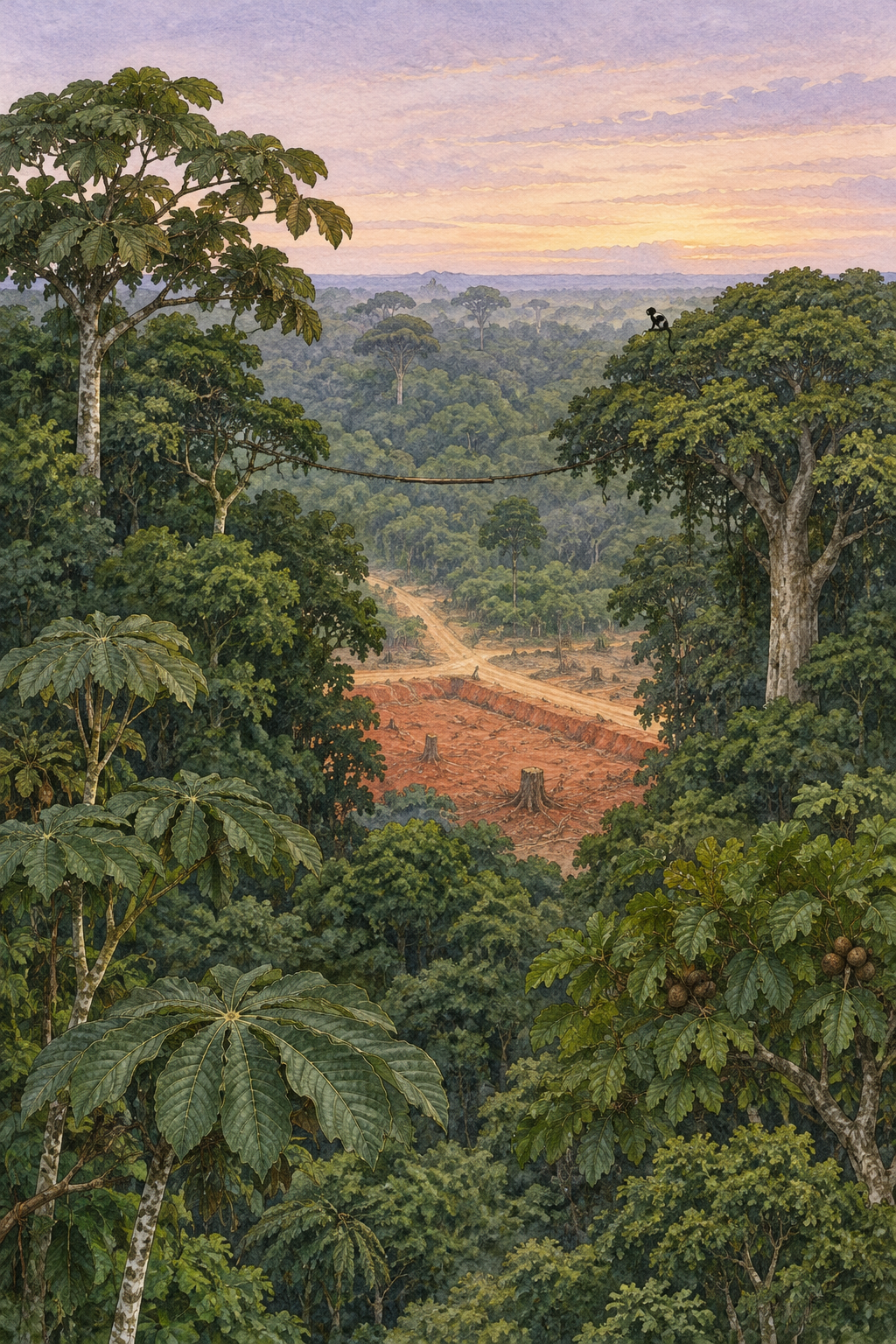
森林不一定消失,而是被住宅、道路與各種基礎設施切成彼此分開的小塊。樹還在,但塊與塊之間斷了。黑白花狨要找食物、同伴或新地盤時,可能被迫下到地面或沿電線移動,面對車撞、觸電與家犬攻擊;被隔開的小群體也更難與其他群體相遇。片中的路線動畫為概念示意,不代表特定個體或地點。BC
The forest doesn’t always vanish — it gets cut into separate patches by houses, roads and infrastructure. The trees remain, but the links between patches break. To reach food, companions or new territory a tamarin may have to cross the ground or travel along power lines, facing vehicle strikes, electrocution and dog attacks; isolated groups also find it harder to meet others. The route animation in the film is a concept, not a specific animal or place.BC
保育正在做什麼What conservation is doing
保育狀態Conservation status
IUCN 紅色名錄列為極危(CR),此版本為 2021 年修訂版(2019 年評估之修訂)。評估中提到的大幅下降,是當時對未來的推估,不是已發生的數字,也不從今天起算。本站不提供野生總數。B
Critically Endangered (CR) on the IUCN Red List, in the 2021 amended version of the 2019 assessment. The steep decline mentioned there was a projection at the time — not an observed figure, and not counted from today. We do not state a wild population total.B
2024 年:一個新的保護區2024: a new protected area
2024 年 6 月 5 日,巴西第 12.047 號法令在 Itacoatiara 設立約 15,300 公頃的黑白花狨野生動物保護區(Refúgio de Vida Silvestre do Sauim-de-Coleira),目標包括保護棲地、促進森林連通,並兼顧相容的農業利用。2025 年 Oryx 刊出的保育團隊報告記述了這項設立。保護區成立是行動,不等於族群已經恢復。DCF
On 5 June 2024, Brazil’s Decree nº 12.047 created the Refúgio de Vida Silvestre do Sauim-de-Coleira, about 15,300 hectares in Itacoatiara, aiming to protect habitat, promote forest connectivity and allow compatible farming. A conservation team report in Oryx (2025) records its creation. Creating the refuge is action — it does not mean the population has recovered.DCF
另一類措施:樹冠橋與苗木復育A different measure: canopy bridges and replanting
與保護區分開來看:也有保育團隊搭建細繩樹冠橋、復育原生苗木,並記錄動物使用情形。這些屬團隊報告與監測紀錄,本站不推論其整體成效。GH
Separately from the refuge, conservation teams build rope canopy bridges, replant native seedlings and record how animals use the bridges. These are team reports and monitoring records; we draw no conclusion about overall effect.GH
帶走一個問題Questions to take with you
為什麼有樹林還不夠?Why isn't having trees enough?
黑白花狨需要足夠的食物、活動空間和安全的移動路線。樹林若被道路與房屋切成互不相連的小塊,即使仍看得到樹,也可能難以到達食物或其他群體;穿越空地或沿電線移動,還可能遇到車輛、家犬與觸電危險。因此,除了保留樹林,還要看棲地的大小、品質、安全,以及彼此是否連得起來。
Pied tamarins need enough food, room to move and safe routes between places. When forest is cut by roads and houses into separate, unconnected patches, trees may still be visible, yet food or other groups can be hard to reach; crossing open ground or travelling along power lines also exposes them to vehicles, dogs and electrocution. So besides keeping forest, what matters is the habitat’s size, quality and safety — and whether the patches connect.
本站依來源整理的解釋Explanation synthesised from the source
查看依據:IUCN 紅色名錄 — Saguinus bicolorView evidence: IUCN Red List — Saguinus bicolor 可查閱:棲地與生態(Habitat and Ecology)、威脅(Threats)See: Habitat and Ecology; Threats
一座橋怎樣才適合牠?What makes a bridge right for it?
先看橋的位置:兩端是否接上牠能使用的樹冠,並連到有食物與遮蔽的棲地。再看牠是否能安全抓握和通過;不同體型、移動方式的動物,未必適合同一種橋。橋也需要定期檢查與維護。最後要用攝影機記錄:牠有沒有靠近、猶豫、轉身,或完整通過,才能判斷設計是否適合。
Start with where the bridge goes: do both ends join canopy it can use, and link to habitat with food and cover? Then ask whether it can grip and cross safely — animals of different sizes and ways of moving may not suit the same kind of bridge. Bridges also need regular inspection and maintenance. Finally, camera records — does it approach, hesitate, turn back, or cross all the way? — are what show whether a design suits it.
本站依來源整理的解釋Explanation synthesised from the sources
查看依據:Projeto Reconecta — 橋梁設計與設置View evidence: Projeto Reconecta — Bridge design and installation 可查閱:兩種橋型、樹冠連接與選址方法。See: the two bridge types, canopy connection and site-selection methods.
查看依據:Projeto Reconecta — 人工樹冠橋監測View evidence: Projeto Reconecta — Artificial canopy bridge monitoring 可查閱:靠近與通過的攝影機紀錄、不同橋型的使用比較。See: camera records of approaches and crossings; comparison of use between bridge types.
查看依據:Tamarin Trust — 黑白花狨保育進度(2026-03-08)View evidence: Tamarin Trust — Pied tamarin conservation update (2026-03-08) 可查閱:黑白花狨棲地連接、橋梁維護與新址安全評估。See: pied tamarin habitat connection, bridge maintenance and safety checks for new sites.
Reconecta 是其他亞馬遜樹棲動物的設計與監測案例,可參考其方法;不是黑白花狨專屬設計規格或成效證明。Reconecta is a design and monitoring case for other Amazonian tree-dwelling animals — useful for its methods, but not a pied-tamarin-specific design specification or proof of effect.
我們怎樣知道保護措施有幫助?How do we know a protection measure is helping?
要分清楚「做了什麼」和「動物是否因此受益」。橋建好了,是完成一項工程;拍到牠過橋,表示牠會使用,但還不能證明族群已恢復。可以持續記錄靠近與通過的情形,並在可比較的調查條件下追蹤路殺、棲地品質及族群變化;若有措施前的資料或相近的對照地點,會更有助於判斷。單一片段或短期紀錄不足以說明長期成效。
Separate “what was done” from “whether the animals benefit”. A finished bridge is a completed project; filming a tamarin crossing shows it uses the bridge, but does not prove the population has recovered. Keep recording approaches and crossings, and track roadkill, habitat quality and population change under comparable survey conditions; data from before the measure, or a similar comparison site, makes the judgement stronger. A single clip or short-term record is not enough to show long-term effect.
本站依來源整理的解釋;比較措施前後與對照地點為建議的評估思路,並非下列團隊已證實的結果。Explanation synthesised from the sources; comparing before/after and with comparison sites is a suggested way to evaluate, not a result these teams have demonstrated.
查看依據:Projeto Reconecta — 人工樹冠橋監測View evidence: Projeto Reconecta — Artificial canopy bridge monitoring 可查閱:同時記錄靠近與通過、比較橋型接受情形。See: recording both approaches and crossings; comparing how bridge types are accepted.
查看依據:Projeto Reconecta — 路殺監測View evidence: Projeto Reconecta — Wildlife roadkill monitoring 可查閱:固定調查範圍與投入、屍體移除對估計的影響。See: fixed survey area and effort; how carcass removal affects estimates.
查看依據:Tamarin Trust — 黑白花狨保育進度(2026-03-08)View evidence: Tamarin Trust — Pied tamarin conservation update (2026-03-08) 可查閱:種植、樹冠橋與維護等已報告行動;不是族群恢復的因果證明。See: reported actions such as planting, canopy bridges and maintenance — not causal proof of population recovery.
複製時會附上本頁網址與這個問題的資料來源,方便查證與討論。Each copied question includes this page’s address and that question’s sources, so you can check and discuss it.
繼續探索兩個問題Explore two questions
牠會過橋嗎?Will They Cross?
調整廊橋連接、遮蔽與環境,比較不同假設下的接近與通過;這是尚未以現場資料校準的模擬。Adjust the bridge’s connections, cover and surroundings to compare approaches and crossings under different assumptions; this is a simulation not yet calibrated with field data.
試試廊橋模擬Try the bridge simulation →城市變吵時,牠怎麼溝通?Signals in a Noisy City
探索馬瑙斯 2018–2019 年的叫聲與氣味記錄,按群體與噪音區間比較,再從觀測值抽樣。Explore 2018–2019 call and scent records from Manaus, compare them by group and noise band, then resample from the observed values.
787/1,862 是觀測片段,非動物數量;不預測未來行為。787 / 1,862 are observation clips, not numbers of animals; no prediction of future behaviour. 探索聲音與氣味Explore calls and scent →資料與逐幕閱讀Sources & transcript
各項可分別展開。點選短片或正文中的來源字母,會自動打開並跳到對應條目。Each part opens on its own. Tapping a source letter in the film or text opens it and jumps to that entry.
資料來源 A–H(各幕標示的字母)Sources A–H (letters shown in each scene)
mammaldiversity.org/taxon/1000806/
支持:現行學名、Spix 1823 年描述、原名 Midas bicolor、模式產地 Manaus(Barra do Rio Negro)。注意:該頁圖片說明的分布較舊且寬泛,本站分布改依 B、C。
Supports: current name, description by Spix in 1823, original name Midas bicolor, type locality Manaus (Barra do Rio Negro). Note: the range in that page’s image caption is older and broader; our range follows B and C.
用於第 1、3、8 幕Used in scenes 1, 3, 8doi.org/10.2305/IUCN.UK.2021-1.RLTS.T40644A192551696.en
支持:極危(CR)、2021 年修訂版(2019 年評估之修訂)、分布與威脅(破碎化、道路、觸電等)。評估中的下降屬當時推估。不同資料的分布面積數字(舊評估與 2025 年 Oryx 報告)年代與口徑不同,本片不使用面積數字。
Supports: CR status, 2021 amended version of the 2019 assessment, range and threats (fragmentation, roads, electrocution and more). The decline cited was a projection. Range-area figures differ between the older assessment and the 2025 Oryx report (different dates and methods), so the film uses none.
用於第 2、6、7 幕Used in scenes 2, 6, 7gov.br/incra/…/refugio-de-vida-silvestre-e-criado-em-area-sob-gestao-do-incra-no-amazonas
巴西政府新聞。支持:分布的三個市、以果實與昆蟲為食、傳播種子、群體生活、保護區設立。
Brazilian government news. Supports: the three municipalities, fruit-and-insect diet, seed dispersal, group living, the refuge’s creation.
用於第 2、4、5、6、7 幕Used in scenes 2, 4, 5, 6, 7presidencia.gov.br/ccivil_03/_ato2023-2026/2024/decreto/d12047.htm
法令原文。支持:2024-06-05、位於 Itacoatiara、約 15,300 公頃、保護區目標。
Original decree text. Supports: 5 June 2024, Itacoatiara, about 15,300 ha, the refuge’s aims.
用於第 7 幕Used in scene 7institutosauimdecoleira.org.br/index.php/o-sauim/
在地保育機構的物種介紹。支持:日行、樹棲、小群生活(每群約 2–13 隻)。
A local conservation organisation’s species profile. Supports: diurnal, arboreal, small groups (about 2–13 animals).
用於第 1、4 幕Used in scenes 1, 4doi.org/10.1017/S0030605324001133
保育團隊報告,記述 2024 年保護區設立。屬進度敘述,不是族群恢復的實驗結果。
A conservation team report describing the 2024 refuge. A progress account, not an experimental result showing recovery.
用於第 7 幕Used in scene 7tamarintrust.org/news/pied-tamarin-conservation-update/
保育團隊的進度更新:瑪瑙斯周邊的破碎化、原生苗木復育、樹冠橋與在地參與。屬團隊報告,非同行評審研究。
A conservation team update on fragmentation around Manaus, native seedling restoration, canopy bridges and local involvement. A team report, not a peer-reviewed study.
用於第 7 幕(樹冠橋段)Used in scene 7 (bridge segment)projetoreconecta.com/about/artificialcanopybridgesmonitoring/
記錄動物接近與通過人工樹冠橋的情形。本站僅作延伸閱讀。
Records animals approaching and crossing artificial canopy bridges. Listed as further reading only.
關於畫面About the images
本片所有畫面皆為生成插畫與示意動畫,不是實拍照片或野外錄音。地圖為簡化示意,分布範圍與州界不代表精確地理資料。城市路線、種子傳播、樹冠橋與苗木畫面為概念示意,不代表特定地點、工程或個體。查核日期:2026-10-21。
All visuals are generated illustrations and schematic animations — not photographs or field recordings. The map is simplified; its range and state outline are not precise. The city route, seed dispersal, canopy bridge and seedlings are concepts, not specific sites, projects or animals. Checked: 2026-10-21.
完整字幕・逐幕閱讀Full subtitles, scene by scene
01 · 眼前是誰Who it is · A E
先認識牠。黑白花狨,學名 Saguinus bicolor。黑色、幾乎無毛的臉,白色的頸胸與前肢,後半身是棕色,還有一條長尾巴。
First, let’s meet. The pied tamarin — Saguinus bicolor. A black, almost hairless face; white neck, chest and forelimbs; brownish hindquarters, and a long tail.
02 · 來自哪裡Where it is from · B C
牠來自哪裡?南美洲,巴西。亞馬遜州的瑪瑙斯,和周邊的森林。野生分布集中在 Manaus、Rio Preto da Eva 與 Itacoatiara 一帶。牠的家,不是整片亞馬遜。
Where is it from? South America — Brazil. Around Manaus, in Brazil’s Amazonas state. In the wild it lives around Manaus, Rio Preto da Eva and Itacoatiara. Its home is not the whole Amazon.
03 · 命名的來歷How it was named · A
1823 年,博物學家 Spix 正式描述了牠。當時的學名是 Midas bicolor,模式產地記為瑪瑙斯。這是科學命名的紀錄,不是牠出現的年份。
In 1823, the naturalist Spix formally described it. He named it Midas bicolor; its type locality was recorded as Manaus. That is when science named it — not when it first appeared.
04 · 怎樣生活How it lives · C E
牠在白天活動,生活在樹上。通常以小群體一起生活,在地保育機構記錄每群約 2 到 13 隻。食物包括果實,也有昆蟲。
It is active by day and lives in the trees. It lives in small groups — local conservationists report about 2 to 13 animals. Its food includes fruit, and insects too.
05 · 牠與森林It and the forest · C
牠吃下果實,也把種子帶到別處。種子落地,也許長成新的樹。牠是森林裡的播種者之一。
When it eats fruit, it carries seeds elsewhere. Dropped seeds may grow into new trees. It is one of the forest’s seed dispersers.
06 · 與城市相遇Meeting the city · B C
在瑪瑙斯,森林被住宅、道路和設施分開。即使還有樹,通往食物和同伴的路,也可能斷開。車撞、觸電與家犬攻擊,都是真實的威脅。(動畫為概念示意,不代表特定個體或地點。)
In Manaus, forest is split by houses, roads and infrastructure. Even where trees remain, the route to food and companions can break. Vehicle strikes, electrocution and dog attacks are real threats. (Concept animation — not a specific animal or place.)
07 · 極危與行動Endangered, and action · B D F G
IUCN 紅色名錄將牠列為極危(CR)。2024 年 6 月,巴西在 Itacoatiara 設立約 15,300 公頃的保護區。目標是保護棲地、促進連通,並兼顧相容的農業。(設立保護區是行動,不代表族群已經恢復。)另有團隊搭建樹冠橋、復育原生苗木,是不同的做法。
The IUCN Red List lists it as Critically Endangered (CR). In June 2024, Brazil created a refuge of about 15,300 hectares in Itacoatiara. Its aims: protect habitat, improve connectivity, and allow compatible farming. (Creating a refuge is action — it does not mean the population has recovered.) Separately, teams build canopy bridges and replant native seedlings — a different approach.
08 · 帶著認識離開Leave knowing it · A–F
記住牠:黑色的臉、白色的頸胸。住在瑪瑙斯一帶,白天在樹上小群生活,吃果實與昆蟲。如果你住在樹上,你會怎麼走到另一邊?
Remember it: black face, white neck and chest. It lives around Manaus — by day, in trees, in small groups, eating fruit and insects. If you lived in the trees, how would you get to the other side?
最後一站One last stop
最後,和牠拍張照Before you go, take a photo with the tamarin
打開相機,讓畫面中的黑白花狨陪你拍一張照,把這次認識帶走。Open the camera and take a photo with the on-screen pied tamarin—a keepsake from getting to know it.
和牠拍照Take a photo → 需允許相機使用Camera access required