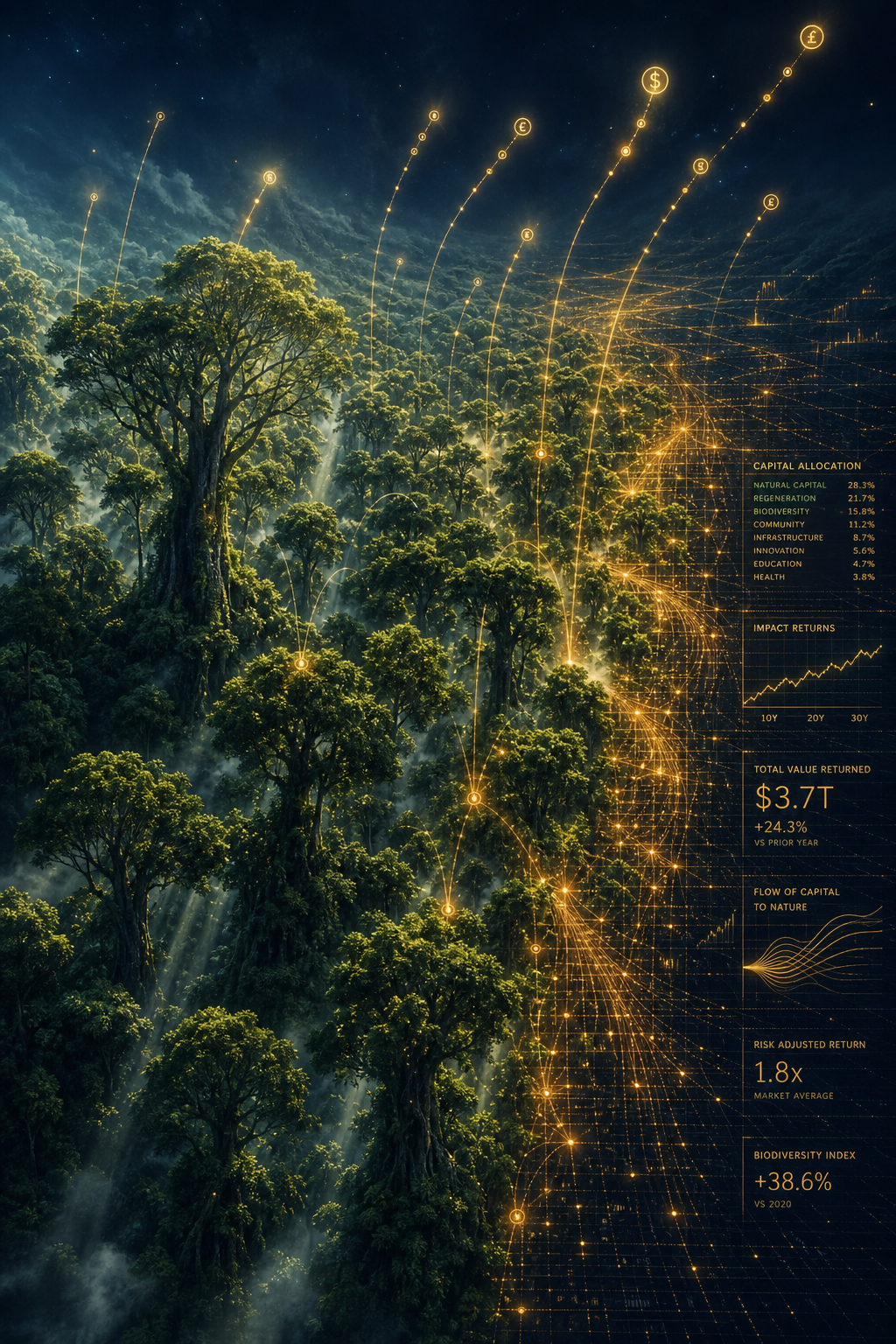
The short answer先给结论
Stop asking “what should we give?” Start asking “what would it cost us to lose it?”
别再问“我们该捐多少”,改问“失去它我们要赔多少”。
Find the dependency
找到依赖
Which cubic metres of water, hectares of soil, tonnes of fish biomass, pollination or storm-buffering does your EBIT actually rest on — and where, precisely, on a map?
你的息税前利润究竟建立在多少立方米水、多少公顷土壤、多少吨鱼类生物量、多少授粉与风暴缓冲之上——而且,精确到地图上的哪一处?
Price the loss you avoid
给“避免的损失”定价
Nature spending is not a cost centre; it is an insurance premium with a measurable claim behind it. Value it as avoided loss, secured volume and cheaper capital.
自然投入不是成本中心,而是一笔背后有真实赔付的保费。用“避免的损失、锁定的产量、更便宜的资本”来计价。
Fund it from the risk budget
从风险预算里出钱
Money that leaves the CSR budget dies at the first downturn. Money that leaves the capex, procurement or risk budget compounds — and comes back.
从 CSR 预算里出的钱,第一次业绩下滑就会消失;从资本开支、采购或风险预算里出的钱,会复利,也会回流。
Nature does not send an invoice. It sends a supply shock, a permit refusal, or a court judgment — all at once, and priced at replacement cost.
自然不会开发票。它送来的是供应中断、许可被拒或一纸判决——一次性到账,并按重置成本计价。
01 / The mismatch — where the money is01 / 错配——钱到底在哪里
Global finance is not neutral toward nature. It is 35 times more invested in losing it.
全球金融对自然并不中立——它在“失去自然”上的投入,是修复的 35 倍。
These three bars are the entire policy debate in one picture. Bar one is what the world spends every year on activity that degrades ecosystems. Bar two is what UNEP calculates we must spend by 2030. Bar three is what we actually spend today.
这三条柱状,就是整场政策辩论的全貌。第一条是全球每年投向破坏生态活动的资金;第二条是联合国环境署测算到 2030 年必须投入的规模;第三条是今天实际投入的数字。
02 / The arithmetic — six steps, in order02 / 算法——六步,按顺序
How to calculate what you owe nature — as an investment, not a gift.
如何算出你欠自然多少——按投资算,不按捐赠算。
This is the sequence a CFO can defend. Each step converts something ecological into something financial. Open a step to go deeper; open the nested question to see why most companies stall there.
这是一套 CFO 能够为之辩护的顺序:每一步都把生态量转换为财务量。点开每一步深入;再点开其中的追问,看看多数企业为什么卡在这里。
// s = each site or sourcing basin · D = dependency severity · P = annual probability · T = duration in loss-years · M = existing mitigation// s = 每个厂址或采购流域 · D = 依赖严重度 · P = 年发生概率 · T = 损失年数 · M = 既有缓释
Return on Nature = ( ΔAvoided loss + ΔSecured margin + ΔCost-of-capital + ΔNew revenue ) ÷ ( Nature capex + opex )
01LOCATE — put your dependency on a map定位 —— 把依赖画到地图上
Not “we care about biodiversity”, but: this brewery draws 1.4 million m³/yr from a basin rated high water stress; this mill sources fibre from 42,000 ha within 15 km of primary forest; this fleet lands 60% of volume from one stock. Screen assets and upstream sourcing regions — for most sectors 70–90% of the exposure sits in tiers 2–4, not at your own gate.
不是“我们关注生物多样性”,而是:这家酒厂每年从高水压流域取水 140 万立方米;这家纸厂的纤维来自距原始林 15 公里内的 4.2 万公顷;这支船队 60% 的渔获来自同一鱼群。既筛查自有资产,也筛查上游采购地——多数行业 70–90% 的敞口在二至四级供应链,而不在你的厂门口。
TNFD LEAPENCOREWWF Biodiversity & Water Risk FilterGlobal Forest Watch
Why do most companies fail at step one?为什么多数公司在第一步就失败?
Because procurement systems are built to track price and volume, not place. A supplier ID has no coordinates. Until the EU Deforestation Regulation forced geolocation of production plots, almost no consumer-goods company could answer “where did this come from?” at plot level — and you cannot price a risk you cannot locate.
因为采购系统只跟踪价格与数量,不跟踪地点。供应商编号没有坐标。在欧盟《零毁林法规》强制要求地块级地理定位之前,几乎没有一家快消企业能在地块层面回答“这东西从哪来”——而无法定位的风险,无法定价。
02EVALUATE — measure dependency and impact in physical units评估 —— 用实物单位量化依赖与影响
Two ledgers, never one. Dependency: what nature gives you (water yield, soil fertility, pollination, fish recruitment, coastal protection, climate regulation). Impact: what you take or damage (land converted, water consumed, effluent, habitat fragmentation, GHG). Keep them in m³, ha, tonnes, species-condition — money comes later. Mixing the two is why so many “biodiversity strategies” produce numbers no auditor will sign.
两本账,缺一不可。依赖:自然给你的(产水量、土壤肥力、授粉、鱼群补充、海岸防护、气候调节)。影响:你取走或破坏的(土地转换、耗水、排放、生境破碎、温室气体)。先用立方米、公顷、吨、物种状态记账,货币化放在后面。把两者混为一谈,正是大量“生物多样性战略”做出无人敢审计的数字的原因。
Natural Capital ProtocolSBTN AR3TESRS E3 / E4GRI 101 (2024)
03VALUE — convert ecology into currency, honestly估值 —— 诚实地把生态换算成货币
Four defensible methods, in descending order of auditability: (a) avoided cost — what the engineered substitute would cost (New York paid ~US$1.5bn to protect the Catskills watershed instead of US$6–8bn for a filtration plant plus ~US$300m a year to run it); (b) production function — yield or catch lost per unit of degradation; (c) damage cost — insurance claims, remediation, fines, litigation; (d) market proxy — carbon, water rights, credits. State the method next to every number, or the number is decoration.
四种可辩护的方法,按可审计性由高到低:(a) 规避成本——工程替代方案的造价(纽约市花约 15 亿美元保护卡茨基尔流域,而非花 60–80 亿美元建过滤厂并每年多付约 3 亿美元运行费);(b) 生产函数——每单位退化导致的产量或渔获损失;(c) 损害成本——理赔、修复、罚款与诉讼;(d) 市场替代价——碳、水权、信用额。每个数字旁必须写明方法,否则它只是装饰。
Why not just buy offsets and book the price?为什么不能直接买抵消额、按价格入账?
Because an offset price is what a market will pay for a certificate, not what the service is worth to your operation. A mangrove credit bought 3,000 km away does not keep salt out of your intake pipe. Offsets sit at the bottom of the mitigation hierarchy — avoid, reduce, restore, then, only for residual impact, offset. Reversing that order is the single most common accounting error in this field.
因为抵消额的价格只是市场愿意为一张证书支付的价格,而不是该服务对你运营的价值。在 3000 公里外买的红树林信用,挡不住你取水口的盐分入侵。抵消位于缓释层级的最底端——避免、减少、修复,最后才对残余影响做抵消。把顺序颠倒,是这个领域最常见的会计错误。
04COUNTERFACTUAL — price the cost of doing nothing反事实 —— 给“什么都不做”定价
The investment case is never “spend vs. save”. It is “spend now vs. pay later, with interest”. Build the do-nothing curve: production downtime, forced sourcing at spot price, insurance repricing, permit delay, community blockade, litigation. Deepwater Horizon cost BP over US$65bn in total charges, of which US$8.8bn was natural-resource damages alone. That is the true price tag of an unmanaged nature dependency arriving as a single line item.
投资论证从来不是“花钱 vs 省钱”,而是“现在花 vs 以后连本带利地赔”。要画出“不作为曲线”:停产、被迫按现货价采购、保费重定价、许可延误、社区封锁、诉讼。深水地平线事故令 BP 总计支出超过 650 亿美元,其中仅自然资源损害赔偿就达 88 亿美元。这就是一项未被管理的自然依赖,以单一科目一次性到账时的真实价签。
05INVEST — run it through the same hurdle rate as any capex投资 —— 用与其他资本开支相同的门槛收益率评审
NPV over the horizon of the asset, not the horizon of the CEO. Watershed and mangrove projects mature in 5–15 years; a 12% corporate discount rate quietly kills every one of them. Use a term-structured or blended rate, count the option value of continuing to operate, and put the nature KPI into the debt covenant — a sustainability-linked loan converts ecology into basis points, which is the language the treasury already speaks.
按资产的时间跨度计算净现值,而不是按 CEO 的任期。流域与红树林项目的回报期为 5–15 年;12% 的公司折现率会悄悄杀死其中每一个。应采用分期限或混合折现率,计入“可持续经营”的期权价值,并把自然 KPI 写进债务条款——可持续挂钩贷款把生态换算成基点,而基点正是财资部门早已熟悉的语言。
06DISCLOSE & LOOP — book it, report it, then re-measure披露与闭环 —— 入账、报告、再测量
TNFD for the market, CSRD/ESRS E4 for Europe, SBTN for the target, ISSB for the accounts. But the step that actually changes behaviour is internal: put a shadow price on water and land in the capital-approval template, and put the nature KPI in the bonus. Kering has published an Environmental P&L in euros since 2011 — and it revealed that the great majority of its footprint sits in raw-material production, four tiers upstream. That single finding redirected its sourcing strategy.
对市场用 TNFD,对欧洲用 CSRD/ESRS E4,目标设定用 SBTN,账务口径用 ISSB。但真正改变行为的是内部动作:在资本审批模板里给水和土地设定影子价格,把自然 KPI 写进奖金。开云集团自 2011 年起以欧元发布环境损益表,结果显示其绝大部分足迹位于上游四级的原材料生产环节——这一个发现,改写了它的采购战略。
03 / Do it on your own numbers03 / 用你自己的数字算一遍
A directional nature value-at-risk model.
一个方向性的“自然风险价值”模型。
Move the sliders. This is deliberately simple — the point is the shape of the answer, not the decimal. Every real assessment replaces these assumptions with site-level hydrology, stock assessments and yield curves.
拖动滑块。模型刻意做得简单——重要的是答案的形状,而不是小数点。真实评估会用厂址级水文数据、资源量评估与产量曲线替换这些假设。
Inputs输入
The ledger账本
Reads as: for every dollar placed into securing the ecosystems this business runs on, 3.4 dollars of expected loss are avoided. Directional only — not investment advice, and no substitute for site-level assessment. 读法:每投入 1 美元用于保障本业务所依赖的生态系统,可避免约 3.4 美元的预期损失。仅为方向性测算,不构成投资建议,也不能替代厂址级评估。
04 / The loop — how money returns04 / 闭环 —— 钱如何回来
Six stations on one circuit. Click any of them.
一条回路上的六个节点。点击任意一个。
Nature investment only becomes self-sustaining when the return re-enters the same circuit. Where the loop breaks — and it usually breaks in the same three places — the money leaks out as a one-off cost and never comes back.
只有当回报重新进入同一条回路,自然投资才能自我维持。回路一旦断开——而且通常断在同样的三处——资金就会以一次性成本的形式漏掉,再也回不来。
01 · Capital placed资本投入
Capex, opex, procurement premium, blended finance, or a debt instrument. The source matters more than the size: money from the CSR line is discretionary and dies in a bad quarter; money from procurement, capex or risk is contractual and survives.
资本开支、运营支出、采购溢价、混合融资,或一项债务工具。资金来源比规模更重要:来自 CSR 预算的钱是酌情支出,一个坏季度就消失;来自采购、资本开支或风险预算的钱是合同义务,能活下来。
Instruments: sustainability-linked loans · blue & green bonds · payments for ecosystem services · debt-for-nature swaps工具:可持续挂钩贷款 · 蓝色与绿色债券 · 生态系统服务付费 · 债务换自然
02 · Ecosystem restored生态修复
Riparian buffers replanted, mangrove belts rebuilt, soil organic matter raised, fishing effort reduced so a stock can rebuild, primary forest left standing. Physical units first: hectares, m³ of infiltration, tonnes of spawning biomass. If it can't be measured in the field, it can't be discounted in the model.
重建河岸缓冲带、恢复红树林带、提升土壤有机质、削减捕捞努力量让鱼群恢复、让原始林保持原状。先记实物单位:公顷、入渗立方米、产卵生物量吨数。如果在野外测不出来,在模型里也就折不了现。
03 · Service stabilised服务稳定
The ecosystem starts doing work you would otherwise buy: dry-season water yield, filtration, pollination, storm buffering, fish recruitment, microclimate. Mangroves alone prevent an estimated US$65bn a year in property flood damage and protect 15 million people. Coastal wetlands in the US Northeast avoided US$625m of damage during Hurricane Sandy.
生态系统开始承担你原本要花钱买的工作:旱季产水、过滤、授粉、风暴缓冲、鱼群补充、微气候调节。仅红树林每年就避免约 650 亿美元的财产洪灾损失,并保护 1500 万人。飓风桑迪期间,美国东北部沿海湿地避免了 6.25 亿美元损失。
04 · Input secured投入品安全
This is where ecology becomes procurement: volume secured, quality maintained, price volatility reduced, spot-market exposure cut, licence to operate retained. For most companies this is the single largest quantifiable line — and the easiest one to get a CFO to sign, because it already exists in the risk register.
这一步生态转化为采购语言:产量得到保障、品质稳定、价格波动下降、现货市场敞口收窄、经营许可得以保留。对多数企业而言,这是最大的一项可量化收益,也是最容易让 CFO 签字的一项——因为它本来就写在风险登记册里。
05 · Financial return财务回报
Four channels: avoided loss (the biggest), margin protection, insurance and cost-of-capital reduction, and new revenue from verified provenance. Central banks now treat this as prudential: the Dutch central bank found €510bn of Dutch financial institutions' portfolios highly dependent on ecosystem services.
四条渠道:避免的损失(最大的一块)、毛利保护、保费与资本成本下降,以及来自可验证来源的新增收入。央行已将其视为审慎监管议题:荷兰央行发现该国金融机构组合中有 5100 亿欧元高度依赖生态系统服务。
06 · Re-invested — or leaked再投入 —— 或漏出
The loop closes only if a share of the return is contractually recycled: a percentage of protected volume, a levy per m³ abstracted, a share of the credit revenue. Where it leaks: (a) a discount rate that erases anything beyond year 7; (b) quarterly reporting that cannot see a 15-year hydrological response; (c) subsidies that keep the destructive option cheaper than the regenerative one.
只有当一部分回报被合同化地循环回投时,闭环才成立:受保护产量的一定比例、每立方米取水的附加费、信用额收入的分成。漏点在于:(a) 折现率抹掉第 7 年以后的一切;(b) 季度报告看不见 15 年的水文响应;(c) 补贴让破坏性方案始终比再生性方案便宜。
05 / Industry deep dive05 / 行业深潜
Four sectors, four completely different balance sheets.
四个行业,四张截然不同的资产负债表。
Some industries are exposed because they depend on nature. Others are exposed because they damage it and the bill is arriving. Read the two gauges first — they decide which strategy is rational.
有些行业的敞口来自“依赖”自然,另一些来自“破坏”自然而账单正在寄来。先看两条标尺——它们决定了哪种策略才是理性的。
Oil & Gas — low dependency, enormous liability
石油与天然气 —— 低依赖,巨额负债
This sector does not need pollinators. It needs permits, coastlines, and the absence of a court judgment. Its nature exposure is therefore almost entirely on the liability side — spill damages, decommissioning, frontier access, and the roughly US$7 trillion in explicit and implicit fossil subsidies that currently make the arithmetic work.
这个行业不需要传粉者。它需要的是许可证、海岸线,以及一份不出现的法院判决。因此,它的自然敞口几乎全部在负债端——泄漏赔偿、退役拆除、前沿区块准入,以及目前让其财务模型成立的约 7 万亿美元显性与隐性化石补贴。
+What's working — the leading examples哪些做法有效 —— 领先案例
Ørsted is the sharpest case in any sector: a Danish oil and gas company that reinvented itself as the world's largest offshore wind developer, and has since committed that all new energy projects commissioned from 2030 must deliver a net-positive biodiversity impact. It converted a stranded-asset problem into a capital-market re-rating. TotalEnergies allocates around US$100m a year to natural carbon sinks. Across the sector, IPIECA/IOGP guidance and the mitigation hierarchy are now standard language in project consent.
Ørsted(沃旭)是所有行业中最锋利的案例:一家丹麦油气公司彻底转型为全球最大的海上风电开发商,并承诺自 2030 年起投产的所有新能源项目必须实现生物多样性净正影响。它把搁浅资产问题转化为资本市场的重新估值。TotalEnergies 每年约投入 1 亿美元于自然碳汇。在行业层面,IPIECA/IOGP 指南与缓释层级已成为项目审批中的标准语言。
+What's on trend当前趋势
TNFD adoption entering energy disclosures; site-level biodiversity net gain becoming statutory (the UK made a 10% uplift, maintained 30 years, mandatory for development from February 2024); decommissioning re-framed as restoration; and lenders beginning to price frontier-basin access as a nature risk rather than a political one.
TNFD 开始进入能源行业披露;场址级“生物多样性净增益”走向法定化(英国自 2024 年 2 月起强制要求开发项目实现 10% 增益并维持 30 年);退役拆除被重新表述为生态修复;贷款方开始把前沿盆地准入按自然风险而非政治风险定价。
?What's missing — and why, why, why缺失的部分 —— 为什么,为什么,为什么
Missing: credible avoidance rather than offsetting; provisioning for the full decommissioning bill; any accounting for downstream petrochemical and plastic impacts; and honest treatment of implicit subsidy in project economics.
缺失:真正的“避免”而非抵消;对全额退役成本的充分计提;对下游石化与塑料影响的任何核算;以及在项目经济性中对隐性补贴的诚实处理。
Why is offsetting preferred over avoidance?为什么更愿意做抵消而不是避免?
Because avoidance changes the asset plan and offsetting changes only the budget. Why does that matter? Because the asset plan is what the equity story is built on. Why does that persist? Because damage costs land in a later decade, on someone else's watch, while avoided production hits this quarter's guidance. The only forces that break this are legal liability and mandatory disclosure — which is exactly why the US$8.8bn natural-resource damages figure from Deepwater Horizon changed more boardroom behaviour than any voluntary pledge.
因为“避免”要改资产计划,而“抵消”只改预算。为什么这很关键?因为资产计划是股权故事的地基。为什么会长期如此?因为损害成本落在下一个十年、落在别人任期内,而减产立刻打击本季度业绩指引。唯一能打破这一点的是法律责任与强制披露——这正是为什么深水地平线 88 亿美元自然资源损害赔偿,比任何自愿承诺都更能改变董事会行为。
Wood & Fibre — the industry that eats its own asset base
木材与纤维 —— 吃掉自身资产基础的行业
Here the dependency and the impact are the same object. Forest productivity, soil, water regulation and fire regime are the balance sheet. The world lost 6.7 million hectares of primary tropical forest in 2024 — roughly double the previous year, driven largely by fire. Meanwhile only about a tenth of the world's forests carry FSC (~160m ha) or PEFC (~295m ha) certification.
在这里,依赖与影响是同一个对象。森林生产力、土壤、水文调节与火烧机制本身就是资产负债表。2024 年全球损失热带原始林 670 万公顷,约为前一年的两倍,主要由火灾驱动。与此同时,全球仅约十分之一的森林获得 FSC(约 1.6 亿公顷)或 PEFC(约 2.95 亿公顷)认证。
+What's working — the leading examples哪些做法有效 —— 领先案例
Suzano (Brazil) has committed to connect 500,000 hectares of native Cerrado, Atlantic Forest and Amazon fragments by 2030 — a landscape-connectivity target, not a tree-count target, which is the difference between ecology and PR. UPM has run a biodiversity programme in its Finnish forests since 1998 and targets a net positive impact. Stora Enso and Holmen report forest carbon and biodiversity together. Inter IKEA reached 100% FSC-certified or recycled wood and now buys at a scale that moves regional forestry practice.
Suzano(巴西)承诺到 2030 年连接 50 万公顷塞拉多、大西洋森林与亚马逊的原生植被碎片——这是“景观连通性”目标而非“种树棵数”目标,这正是生态与公关的分野。UPM 自 1998 年起在芬兰自有林区推行生物多样性计划,并以净正影响为目标。Stora Enso 与 Holmen 将森林碳汇与生物多样性合并披露。Inter IKEA 已实现木材 100% FSC 认证或再生,其采购体量足以改变区域林业实践。
+What's on trend当前趋势
The EU Deforestation Regulation is quietly the most consequential nature policy of the decade for this sector: it requires plot-level geolocation for timber, pulp, rubber, soy, cocoa, coffee, palm and cattle. Companies that built that traceability for compliance are discovering they now hold the risk map they were missing at step one. Alongside it: fire-risk repricing by insurers, stacked carbon-and-biodiversity contracts, and long-rotation forestry re-entering the investment case.
欧盟《零毁林法规》在本行业悄然成为本十年影响最大的自然政策:木材、纸浆、橡胶、大豆、可可、咖啡、棕榈与牛肉均须提供地块级地理定位。那些为合规而搭建溯源体系的企业发现,自己终于拿到了第一步一直缺失的风险地图。与之并行的还有:保险公司对火灾风险重新定价、碳与生物多样性叠加合约,以及长轮伐期林业重回投资视野。
?What's missing — and why, why, why缺失的部分 —— 为什么,为什么,为什么
Missing: the water and fire-regulation value of natural forest versus plantation is almost never priced; monoculture plantations are still counted as “forest” in most accounts; soil nutrient depletion across rotations is unbooked; and smallholders — who supply a large share of tropical fibre — are handed the cost of traceability without the finance to meet it.
缺失:天然林相对人工林在水文与火灾调节上的价值几乎从未被定价;多数统计口径仍把单一树种人工林算作“森林”;跨轮伐期的土壤养分消耗未入账;而供应大量热带纤维的小农户,被要求承担溯源成本,却拿不到相应融资。
Why is water regulation never on the P&L?为什么水文调节从不出现在损益表上?
Because the beneficiary is downstream and the cost-bearer is upstream — the classic split incentive. Why hasn't the market solved it? Because there is no contract between them. Why not? Because water is usually free at the point of abstraction, so the downstream user has no line item to redirect. The fix already exists and is thirty years old: Vittel paid farmers in its aquifer catchment to change practice; New York City paid the Catskills instead of building a filtration plant; Danone's Evian has protected its impluvium since 1992. Payments for ecosystem services turn a hydrological fact into an enforceable cash flow.
因为受益者在下游、承担成本者在上游——典型的激励错配。市场为什么没有解决?因为两者之间没有合同。为什么没有合同?因为在取水端水通常是免费的,下游用户没有可以转移的科目。解法早已存在,且已有三十年:Vittel 付费给其含水层集水区的农户改变耕作方式;纽约市选择付钱给卡茨基尔流域而非建过滤厂;达能旗下依云自 1992 年起保护其涵养区。生态系统服务付费,把一个水文事实变成可执行的现金流。
Ocean & Seafood — the clearest ROI in the whole economy
海洋与水产 —— 全经济体中最清晰的投资回报
Fisheries are the only major industry where the return on restraint has been calculated to the dollar. The World Bank estimates that rebuilding global fish stocks would generate an additional US$83 billion a year. Today, 37.7% of assessed stocks are fished beyond biologically sustainable limits, and roughly US$22bn a year in harmful subsidies keeps over-capacity fleets on the water. Fisheries and aquaculture first-sale value: about US$472bn.
渔业是唯一一个把“克制的回报”算到美元的重要产业。世界银行测算,恢复全球鱼类种群每年可额外创造 830 亿美元。当前,37.7% 的已评估种群捕捞强度超出生物可持续限度,而每年约 220 亿美元的有害补贴让过剩运力继续留在海上。渔业与水产养殖的初次销售额约为 4720 亿美元。
+What's working — the leading examples哪些做法有效 —— 领先案例
Thai Union's SeaChange 2030 attaches a number to the strategy — a commitment of US$200m by 2030 — which is what turns a policy into a capital plan. SeaBOS brings ten of the world's largest seafood companies into joint stock-and-traceability commitments, a rare case of competitors treating a shared resource as shared capital. MSC-engaged fisheries now cover a meaningful share of the global wild marine catch. On the finance side, debt-for-nature conversions have moved real money: Belize converted US$364m of debt and unlocked ~US$180m for marine conservation; Ecuador's Galápagos swap (~US$1.6bn) is projected to generate ~US$450m for conservation.
泰国联合集团(Thai Union)的 SeaChange 2030 给战略配上了数字——到 2030 年投入 2 亿美元——这正是把政策变成资本计划的关键。SeaBOS 把全球十家最大水产企业纳入共同的种群与溯源承诺,是竞争者把共享资源当作共享资本的罕见案例。MSC 参与的渔业已覆盖全球野生海洋渔获的可观份额。金融端,债务换自然已在调动真金白银:伯利兹置换 3.64 亿美元债务,为海洋保护释放约 1.8 亿美元;厄瓜多尔加拉帕戈斯约 16 亿美元的债务置换,预计可产生约 4.5 亿美元保护资金。
+What's on trend当前趋势
Buyer-financed fishery improvement projects; electronic monitoring replacing observer coverage; the WTO Agreement on Fisheries Subsidies (adopted 2022) finally disciplining the subsidy layer; and parametric nature insurance — the Quintana Roo reef policy in Mexico, the first of its kind, paid out after Hurricane Delta in 2020, funding immediate reef repair because a healthy reef is measurable coastal infrastructure.
买方出资的渔业改进项目;电子监控取代观察员覆盖;世贸组织《渔业补贴协定》(2022 年通过)终于开始约束补贴层;以及参数化自然保险——墨西哥金塔纳罗奥州的珊瑚礁保单是同类首例,在 2020 年飓风德尔塔后完成赔付,直接资助珊瑚礁抢修,因为健康的珊瑚礁就是可计量的海岸基础设施。
?What's missing — and why, why, why缺失的部分 —— 为什么,为什么,为什么
Missing: most tropical and small-scale fisheries have no stock assessment at all, so they cannot be priced or financed; aquaculture's feed footprint (fishmeal and soy) is rarely consolidated into the buyer's account; nursery habitat — mangrove and seagrass — never appears in seafood cost of goods; and illegal, unreported and unregulated fishing (estimated US$10–23.5bn a year) functions as a subsidy to the worst operator in the market.
缺失:多数热带与小规模渔业根本没有资源量评估,因而无法定价、无法融资;水产养殖的饲料足迹(鱼粉与大豆)很少并入买方账目;育幼生境——红树林与海草床——从不出现在水产品的销货成本中;而非法、未报告、不受管制的捕捞(估计每年 100–235 亿美元)实质上是对市场中最恶劣经营者的补贴。
Why does an industry that visibly depends on fish keep overfishing?为什么一个明显依赖鱼的行业还在持续过度捕捞?
Because the stock is a shared asset while the vessel is a private one. Why does that break the maths? Because restraint by one operator becomes catch for another, so the individual return on conservation is negative even when the collective return is +US$83bn. Why hasn't it been fixed? Because fixing it requires enforceable, allocated rights — quotas, closures, subsidy reform — which are political goods, not corporate ones. The corporate lever that does work is the buyer: a supermarket or a processor with long-term contracts can pay for restraint and capture the recovered volume. That is the only version of this loop that closes without a treaty.
因为鱼群是共享资产,而渔船是私有资产。为什么这会毁掉这笔账?因为一方的克制会变成另一方的渔获,于是即使集体回报是 +830 亿美元,个体的保护回报仍为负。为什么至今没解决?因为解决它需要可执行、可分配的权利——配额、休渔、补贴改革——这些是政治产品,而非企业产品。真正有效的企业杠杆是买方:拥有长期合同的超市或加工商可以为“克制”付费,并锁定恢复后的产量。这是这一闭环在没有国际条约的情况下唯一能合上的版本。
AI & Data Centres — a new nature dependency, barely measured
人工智能与数据中心 —— 一种几乎未被测量的新型自然依赖
The IEA puts data-centre electricity use at about 415 TWh in 2024 — roughly 1.5% of global demand — rising toward 945 TWh by 2030. Water is the sharper local constraint: Google reported about 5.6 billion gallons (~21 billion litres) of water consumption in 2022; Microsoft's use rose 34% that year to nearly 1.7 billion gallons. Analyses in 2025 reported that a large share of new data centres are being built in high water-stress basins — which is a siting decision, not a technology one.
国际能源署估算,数据中心 2024 年用电约 415 太瓦时(约占全球需求 1.5%),到 2030 年将升至约 945 太瓦时。水是更尖锐的本地约束:谷歌报告 2022 年耗水约 56 亿加仑(约 210 亿升);微软同年用水量增长 34%,接近 17 亿加仑。2025 年的多项分析指出,相当比例的新建数据中心位于高水压流域——这是一个选址决策,而非技术问题。
+What's working — the leading examples哪些做法有效 —— 领先案例
Microsoft set a water-positive-by-2030 target and pledged to protect more land than it uses — a commitment it reports having met, covering thousands of hectares. Google has committed to replenish 120% of the freshwater it consumes by 2030 and reports replenishment basin by basin rather than as a single global net. Amazon targets water positive by 2030 and publishes progress annually. The good practice here is not the pledge; it is the basin-level accounting underneath it.
微软设定了 2030 年“水正向”目标,并承诺保护的土地多于其占用的土地——公司报告已达成该目标,覆盖数千公顷。谷歌承诺到 2030 年补充其消耗淡水量的 120%,并按流域逐一披露补给情况,而非只给出一个全球净值。亚马逊以 2030 年水正向为目标并逐年公布进展。真正的良好实践不在于承诺,而在于其下的流域级核算。
+What's on trend当前趋势
Closed-loop and air-side cooling design; reporting consumption rather than withdrawal (the two differ by an order of magnitude); siting driven by basin stress and grid carbon rather than land price and latency alone; firm clean-power PPAs; and the first tentative TNFD disclosures from the technology sector. The strongest opportunity in this industry is on the other side of the ledger: AI is the cheapest measurement technology ever built for ecosystems — satellite deforestation alerts, acoustic biodiversity monitoring, fish-stock modelling, illegal-fishing detection.
闭式循环与风侧冷却设计;披露“消耗量”而非“取水量”(两者相差一个数量级);选址依据流域压力与电网碳强度,而不只看地价与时延;长期清洁电力购电协议;以及科技行业首批试探性的 TNFD 披露。这个行业最强的机会在账本的另一侧:AI 是人类为生态系统建造过的最廉价测量技术——卫星毁林预警、声学生物多样性监测、鱼类资源建模、非法捕捞识别。
?What's missing — and why, why, why缺失的部分 —— 为什么,为什么,为什么
Missing: embodied nature in hardware — advanced semiconductor fabs are among the most water- and chemical-intensive facilities on earth, and their footprint is almost never consolidated into a model's cost; the land and habitat fragmentation of grid and transmission build-out; and a common standard for water consumption per unit of compute. Above all: a global net-positive water number can coexist with a single aquifer being drawn down to nothing.
缺失:硬件中的隐含自然足迹——先进半导体晶圆厂是全球最耗水、最耗化学品的设施之一,其足迹几乎从未并入模型成本;电网与输电扩建带来的土地占用与生境破碎;以及单位算力耗水量的统一标准。最关键的是:一个全球“水正向”的净值,完全可以与某个含水层被抽干并存。
Why is water underpriced for compute?为什么算力的用水被低估定价?
Because industrial water tariffs reflect delivery cost, not scarcity value. Why? Because scarcity is local and tariffs are political. Why does that matter to an AI company? Because the risk does not arrive as a price rise — it arrives as a moratorium, a refused permit, or a community campaign that stops a €1bn campus after the concrete is poured. Nature risk for data centres is overwhelmingly a permission risk, and permission is priced in delay.
因为工业水价反映的是输送成本,而非稀缺价值。为什么?因为稀缺是本地的,而水价是政治的。这对一家 AI 公司为什么要紧?因为风险不会以涨价的形式到来——它以暂停令、许可被拒,或在混凝土浇筑之后叫停一座 10 亿欧元园区的社区行动到来。数据中心的自然风险绝大部分是“许可风险”,而许可的代价以工期计价。
06 / The value chain — who can actually move the money06 / 价值链 —— 谁真的能调动资金
Seven actors. Each holds one lever the others cannot pull.
七个角色。每一个都握着其他人拉不动的那根杠杆。
Positive money flow is not a moral position; it is a sequencing problem. The producer holds the land but not the capital. The buyer holds the capital but not the land. The insurer prices the tail nobody else models. Match lever to actor and the flow starts.
正向资金流不是道德立场,而是排序问题。生产者握有土地却没有资本;买方握有资本却没有土地;保险公司为其他人都不建模的尾部风险定价。把杠杆与角色对上,资金就开始流动。
Investors & lenders投资者与放贷方
Lever: cost of capital. A nature KPI in a covenant changes behaviour faster than any report, because it is priced in basis points and enforced by a bank.杠杆:资本成本。写进契约的自然 KPI 比任何报告都更快改变行为,因为它以基点计价、由银行执行。
Sustainability-linked loans · blue & green bonds · debt-for-nature swaps (Belize, Ecuador, Gabon) · NGFS nature risk supervision可持续挂钩贷款 · 蓝色与绿色债券 · 债务换自然(伯利兹、厄瓜多尔、加蓬)· NGFS 自然风险监管
Board & CFO董事会与首席财务官
Lever: hurdle rates and incentives. A shadow price on water and land inside the capex template redirects more capital in a year than a decade of strategy documents.杠杆:门槛收益率与激励。在资本开支模板中为水和土地设定影子价格,一年内重新配置的资本超过十年的战略文件。
Environmental P&L (Kering, since 2011) · internal shadow pricing · NVaR in the risk register · nature KPI in executive pay环境损益表(开云,2011 年至今)· 内部影子定价 · 风险登记册中的 NVaR · 高管薪酬中的自然 KPI
Procurement & buyers采购与买方
Lever: the contract. 70–90% of most footprints sit upstream, so the buyer's term sheet is the most powerful conservation instrument in the economy — and it is already signed every year.杠杆:合同。多数企业 70–90% 的足迹在上游,因此买方的条款清单是全经济体最有力的保护工具——而且它每年都在签。
Long-term offtake with practice premiums · payments for ecosystem services (Vittel, Evian) · verified provenance under EUDR带实践溢价的长期承购 · 生态系统服务付费(Vittel、依云)· EUDR 下的可验证来源
Producers — farmers, fishers, foresters生产者 —— 农户、渔民、林农
Lever: the hands and the land. They can change practice tomorrow, but only against a bankable cash flow. Transition finance, not exhortation.杠杆:土地与人手。他们明天就能改变做法,但前提是有可融资的现金流。需要的是转型融资,而不是劝导。
PES contracts · transition credit · smallholder traceability finance · community fisheries rights生态服务付费合同 · 转型信贷 · 小农户溯源融资 · 社区渔业权
Insurers & reinsurers保险与再保险
Lever: they price the tail. When a reef or a mangrove belt is written into a policy as protective infrastructure, ecology becomes an underwriting input.杠杆:为尾部风险定价。当珊瑚礁或红树林带作为防护基础设施被写进保单,生态就成为承保输入项。
Parametric reef insurance (Quintana Roo, first payout 2020) · flood-buffer premium discounts · wildfire risk repricing参数化珊瑚礁保险(金塔纳罗奥,2020 年首次赔付)· 洪水缓冲保费折扣 · 野火风险重定价
Regulators & governments监管者与政府
Lever: they decide whether the externality is a cost. Nothing on this page scales until the destructive option stops being the cheap one.杠杆:由他们决定外部性是否成为成本。在破坏性方案不再最便宜之前,本页所有内容都无法规模化。
GBF Targets 15, 18, 19 · CSRD / ESRS E4 · EUDR · UK Biodiversity Net Gain · WTO fisheries subsidies · subsidy reform昆蒙框架目标 15、18、19 · CSRD / ESRS E4 · 欧盟零毁林法规 · 英国生物多样性净增益 · WTO 渔业补贴 · 补贴改革
A pledge without a payer is a press release. Find the payer, and the ecology follows.
没有付款方的承诺,只是一份新闻稿。找到付款方,生态自会随之而来。
Start with your single biggest dependency从你最大的那一项依赖开始07 / Sources — for deeper diving07 / 参考来源 —— 继续深潜
Every number on this page has an address.
本页每一个数字都有出处。
Titles are given in English as published, so they can be searched exactly. Figures shift as new editions appear — always check the latest release before putting a number in a board pack.
文献标题保留英文原名,便于精确检索。数据会随新版本更新——把数字放进董事会材料前,请务必核对最新一期。
Frameworks, standards & regulation框架、标准与法规
- TNFD — Recommendations of the Taskforce on Nature-related Financial Disclosures, and the LEAP approach (2023); sector guidance (2024–).
- Capitals Coalition — Natural Capital Protocol (2016).
- Science Based Targets Network (SBTN) — Corporate Science-Based Targets for Nature: technical guidance and the AR3T framework (2023–2024).
- UNEP-WCMC / UNEP FI / Global Canopy — ENCORE: Exploring Natural Capital Opportunities, Risks and Exposure.
- WWF — Biodiversity Risk Filter & Water Risk Filter.
- CBD — Kunming-Montreal Global Biodiversity Framework (2022), Targets 14, 15, 18, 19.
- European Union — CSRD and ESRS E3 (Water) and E4 (Biodiversity & Ecosystems), 2023.
- European Union — Regulation (EU) 2023/1115 on deforestation-free products (EUDR).
- UK — Environment Act 2021; mandatory Biodiversity Net Gain (10%, 30 years) from February 2024.
- GRI — GRI 101: Biodiversity 2024. ISSB — IFRS S1/S2 and biodiversity research project.
- WTO — Agreement on Fisheries Subsidies (adopted 2022).
Global economics & finance data全球经济与金融数据
- World Economic Forum — Nature Risk Rising (2020): US$44tn of value generation, 55% of GDP.
- World Economic Forum — The Future of Nature and Business, New Nature Economy Report II (2020): US$10.1tn, 395m jobs by 2030.
- Dasgupta, P. — The Economics of Biodiversity: The Dasgupta Review, HM Treasury (2021).
- UNEP — State of Finance for Nature (2023): ~US$200bn NbS finance; ~US$7tn nature-negative flows; US$542bn/yr needed by 2030.
- IPBES — Global Assessment (2019); Values Assessment (2022); Nexus Assessment (2024): US$10–25tn/yr unaccounted costs.
- World Bank — The Economic Case for Nature (2021): ~US$2.7tn annual GDP loss by 2030 under partial ecosystem-service collapse.
- IMF — Fossil Fuel Subsidies Surged to a Record US$7 Trillion (2023).
- Costanza, R. et al. — Changes in the global value of ecosystem services, Global Environmental Change (2014).
- De Nederlandsche Bank — Indebted to Nature (2020): €510bn of Dutch financial exposure highly dependent on ecosystem services. NGFS — Nature-related Financial Risks (2023).
- UN Decade on Ecosystem Restoration / FAO-UNEP — restoration benefit ratios up to 1:30.
- OECD — Biodiversity: Finance and the Economic and Business Case for Action (2019/2020).
Sector evidence行业证据
- FAO — The State of World Fisheries and Aquaculture (SOFIA) 2024: 37.7% of stocks unsustainable; ~US$472bn first-sale value.
- World Bank — The Sunken Billions Revisited (2017): US$83bn/yr forgone.
- Sumaila, U.R. et al. — Updated estimates and analysis of global fisheries subsidies, Marine Policy (2019): ~US$22bn harmful subsidies.
- Menéndez, P. et al. — The Global Flood Protection Benefits of Mangroves, Scientific Reports (2020): US$65bn/yr, 15m people.
- Narayan, S. et al. — Coastal wetlands and flood damage reduction, Scientific Reports (2017): US$625m avoided, Hurricane Sandy.
- WRI / Global Forest Watch — Forest Pulse: primary tropical forest loss, 2024 data (published 2025).
- FSC and PEFC — certified forest area statistics (2024). MSC — Annual Report (2023/24).
- IEA — Energy and AI (2025): data-centre electricity ~415 TWh (2024) → ~945 TWh (2030).
- Google — Environmental Report (2023, 2024). Microsoft — Environmental Sustainability Report (2023, 2024). Amazon — Sustainability Report (2024).
- IPIECA / IOGP — Biodiversity and Ecosystem Services Fundamentals.
Cases & instruments案例与工具
- Kering — Environmental Profit & Loss account (published annually since 2011).
- New York City DEP — Catskill/Delaware Watershed Protection Program and Filtration Avoidance Determination.
- Perrot-Maître, D. — The Vittel payments for ecosystem services: a “perfect” PES case?, IIED (2006).
- The Nature Conservancy — Belize Blue Bond for Ocean Conservation (2021); Ecuador Galápagos debt conversion (2023); Gabon (2023).
- Swiss Re / State of Quintana Roo — parametric coral reef insurance (2019; first payout 2020).
- Thai Union — SeaChange 2030 strategy (2023). SeaBOS — Seafood Business for Ocean Stewardship.
- Ørsted — Biodiversity policy: net-positive biodiversity impact for projects commissioned from 2030.
- Suzano, Stora Enso, UPM, Holmen, Inter IKEA — forest biodiversity and connectivity programmes.
- BP / US Department of Justice — Deepwater Horizon settlement (2016): US$8.8bn natural-resource damages within total charges exceeding US$65bn.