UndergroundOS
Demonstration station

AI-native underground infrastructure· public product station

From a BIM model to a governed, intelligent underground delivery system.

Connect every model object to chainage, work, evidence, risk, cost and accountable action — one relationship system beneath the whole drive.
01 — Foundation
One governed data core
02 — Relationships
Task-to-model relationships, kept current
03 — Authority
Human-authorized action, always
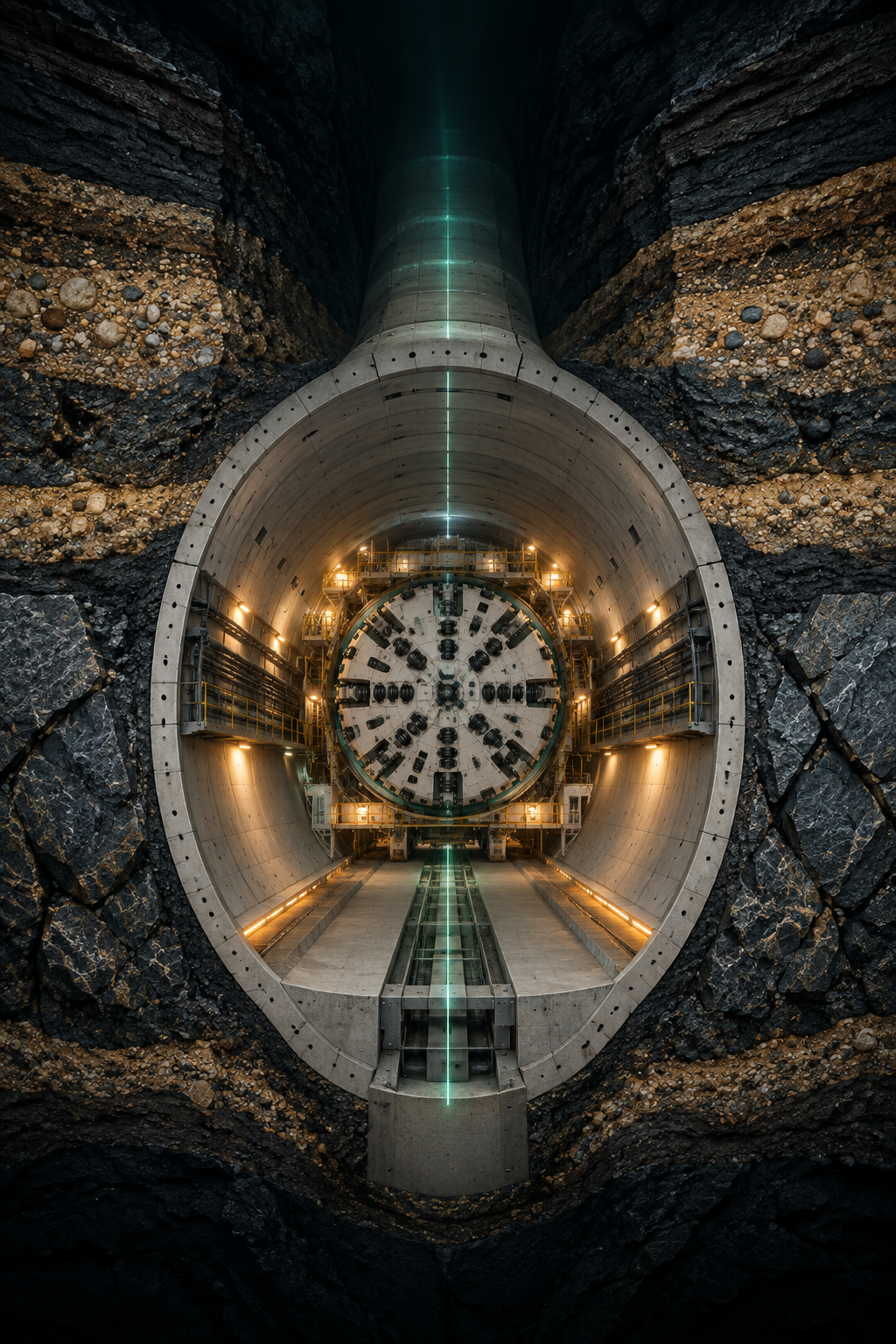
Cutaway visualization of a lined underground tunnel corridor with a shield machine along the alignment
Corridor Metro Link Eastbound Tunnel · UMT-017 Alignment ALN-EB-01 · CH 12+420 → CH 12+570 Machine TBM-EB-01 · Earth Pressure Balance shield Position CH 12+462 · Ring 842

Stage 01Linear BIM & shield tunnelling digital twin

The alignment is the interface.

Geometry alone is a picture. Here, every metre of the drive carries its geology, its workfronts, its production cycle, its risks and the person accountable for them — all addressable by chainage.

Governed demonstration data — not a live operational feed.

ZG-1 STIFF CLAY ZG-2 SAND & GRAVEL · WATER BEARING ZG-3 WEATHERED ROCK ZG-4 MIXED FACE GROUND SURFACE · MONITORING ARRAY MP-101 → MP-124 (DEMO) TUNNEL LINING · IfcWall · urn:asset:UMT-017:lining:* TBM-EB-01 CH 12+462 BORE Ø · DEMO COVER TO CROWN 18.6 m (demo) CONTROLLED COMPONENT Eastbound Tunnel Lining Segment S-17 PERSISTENT IDENTIFIER urn:asset:UMT-017:lining:S-17 IFC-ALIGNED CLASS IfcWall SLICE LOCATION CH 12+462 · Ring 842 · ZG-1 Stiff clay CONDITION PROPERTY seepageRate · approved unit L/min DRIVE-THROUGH · LOOKING AHEAD OF FACE Rings ahead are planned, not built — demonstration state. RING 842 · CH 12+462 Highlighted panel: Segment S-17 (IfcWall)
CH 12+462
Ring 842 · ZG-1 stiff clay · nearest workfront WF-B
TBM command layer · TBM-EB-01
Advance rate
32mm/min
Within approved band
Total thrust
28,600kN
Ring 842 push
Cutterhead torque
4,650kNm
Stable over last 6 rings
Face pressure
2.35bar
Approved band 2.10 – 2.60 bar
Ring position
842ring
CH 12+462 · ALN-EB-01
Tail void grout
6.4m³/ring
Above theoretical volume

Governed demonstration data — not a live operational feed.

Production cycle · six steps
Step 04 · Build ring — Segments are erected under exclusion-zone control to form Ring 842. Linked task TBM-C04 · risk TBM-R03 · accountable role: Ring Build Supervisor. Hold point: erector interlock verification before the ring is closed.
Geology along the alignment
ZG-1
Stiff clay
CH 12+420 → 12+465
ZG-2
Sand & gravel, water bearing
CH 12+465 → 12+505
ZG-3
Weathered rock
CH 12+505 → 12+540
ZG-4
Fractured rock, mixed face
CH 12+540 → 12+570
Risk points · select to trace the relationship
Open · control verified

Segment handling during ring build

Chainage
CH 12+455 · Ring 838
Machine component
Segment erector, TBM-EB-01
Linked task
TBM-C04 — Ring build cycle
Control
Exclusion zone, two-hand control, erector interlock verification before ring closure
Accountable owner
Ring Build Supervisor
Status
Open — control verified this shift, evidence attached
TBM-R03↔CH 12+455↔Segment erector↔TBM-C04↔Ring Build Supervisor↔Inspection evidence

Stage 02BIM & governed data core

Governance is the product. AI is what it makes possible.

A viewer shows geometry. UndergroundOS holds identity, meaning and relationships — so information stays answerable to a place, a task, a requirement and a person.

Above the core — governed AI

Reasoning and optimization that operates only on trusted records

Interpret, challenge, explain, predict and prepare. Never authorize.

Upstream

Design, planning, procurement, field capture

Design modelsProgrammeProcurement packagesField observationsSurvey & monitoring
The core

Identity, semantics, location, validation, provenance

IFC semanticsPersistent IDsChainageSchema validationProvenanceRevisionCurrent state
Downstream

4D schedule, 5D cost, safety, operations, learning, assurance

4D schedule5D costSafetyOperationsLearningExecutive assurance
The model becomes valuable when every object has a durable identity and trusted relationships to the work around it.
One relationship, end to end
Model object↔Persistent ID↔Chainage↔Task↔Schedule status↔Cost package↔Risk↔Evidence↔Accountable owner↔Approved action
TBM-R03 segment handling risk↔CH 12+455↔Segment erector↔Ring-build task TBM-C04↔Ring Build Supervisor↔Inspection evidence

Governed demonstration data — not a live operational feed.

Stage 03Connected management workspaces

Six capabilities, one relationship model.

Not fifteen disconnected modules. Each capability reads and writes the same governed objects, so a decision made in cost is legible in safety, and both remain anchored to the same metre of tunnel.

Capability 01

Linear BIM & 4D project controls

Management problem
The programme lives in one system and the geometry in another, so nobody can say what work is where.
How the relationships solve it
Every task binds to an object ID and a chainage window, so schedule status colours the alignment itself.
Representative interaction
Alignment panorama with green, amber and red workfronts by chainage band.
Accountable: Project Controls Manager
Capability 02

Cost & commercial intelligence

Management problem
Cost is reported after the period closes, disconnected from where it was actually earned or lost.
How the relationships solve it
Cost packages attach to the same object and chainage band as the task and the measured quantity.
Representative interaction
Earned value by chainage band, with variance flagged against the approved package.
Accountable: Commercial Manager
Capability 03

Safety for life & confined-space control

Management problem
Permits, risks and controls sit in paper systems far from the location where the hazard exists.
How the relationships solve it
Hazard → control → evidence → hold point all attach to the object and chainage they protect.
Representative interaction
Cross-passage entry board showing open hold points and who must authorize each one.
Accountable: Confined Space Authorised Person
Capability 04

Operations, reporting & contractor management

Management problem
Every shift rewrites the same facts in a different format, and the versions quietly disagree.
How the relationships solve it
Field capture writes back to governed records carrying provenance, revision and author.
Representative interaction
Shift report assembled from verified records, then signed by a named person.
Accountable: Section Engineer / Shift Manager
Capability 05

Learning, competence & practical simulation

Management problem
Competence is recorded as attendance rather than capability at a specific workface.
How the relationships solve it
Training scenarios are rebuilt from the same governed geometry, tasks and risk relationships.
Representative interaction
Ring-build cycle simulation that gives feedback against approved method rules.
Accountable: Training & Competence Lead
Capability 06

Sustainability, materials & resource performance

Management problem
Carbon and material data arrive far too late to change the decision that caused them.
How the relationships solve it
Material quantities carry the same object identity used in design, procurement and construction.
Representative interaction
Concrete and spoil intensity per ring, trended against the approved baseline.
Accountable: Sustainability Manager

Stage 04Governed AI · capability with boundaries

Three bounded agents. No agent holds authority.

Each agent has a declared read scope, a declared write scope, an explicit prohibition list, the evidence behind its output, and the human role that must authorize whatever comes next.

Evidence agent

Decides whether a submitted record is decision-grade before anything is built on it.

May read

Submitted records, declared units, instrument calibration references, provenance, revision history.

May write

A validation verdict, a missing-evidence list and a written confidence note.

Prohibited

Approving evidence, converting incompatible units, discounting expired calibration, closing an action.

Supporting evidence: survey record SR-2291, instrument calibration certificate, submission provenance trail.

Human authority gateSection Engineer accepts or rejects the verdict. Nothing proceeds on an unaccepted verdict.

Engineering risk agent

Compares the governed current state with the approved requirement, and says plainly where the gap is.

May read

Governed current state, approved thresholds, geology zones, machine history and the risk register.

May write

A comparison against the approved requirement, a trend interpretation, an uncertainty statement, an escalation draft.

Prohibited

Changing a threshold, releasing a hold point, authorizing restart, or declaring any area safe.

Supporting evidence: approved face-pressure band 2.10 – 2.60 bar, settlement trigger levels, monitoring array readings.

Human authority gateGeotechnical Lead and Shift Tunnel Engineer decide the response.

Action preparation agent

Prepares the paperwork of a decision — and stops at the signature line.

May read

Accepted verdicts, the task library, approved method statements and the role register.

May write

A draft task, draft briefing, draft inspection package and draft notification — all unissued.

Prohibited

Issuing work, committing cost, granting permits, authorizing confined-space entry, signing closure.

Supporting evidence: linked task TBM-C04, inspection template IT-07, accountable role register entry.

Human authority gateRing Build Supervisor issues the task. A draft is not work until a person issues it.
Two paths · the same governance
Chain continues · grounded recommendation prepared
Input
Settlement reading MP-118 at CH 12+512 — unit mm declared, provenance complete, calibration valid at the demonstration date.
Validation
Decision-grade. Nothing inferred, nothing converted.
Interpretation
−12.4 mm against an approved amber trigger of −12.0 mm and a red trigger of −18.0 mm. Rate of change is slowing.
Uncertainty
±1.1 mm instrument band; two of six array points sit outside preferred spacing.
Recommendation
Hold tail-void grout at the upper approved band for the next five rings and add one monitoring round per shift.
Prepared action
Draft task and draft briefing created — not issued.
Authority gate
Geotechnical Lead must authorize before anything changes on site.

Governed demonstration data — not a live operational feed.

Stage 05Safety for life

A control is only real when someone owns it and evidence closes it.

Safety in UndergroundOS is a workflow attached to a location, not a policy document filed somewhere else.

Step 01
Incident report

Captured at the chainage where it happened, linked to the object and the task.

Step 02
Near-miss report

Same structure, same relationships — so weak signals aggregate instead of vanishing.

Step 03
Safety inspection

Template drawn from the approved control for that hazard at that location.

Step 04
Action owner & due date

A named role, a date, and a visible open state until it is answered.

Step 05
Evidence review

Provenance, units and calibration checked before anything is called complete.

Step 06
Verified closure

Closed by a person with authority — never by a score, a timer or an agent.

Step 07
Executive safety visit

A visit route built from red and amber workfronts and open hold points.

Step 08
Scorecard

Trends by workfront, control type and owner — traceable back to source records.

This public Station is a product demonstration. It does not replace emergency response, statutory reporting, permit systems or accountable professional judgment.

Stage 06Executive view

The whole drive, understood in ninety seconds.

Always ready, never oversimplified: what stage the work is at, what is red, who owns it, and what leadership should look at on the next visit.

Project state · demonstration

  • StageShield drive in progress · Ring 842 of the eastbound bore, CH 12+462.
  • PanoramaCH 12+420 → 12+570 · four geology zones · four active workfronts.
  • RedWF-C, CH 12+488 — cross-passage CP-04 preparation, entry hold point open.
  • AmberWF-B, CH 12+455 — segment handling exclusion-zone control under re-verification.
  • GreenWF-A, CH 12+428 and WF-D, CH 12+532 — proceeding to approved method.

Life-critical risks & hold points

  • UMT-R12Confined-space entry, CP-04 · Confined Space Authorised Person · hold point open.
  • TBM-R07Face pressure loss in ZG-2 sand · Shift Tunnel Engineer · monitoring.
  • UMT-R21Surface settlement at CH 12+512 · Geotechnical Lead · amber trigger reached.
  • Visit routeCH 12+488 → CH 12+455 → CH 12+512, each linked to its chainage and object.
  • Follow-upTwo leadership observations open, both with named owners and dates.

Governed demonstration data — not a live operational feed.

Stage 07Traceability and proof

Every conclusion can be walked backwards.

One readable trace, from the source record to the human gate. Change a governed input and the trace changes with it — change nothing, and the same demonstration result returns with the same fingerprint.

Source record
SR-2291 — settlement reading, monitoring array MP-118, submitted by Survey Technician role.
Validation status
Passed Units declared, provenance complete, calibration valid at the demonstration date.
Linked asset
urn:asset:UMT-017:lining:S-17 · IfcWall · CH 12+512 · ALN-EB-01
Approved requirement
Settlement amber trigger −12.0 mm, red trigger −18.0 mm. Condition property seepageRate approved unit L/min.
AI interpretation
Amber trigger reached at −12.4 mm; rate of change slowing over the last three readings.
Uncertainty
±1.1 mm instrument band; two of six array points outside preferred spacing.
Recommendation
Tail-void grout to the upper approved band for five rings, plus one added monitoring round per shift.
Human authority gate
Decision required Geotechnical Lead.
Action status
Draft prepared, not issued. No permit, no restart, no closure has been granted.
Deterministic replay · demonstration fingerprint —
Same governed inputs, same demonstration result, same fingerprint. Move the chainage or change the selected risk above and the fingerprint changes with the state.

Governed demonstration data — not a live operational feed.

Stage 08Why UndergroundOS

Six differences that hold up under scrutiny.

01

Linear BIM, not isolated geometry

Objects live at a chainage on an alignment, the way underground work is actually planned and managed.

02

Governed data before AI

Identity, semantics, provenance and validation come first. Reasoning is built on top, never underneath.

03

Task–risk–chainage–model–owner traceability

Any item can be traced to a place, a task, a control, an evidence record and a named accountable role.

04

Construction and whole life in one model

The relationships built during the drive become the asset record that operations inherit.

05

Human authority designed in

Permits, hold points, restart, expenditure and closure remain human decisions by design, not by policy alone.

06

Public clarity, enterprise governance

Explainable to a regulator or a board, with the control structure intact underneath.

Stage 09Next step

Turn project information into governed action.

A pilot starts on one corridor, one alignment and one accountable team — exactly the scope shown on this Station.

Pilot requests are arranged directly with the presenting team. No contact details are published on this demonstration Station.