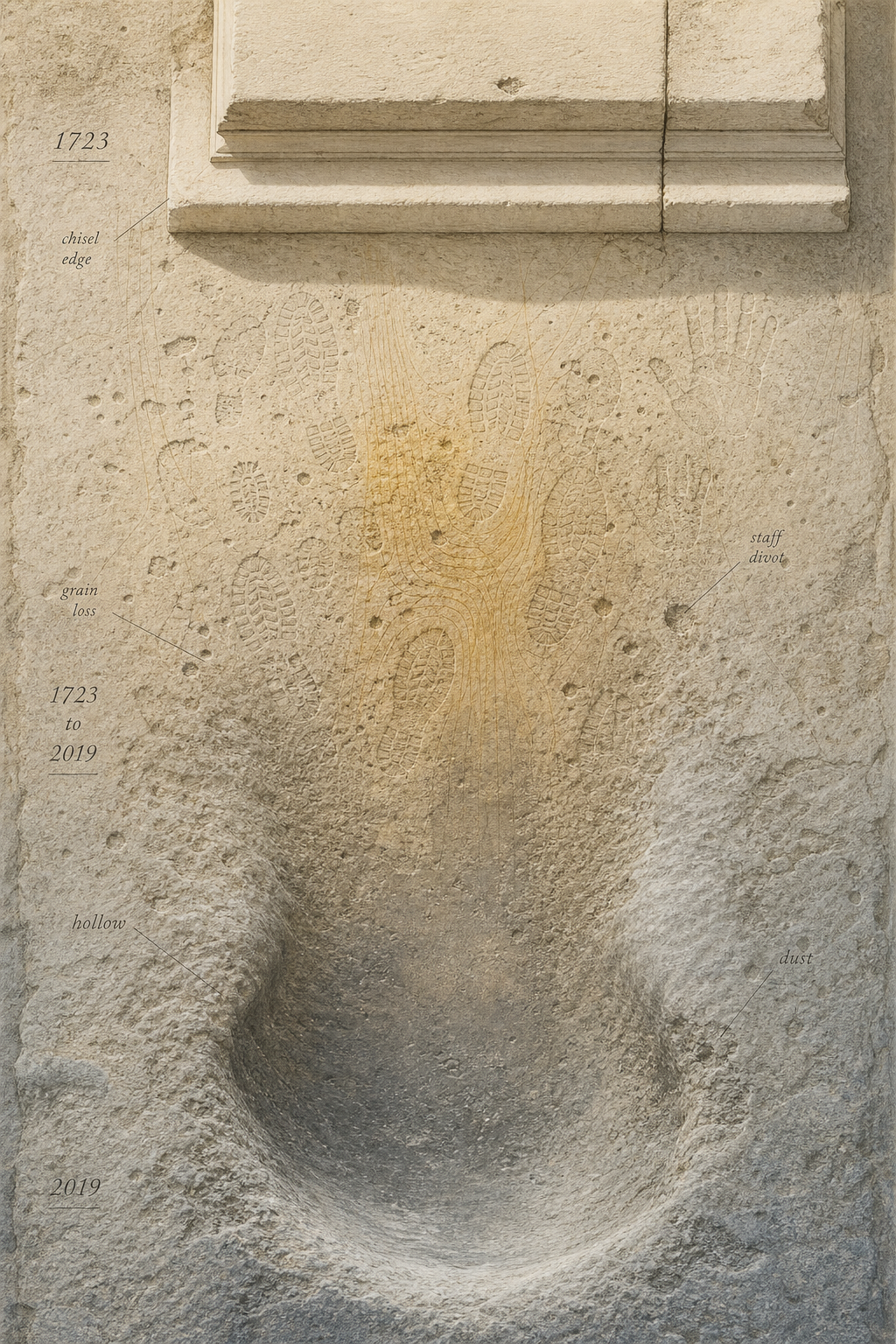
One stone threshold shown in two dated states, the earlier tool-marked surface above giving way to the later worn hollow below.

World Memory · Station S52 · material-memory investigation

What worethe stone?

One threshold, two dated views — c. 1723 and c. 2019. Between them, nothing that happened once. Only passage, and passage, and passage.

Follow the surface down
the low point, where the tooling has gone

view dated c. 1723 · the surface, still whole

The chisel's rhythm is still legible, edge to edge.

The arris holds a line straight enough to rest a rule against — sharp enough, the record says, to catch a fingernail.edge · north jamb

No path across it yet. The bedding joint reads even; dust lies where dust falls.dust · undisturbed

Nothing here happened once.

A shoulder against the jamb, going in sideways with something held.touch path · left of centre

The same two feet, ten thousand mornings, landing in almost the same place.footfall · line of entry

Fingers to the same corner — for balance, or for luck; the stone cannot tell them apart.polish · corner

A bucket set down, and set down again. Boots wet from the yard, carrying grit in.abrasion · grit as tool

still original here — tool facets intact

the grain begins to soften

tooling absent · the low point

polish, where hands rest

trace the grooveMove down the stone with a finger or the cursor. The cut deepens under you and the comparison marks surface; lift away and the surface returns.

the later form

The same stone, swept between its dated states.

Drag through and the hollow arrives — not as a cut, but as an absence. Where the wear is deepest, the earlier tooling has no trace left to compare against.

The threshold as recorded in the later view, its centre hollowed and polished.
The same threshold drawn back toward its earlier, tool-marked state.
c. 1723 c. 2019

What the stone shows

  • In the earlier view the surface reads flat and tool-marked from arris to arris.
  • In the later view a shallow concave hollow follows the line of entry, and the tooling inside it has been erased.
  • The polish and the loss of tooling coincide with the places a body must touch in order to pass.
  • Lichen and settled dust are absent along that same line, and present either side of it.

What stays inference

  • That the wear is cumulative — many small contacts, no single event. The evidence supports accumulation; it does not isolate footfall from hand contact, sweeping, weather or repair.
  • Both views are approximately dated and were never made to be measured against one another.
  • No depth was ever recorded here. Nothing on this page should be read as a rate.
  • Any single cause named for this hollow would be a story added to the stone, not read from it.

The stone remembers pressure, not intention.It kept the sum of the passages and lost the name of every one of them.

stone-rubbing field tag — evidence & limits
subject
One threshold surface; a single continuous stone, compared with itself.
views
Earlier view, dated c. 1723. Later view, dated c. 2019. Both dates approximate.
method
Visual comparison of two dated views of the same surface: tooling legibility, arris profile, polish distribution, dust and lichen coverage.
claim
Cumulative wear along the line of human passage. No single mechanism is asserted.

sources

No source addresses were supplied to this station, so none are linked here — inventing one would be worse than leaving it blank. The two dated views are cited as: earlier view of the threshold, c. 1723, and later view of the same threshold, c. 2019.

explicit limits

  • No measurement: depth, area and volume of loss are unrecorded.
  • No control surface from the same stone was documented alongside either view.
  • Illustration only: the earlier state on this page is drawn back from the earlier view — it is a reconstruction, not a second photograph.
  • Attribution to footfall alone is unsupported; weather, cleaning and later dressing of the stone cannot be excluded.