I. The Youngest Vision
There is a particular quality to art made by a child who has not yet been taught what art is supposed to look like. Linda X, eleven years old, does not yet know that she is doing something remarkable. That unknowing is precisely what makes her work remarkable.
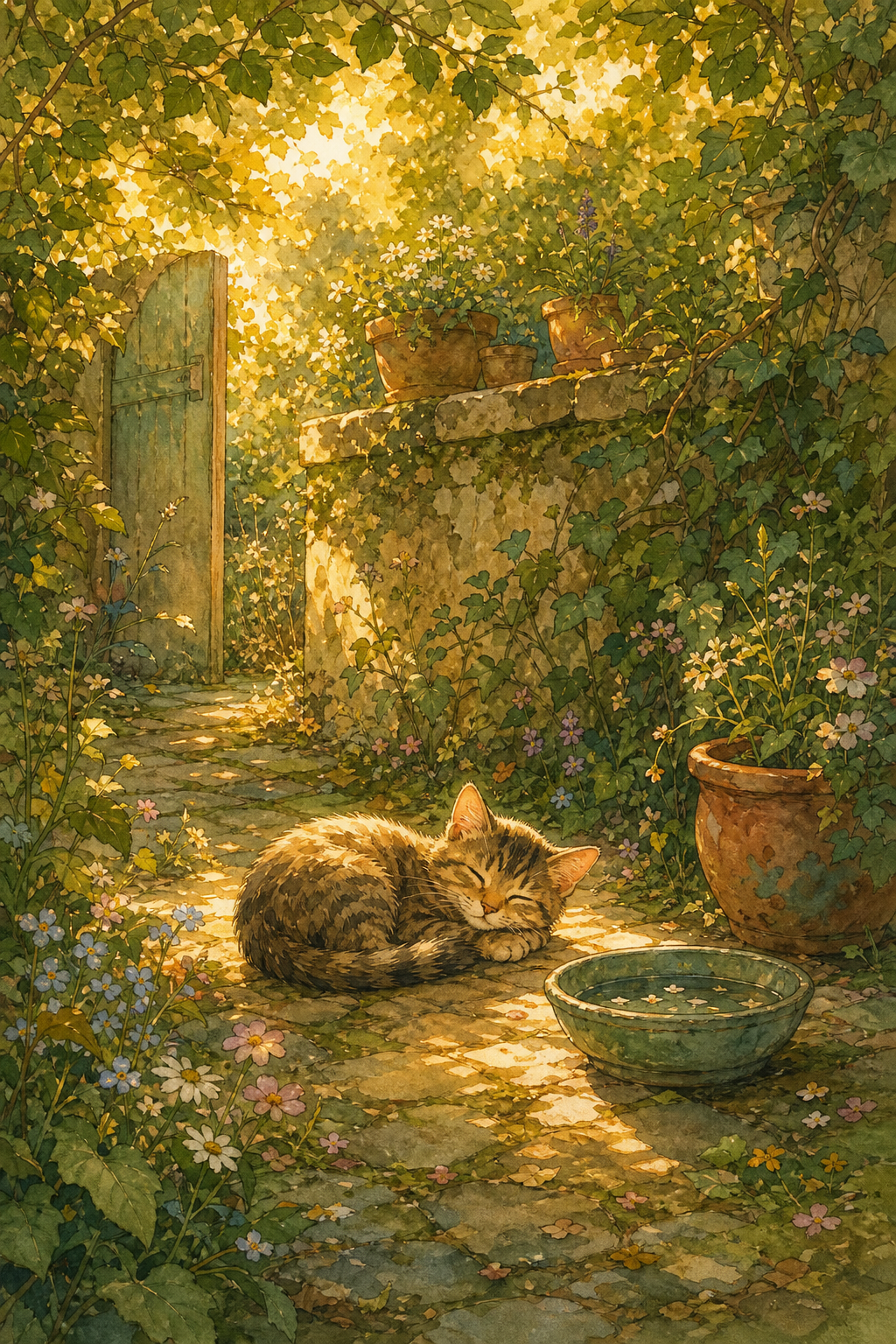
Her subject — a cat in a garden — is ancient in the canon of art. It appears in Egyptian murals, Japanese woodblock prints, French lithographs and mid-century American illustration. Yet in Linda's hand, it is entirely new, because what she is drawing is not "a cat." She is drawing this cat — the one that came, stayed, had kittens, and eventually left, as living things do.
II. What Three Masters Saw
Théophile-Alexandre Steinlen spent a lifetime drawing cats with the devotion of a portraitist. Where other artists placed cats in scenes, Steinlen made the cat the scene itself — studying posture, gesture, the particular way fur describes a mood. His insight: the body of a cat is a complete emotional statement.
"Drawing is the honesty of art. There is no possibility of cheating."
Henri Matisse, working in his final years with scissors and paper, made art of radical simplicity. He understood that a line does not gain authority from complexity — it gains authority from confidence. When we look at Linda's drawing, we see that same confidence: a mark that does not apologize or revise. Matisse would have called it courage.
Beatrix Potter brought something else: the sacred habit of observation. She sketched the same rabbit, the same hedgehog, dozens of times — not for practice, but for understanding. Linda, without knowing it, has done the same. She has watched these cats for months. She knows where they sleep. She knows what makes them feel safe. That knowledge is in every line.
III. The Garden as Subject
J&H Garden is not a setting. It is a character. In Linda's artistic world, the garden is the protagonist of an ongoing story: a place that offers food, water, shelter from rain, warmth from sun, and the particular kind of safety that allows a cat to give birth and nurse her young. That is not landscape painting. That is moral art.
The great environmental artists of the twentieth century — from Andy Goldsworthy to Georgia O'Keeffe — understood that a specific place, observed with love, becomes a universal statement. J&H Garden is Linda's O'Keeffe desert, her Monet pond: a bounded world that contains everything.
IV. HEAL as a Title
The word Linda has chosen — HEAL — is not accidental. It describes what the garden does for the cats: offers refuge. But it also describes what art does for its maker: builds a world where tenderness is possible, where attention is rewarded, where a small creature is taken seriously. To make art is to heal one's perception of the world, making it richer, more detailed, more full of grace.
Linda X is eleven. She is also, already, one of those rare people who make space — in a garden, in a drawing, in a title — for the living things that need it most. That is a kind of mastery no academy can teach.