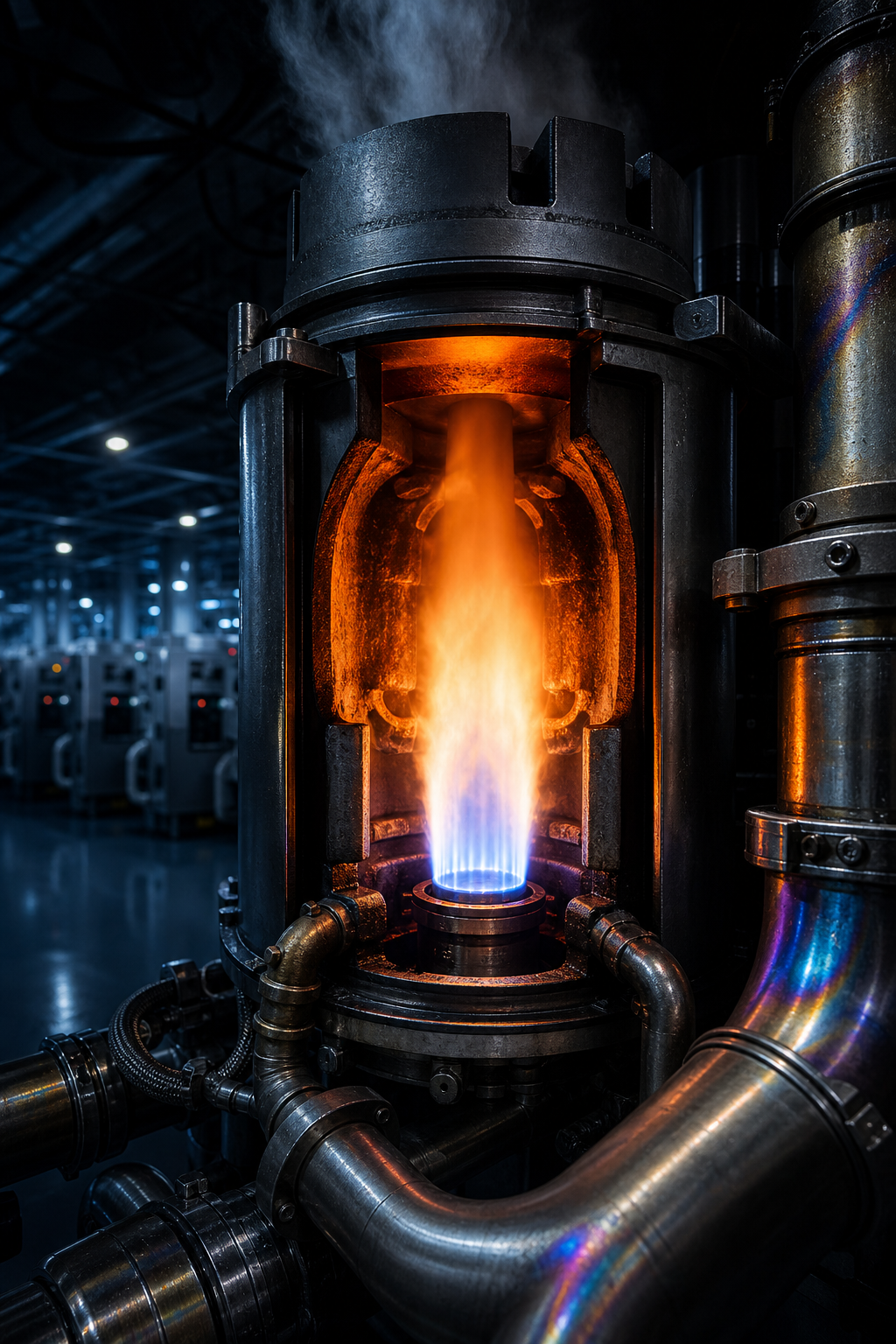
Industrial point-of-use abatement — molten combustion chemistry within cold steel fab exhaust systems

IMPACT BRIEF — F-GAS ABATEMENT

The coverage
gap no one
is counting

Point-of-use abatement works. The DRE is proven. The IP is owned. What remains is a financing and compliance question — and the right buyer has leverage to ask it.

TRL 8–9 CF₄ · C₂F₆ · NF₃ Semiconductor & Display Supply Chain Compliance
A new leading-edge etch tool shipped without abatement attached is the exception — not the rule.

Point-of-use (POU) abatement bolts a burn box or wet scrubber directly onto the exhaust of each etch or clean chamber, destroying PFCs and NF₃ before they ever reach the house scrubber. Vendor-claimed Destruction and Removal Efficiency (DRE) sits above 95%, with combustion-based units reaching ≥98% for CF₄ and C₂F₆ — the two molecules most resistant to thermal cracking.

The core IP is already consolidated: Linde (via Edwards/BOC lineage), Air Liquide, and 3M (Novec wet-scrubbing chemistry) own the critical positions. This is not an R&D bet. It is a deployment and coverage problem.

The open structural issue is who writes the check. Co-funding between fab and gas supplier is a natural structure — the supplier already owns delivery infrastructure and is simply extending it into destruction. That reframes the conversation from "invest in R&D" to "negotiate the retrofit and amortization schedule."

~50–60% Estimated current global POU coverage

Leading-edge logic fabs (TSMC, Samsung, Intel) approach near-full coverage on new chambers. Legacy, display, and trailing-edge fabs lag significantly. Global weighted average estimated at 50–60% of installed etch/clean capacity.

~110–160 Mt Semiconductor F-gas CO₂-eq annually (global)

The semiconductor sector emits roughly 110–160 Mt CO₂-eq per year from fluorinated gases (PFC process emissions), per IPCC AR6 and EPA/USEPA estimates. This includes CF₄, C₂F₆, C₃F₈, NF₃, and SF₆ from etch, clean, and CVD chamber purging.

30–60 Mt Abatable gap at 95% coverage & 95% DRE

Raising coverage from ~55% to 95% of installed chambers — and assuming 95% DRE — implies an additional reduction of 30–60 Mt CO₂-eq per year. The range reflects uncertainty in legacy-fab gas consumption data and NF₃ remote-clean prevalence.

Leading-edge logic (TSMC, Samsung, Intel) ≥85%
Memory (DRAM/NAND — SK Hynix, Micron, Kioxia) ~65–75%
Display (LCD/OLED — BOE, LG Display, Samsung Display) ~30–50%
Trailing-edge & compound semiconductor fabs ~15–35%
Scenario Coverage target DRE assumed Additional CO₂-eq reduction Note
Conservative 70% of installed chambers 90% ~12–18 Mt/yr Legacy fabs retrofit only new-build chambers; display sector unchanged
Moderate 80% of installed chambers 95% ~22–35 Mt/yr Memory sector full retrofit; display sector partial; supply-chain pressure from Tier-1 brands
Ambitious 95% of installed chambers 95–98% ~40–65 Mt/yr Regulatory mandate + brand compliance check drives universal retrofit within 5 years

Sources: EPA 2023, IPCC AR6 WG3 Ch.11, SEMI ESH Committee, SIA ESG Reports, IEA Semiconductor Energy Report 2023. Estimates carry ±30–40% uncertainty due to incomplete fab-level disclosure.

Does every chamber in your etch and clean lines have a point-of-use abatement unit installed and operating — and if not, what is your retrofit plan and timeline?

This is a compliance check, not a technology question. A brand asking this of its semiconductor and display suppliers signals that F-gas destruction has moved from voluntary best-practice to a supply-chain expectation — just as conflict minerals and water intensity disclosures did before it.

Who asks it

Tier-1 brand companies purchasing chips, displays, and modules — Apple, Dell, HP, Microsoft, Sony, Samsung Electronics (device side) — via supplier codes of conduct and ESG scorecards.

Who answers it

Semiconductor and display fabs — foundries, IDMs, and display panel makers — as direct suppliers or sub-tier suppliers. TSMC, Samsung Foundry, SMIC, BOE, LG Display are priority targets.

Why it works

Unlike asking fabs to invent a solution, this question asks them to deploy what already exists. The technology is TRL 8–9. The equipment is commercially available. The barrier is purely financial and contractual.

The financing angle

Co-funding with the gas supplier (Linde, Air Liquide) is natural: they own delivery infrastructure and benefit from regulated gas destruction as a service offering. Amortization over 5–7 years is feasible against avoided carbon costs under emerging carbon pricing regimes.

Multiple regulatory and voluntary frameworks either require, incentivize, or create reputational pressure for POU abatement deployment. The coverage question sits at the intersection of mandatory emissions reporting, procurement standards, and sector-specific guidelines.

Mandatory

US EPA PFC Agreements & GHGRP (40 CFR Part 98, Subpart I)

US fabs must report PFC emissions annually under the Greenhouse Gas Reporting Program. The EPA's 1996 voluntary PFC reduction agreements with SIA members established the abatement baseline; GHGRP now mandates disclosure, creating an audit trail that reveals coverage gaps.

epa.gov → Subpart I Electronics
Mandatory (EU)

EU F-Gas Regulation (EU) 517/2014 & revised 2024/573

The revised EU F-Gas Regulation (adopted 2024) tightens phase-down schedules for HFCs and strengthens controls on PFCs used in electronics. While etch-gas exemptions remain, the regulatory direction is clear: destruction obligations will tighten. Applies to fabs operating within or exporting to the EU.

eur-lex.europa.eu → Regulation 2024/573
Mandatory (Korea/Japan)

Korea GHG ETS & Japan Act on Rational Use of Energy

Korea's Emissions Trading Scheme covers semiconductor fabs directly; Samsung and SK Hynix must surrender allowances for PFC emissions. Japan's energy/GHG laws similarly require fab-level disclosure. Both create direct financial pressure to maximize abatement coverage.

ets.or.kr → Korea ETS
Voluntary / Influential

EPEAT 2.0 — IEEE 1680.1-2018 & emerging criteria

EPEAT's Product Category Rules for servers, PCs, and displays are beginning to include Scope 3 manufacturing emissions criteria. EPEAT 2.0 development (GEC facilitated) includes supply-chain GHG disclosure requirements where PFC reduction — including abatement coverage — is expected to feature as a scored criterion.

globalelectronicscouncil.org → EPEAT
Voluntary / Sector

SEMI S23 — Guide for Conservation of Energy, Utilities and Materials Used by Semiconductor Manufacturing Equipment

SEMI S23 is the primary equipment-level standard that addresses energy and process chemical use, including abatement system specifications. SEMI's ESH Committee also publishes guidance on PFC emission reduction as part of the SEMI Environmental Health & Safety standards suite.

semi.org → SEMI S23
Voluntary / Alliance

World Semiconductor Council (WSC) PFC Reduction Goals

The WSC — representing semiconductor associations from US, EU, Japan, Korea, Taiwan, and China — has committed to sector-wide PFC emission intensity reduction targets. The 2020 goal was a 30% normalized reduction from 2010 baseline. Abatement deployment is the primary lever cited in WSC progress reports.

semiconductors.org → WSC PFC Statement
Emerging

CSRD / ESRS E1 — EU Corporate Sustainability Reporting Directive

From 2024–2026, large EU companies and their suppliers must disclose Scope 1–3 emissions under ESRS E1. Semiconductor fabs supplying EU-based OEMs will face Scope 3 disclosure pressure, requiring them to document PFC emission reduction measures including abatement coverage.

efrag.org → ESRS Standards
Emerging

SEC Climate Disclosure Rule (17 CFR Parts 210, 229, 249)

The SEC's finalized climate disclosure rules (March 2024, litigation pending) require Scope 1 and 2 emissions from large accelerated filers, with material Scope 3 disclosures. US-listed semiconductor companies would need to disclose PFC emission reduction strategies, creating demand for abatement documentation.

sec.gov → Climate Disclosure Final Rule
Voluntary / Procurement

Apple Supplier Code of Conduct & Clean Energy / Carbon Program

Apple's Supplier Clean Energy Program and supply chain carbon reduction commitments (targeting supply chain carbon neutrality by 2030) explicitly include process emissions. Apple's supplier assessment questionnaires increasingly probe F-gas management, making POU abatement coverage a procurement-relevant metric.

apple.com → Supplier Code PDF
  1. US EPA — GHGRP Subpart I: Electronics Manufacturing Annual PFC emission reporting requirements for semiconductor fabs under 40 CFR Part 98.
    https://www.epa.gov/ghgreporting/ghg-reporting-program-subpart-i-electronics-manufacturing
  2. US EPA — Reducing PFC Emissions from Semiconductor Manufacturing (2008 Industry-EPA Agreement) Historical and current voluntary reduction commitments; covers abatement technology options including POU systems.
    https://www.epa.gov/hwgenerators/reducing-perfluorocompound-pfc-emissions-semiconductor-manufacturing
  3. IPCC AR6 Working Group III — Chapter 11: Industry (2022) Estimates of industrial fluorinated gas emissions including semiconductor sector; mitigation potential of abatement technologies.
    https://www.ipcc.ch/report/ar6/wg3/chapter/chapter-11/
  4. EU F-Gas Regulation 2024/573 (Official Journal) Revised regulation tightening F-gas phase-down and destruction requirements across the EU; entered into force March 2024.
    https://eur-lex.europa.eu/legal-content/EN/TXT/?uri=CELEX:32024R0573
  5. World Semiconductor Council — Joint Statement on PFC Emissions Reductions WSC cross-regional commitments to PFC reduction; abatement coverage cited as primary mechanism.
    https://www.semiconductors.org/wsc-joint-statement-pfcs/
  6. SEMI S23 — Guide for Conservation of Energy, Utilities and Materials Used by Semiconductor Manufacturing Equipment Equipment-level standard covering abatement system performance and integration requirements.
    https://www.semi.org/en/Standards/P044831
  7. Global Electronics Council — EPEAT Program & Product Category Rules EPEAT 2.0 development process including emerging supply-chain GHG criteria for IT products.
    https://globalelectronicscouncil.org/programs/epeat/
  8. IEA — The Role of Critical Minerals in Clean Energy Transitions / Semiconductor Energy Report (2023) IEA analysis of semiconductor manufacturing energy and emissions intensity including F-gas abatement economics.
    https://www.iea.org/reports/semiconductors-and-the-clean-energy-transition
  9. EFRAG — ESRS E1 Climate Standard (European Sustainability Reporting Standards) Scope 1–3 disclosure requirements affecting semiconductor supply chains under EU CSRD from 2024.
    https://www.efrag.org/lab6
  10. SEC — The Enhancement and Standardization of Climate-Related Disclosures (Final Rule, March 2024) US climate disclosure rules requiring material Scope 3 emissions; relevant to US-listed semiconductor companies.
    https://www.sec.gov/rules/final/2024/33-11275.pdf
  11. TSMC — 2023 Sustainability Report (PFC Emission Reduction Section) TSMC discloses PFC abatement coverage, DRE achieved, and reduction vs. baseline; primary industry reference for leading-edge fab data.
    https://esg.tsmc.com/en/update/sustainabilityReport/report.html
  12. Samsung Electronics — 2023 Sustainability Report (Semiconductor GHG Management) Samsung device + foundry PFC disclosure; covers abatement coverage progress and NF₃ remote-clean vs. POU abatement trade-offs.
    https://www.samsung.com/global/sustainability/media/pdf/Samsung_Sustainability_Report_2023_ENG.pdf
  13. Apple — 2023 Environmental Progress Report (Supplier Emissions) Documents Apple's Scope 3 supplier engagement on carbon including process gas emissions from semiconductor manufacturing suppliers.
    https://www.apple.com/environment/pdf/Apple_Environmental_Progress_Report_2023.pdf
  14. Linde / Edwards — Point-of-Use Abatement Technology Overview Vendor technical documentation on burn-box and wet-scrubber DRE performance for CF₄, C₂F₆, and NF₃.
    https://www.edwardsvacuum.com/en-gb/products/abatement
  15. Korea Emissions Trading Scheme — Official Portal (K-ETS) Korea's cap-and-trade system covering semiconductor sector PFC emissions; major financial driver for abatement investment in Korean fabs.
    https://www.ets.or.kr/eng/index.do