Quảng Ninh Province · Vietnam · Tidal Zone
Quảng Ninh Province · Vietnam · Tidal Zone
Object of Study — Mangrove Coast
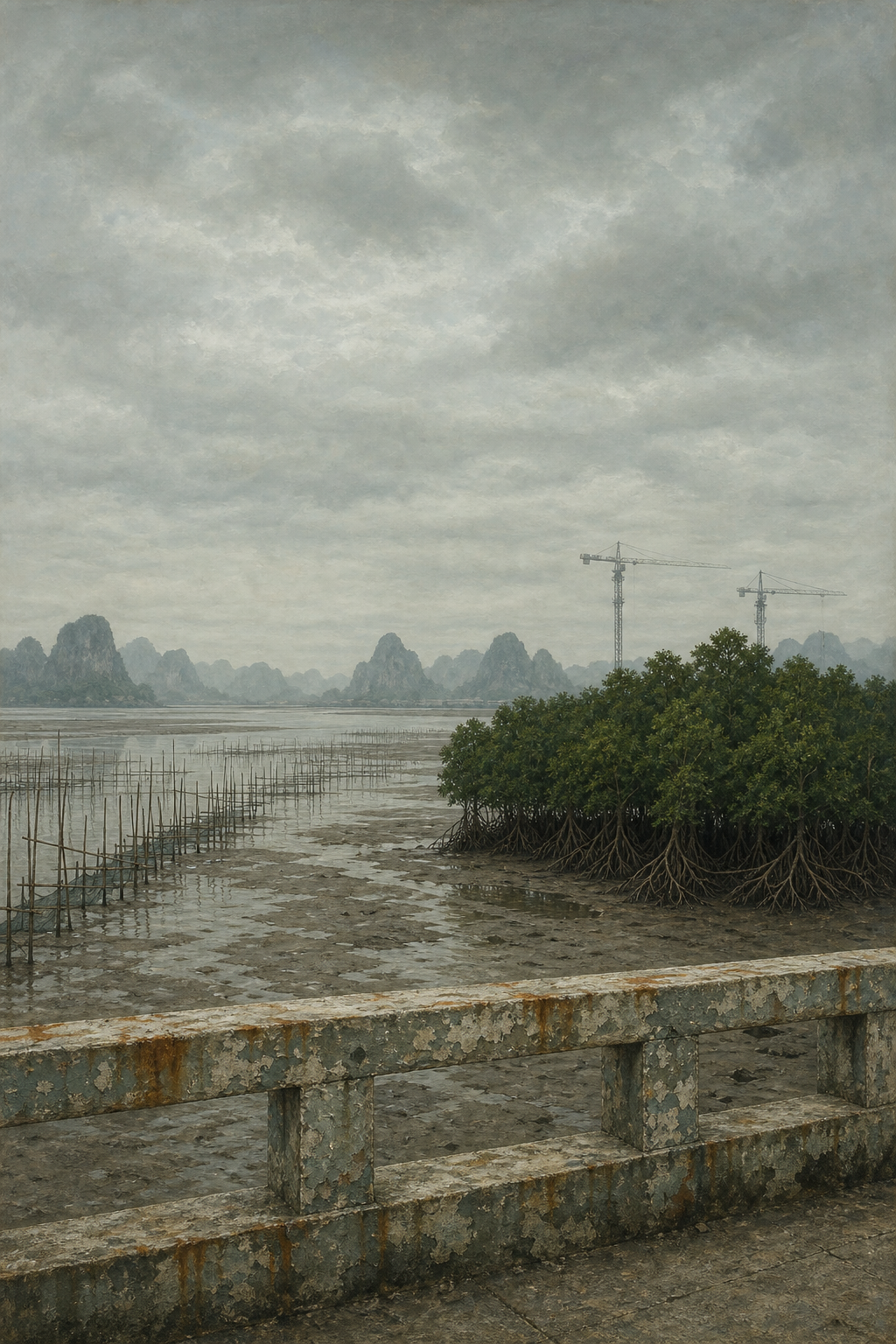
Along the coastal margins of Quảng Ninh Province, tidal flats that once breathed with mangrove roots now hold the silence of cleared ground. Aquaculture ponds, highway embankments, and construction corridors have steadily pressed into the intertidal zone — a transformation recorded in these photographs taken from a moving vehicle, through guardrails, in overcast light. That ordinariness is the point. The loss is not spectacular. It happens at highway speed.
"Restoration is not a return to the past — it is an argument, made in living roots, that the coast still belongs to the water."Field observation · Quảng Ninh
Field Photographs
Observations
Cleared intertidal zone. The first photograph shows fish-stake frameworks extending across a broad, silted flat. Where mangrove fringe once stabilised the shoreline and filtered runoff, open water and disturbed sediment now mark the boundary between land and sea.
Estuary under pressure. The second image, taken from a road bridge, shows a braided estuary channel flanked by bare embankments. The karst peaks dissolving into mist behind the water serve as a reminder that this landscape once supported extraordinary ecological density.
Infrastructure advance. Cranes and unfinished bridge spans push into the treeline. Economic development in Quảng Ninh has accelerated since the early 2000s. Each new crossing and embankment intersects hydrological connections that mangrove communities depend on for seed dispersal and tidal exchange.
Why restoration matters. Mangroves store carbon at rates three to five times greater than terrestrial forests per unit area. They buffer coastlines from storm surge, provide nursery habitat for commercially important fish, and sustain livelihoods that aquaculture alone cannot replace. Restoration, even in a landscape already crossed by highways, is not idealism — it is coastal infrastructure.
Despite the scale of economic development, the tidal flat retains the capacity for recovery. Mangrove restoration in degraded coastal zones of northern Vietnam has demonstrated measurable recovery within five to seven years of planting when tidal connectivity is preserved.