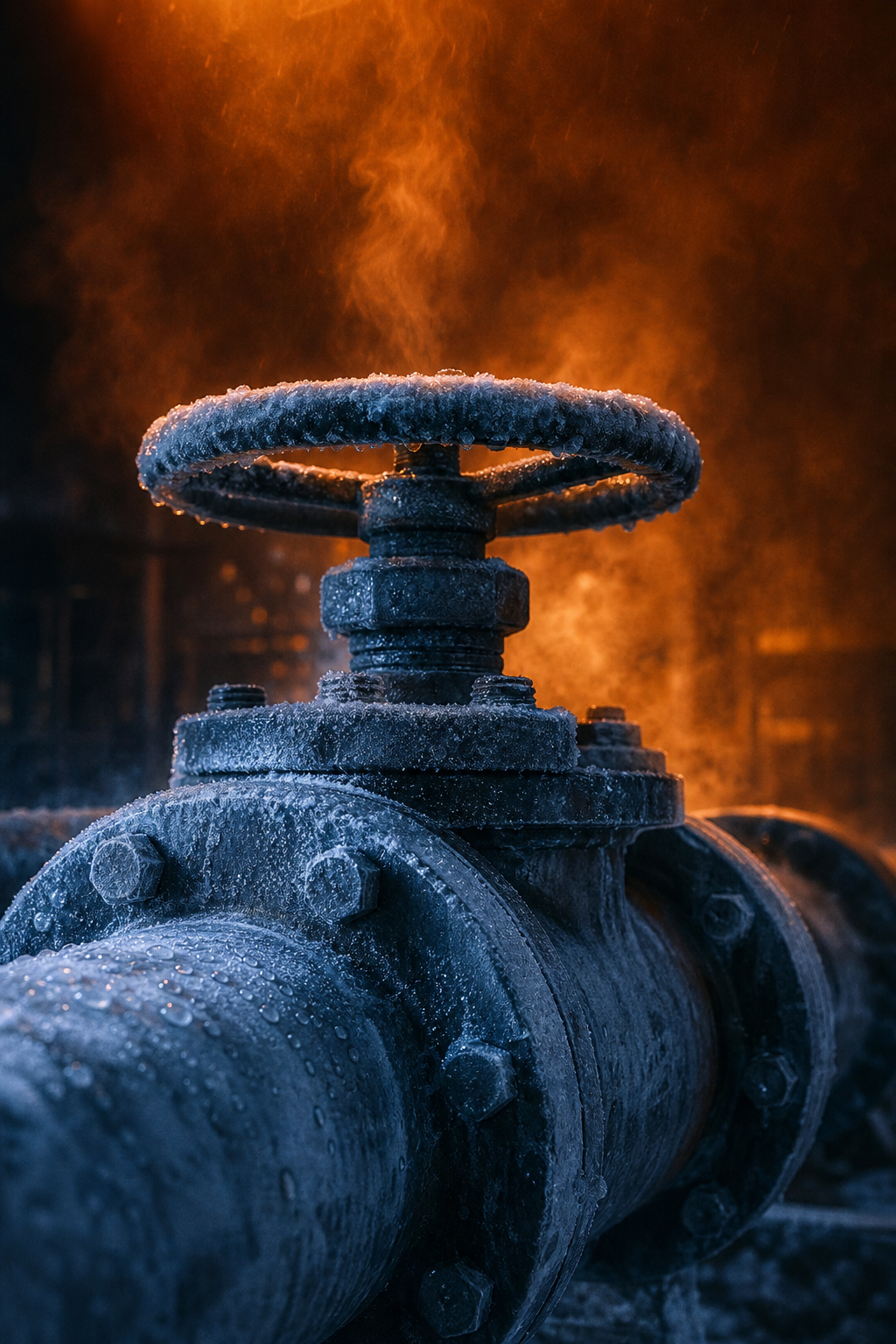
Field dossier · F-gases · traceability, AI & the missing serial number
One kilogram of switchgear insulation gas can do the climate work of two dozen tonnes of carbon dioxide. It leaves no smoke, no smell, no receipt. Conflict minerals got a chain of custody. Fluorinated gases never did — and AI is quietly expanding the pipeline that carries them.
Warming power of sulphur hexafluoride against CO₂ over a century. One kilogram leaked ≈ 24 tonnes of CO₂.
GWP-100, IPCC AR6, rounded
F-gases' share of global greenhouse emissions today — small, and the fastest-growing category of the set.
National inventories / UNEP synthesis
Warming avoided this century if the Kigali Amendment's HFC phase-down is delivered in full.
Montreal Protocol assessment literature
Data-centre electricity projected for 2030, from roughly 415 TWh in 2024 — the build-out that drags cooling and chip gases with it.
IEA energy-and-AI outlook, 2025
Mostly yes — but not in the way the headline suggests. AI does not burn refrigerant. It builds four things that carry fluorinated gases inside them. Here is the honest mechanism map.
Advanced logic and high-bandwidth memory — the physical substrate of AI — are etched and chamber-cleaned with NF₃, SF₆, c-C₄F₈ and CF₄. More layers and more process steps per wafer generally mean more fluorinated gas per chip. Fabs abate these at the tool, but destruction efficiency is often assumed from nameplate rather than continuously measured.
Every megawatt of AI capacity needs heat moved. Large chillers still hold substantial charges of HFCs and HFO blends — R-134a, R-513A, R-515B, R-1234ze. The emission is not the use, it's the leak rate over a twenty-year asset life plus whatever is vented at decommissioning. Almost nobody discloses either per site.
Two-phase immersion cooling depended on engineered fluorinated fluids. With 3M's announced exit from PFAS manufacturing, that supply route is closing faster than fully qualified replacements arrive. The industry's pivot toward single-phase and direct-to-chip water loops is partly a chemistry retreat, not only an efficiency choice.
New substations, new transformers, new interconnects for data-centre load. Medium- and high-voltage switchgear has historically been insulated with SF₆ — the most potent gas the industry uses, in assets with 30–40 year lives. Every SF₆ breaker installed for an AI campus in 2025 is a 2060 emission decision.
AI's dominant climate impact is still electricity, not fluorochemicals. And the shift toward direct-to-chip liquid cooling can lower refrigerant intensity per megawatt, not raise it. So the correct claim is narrower and sharper: AI is expanding the installed bank of F-gases and the fab process-gas volume, in exactly the two places where measurement is weakest. The risk is not a spike. It is quiet accumulation with no ledger.
Step one is not a new law. It is a serial number.
The traceability gap, in one line
The minerals analogy holds better than expected. Both involve a physical substance moving through many hands, where the harm happens far from the buyer and the paperwork is the only witness. What minerals built — OECD due-diligence guidance, smelter audit programmes, tagged bags from mine to smelter — F-gas has only in fragments.
Who drives it today: UNEP's Ozone Secretariat under the Montreal Protocol and Kigali Amendment sets the volume ceiling. The EU's F-gas Regulation 2024/573 and the US AIM Act run quota and allowance registries. Industry bodies and enforcement NGOs press on illegal trade. What is missing is the equivalent of a minerals audit programme — one owner of the chain of custody for a cylinder of gas. That seat is vacant.
Reconcile production, imports and quota. Know how much gas legally enters a market each year.
In force — EU quota registry, US EPA allowance systemA serialised, machine-readable identity per cylinder and per fill — the refrigerant equivalent of a tagged mineral bag. US rules have begun requiring cylinder tracking codes; EU reporting is digitising.
Starting — not interoperable across jurisdictionsProducer → distributor → contractor → the specific machine it was charged into. This is the frontier. Without it, quota is a number on a spreadsheet and illegal fill is invisible.
Missing almost everywhere — this is Step 1's real workCharge, every top-up, every leak test, and the mass actually recovered at end of life. A top-up is a confession of a leak; today it is rarely read as one.
Partly mandated in the EU for larger systems — seldom digital or auditableGlobal monitoring networks and inverse modelling can catch what the paperwork hides — the 2018 detection of unreported CFC-11 production proved the method works. It is scientifically mature and institutionally disconnected from compliance.
Proven science, no formal link to enforcementProcurement conditions, mandatory disclosure of site charge and leak rate, customs screening, and a real price on a leak. Data without consequence changes nothing.
Not yet — the missing teethNine actors can move this. Read the third column as the honest answer to "does anyone have attention on this" — and the fourth as what needs a seat at the table.
| Actor | The lever they actually hold | Accountable today? | The gap that needs a seat |
|---|---|---|---|
| Fluorochemical producers | Molecule design, quota compliance, HFC-23 by-product destruction | Partly | No cylinder-level custody to the end user; by-product destruction largely self-reported |
| Equipment OEMs | Charge size, leak-tight design, refrigerant selection, service data | Weakly | No duty to publish expected lifetime leak rate or embedded GWP per unit |
| AI & cloud operators | Procurement specs, cooling architecture, fluid chemistry, site-level monitoring | Voluntary | No standard disclosure of refrigerant charge, leak rate or fluid type per data centre |
| Semiconductor fabs | Process-gas dose per wafer, point-of-use abatement, verified destruction | Partly | Abatement performance often modelled, not measured, tool by tool |
| Utilities & grid buyers | SF₆-free specification, retrofit, recovery at asset end of life | Emerging | No global rule; the installed SF₆ bank keeps growing where grids build fastest |
| Servicing & disposal trade | Where most emissions physically happen — recovery instead of venting | Largely informal | No verified recovery rate per job; economics still reward venting |
| Regulators & customs | Quota, import screening, illegal-trade enforcement | Yes, under-resourced | No unified digital import verification; illegal HFC flows persist |
| Standards & audit bodies | The definitions that make monitoring auditable | Partial | No chain-of-custody standard for refrigerant; carbon accounting misses embedded fab gases |
| Financiers & large buyers | Capital conditions, contract terms, procurement scoring | Almost absent | F-gas rarely appears in a transition plan or a purchase specification at all |
Scroll the table sideways →
Ask "what is the innovation status" and you get four different answers depending on how deep you dig. Each layer has its own physics, its own wall, and its own place where AI genuinely helps.
The core trick is deliberate weakness. Hydrofluoroolefins carry a carbon–carbon double bond that hydroxyl radicals attack within days or weeks, instead of the years a saturated HFC survives. Short atmospheric lifetime collapses global warming potential from thousands to single digits. R-1234yf sits near 4; R-1234ze below 1; propane 3; ammonia and CO₂ effectively at the floor.
But the same reactivity you bought creates the next problem. Many HFOs degrade into trifluoroacetic acid, which ends up in water and persists — squarely inside Europe's proposed restriction on PFAS as a class. So the low-GWP road and the PFAS road are, right now, heading toward each other. Nobody at the table has resolved that collision.
Often the bigger win is not a new fluid but a smaller one. CO₂ transcritical cycles with ejectors have moved from novelty to mainstream in commercial refrigeration. Propane systems work at charges of a few hundred grams with secondary loops keeping hydrocarbon out of occupied space. Ammonia still runs industrial scale better than anything synthetic. And in switchgear, vacuum interruption with clean dry air replaces SF₆ at effectively zero warming potential — commercially available at medium voltage today, harder and later at the highest voltages.
Then the unglamorous half: leak-tight joints, brazed instead of flared, instrumented circuits, and charge minimisation as a design KPI. Emissions are a plumbing outcome more than a chemistry one.
Elastocaloric, magnetocaloric and electrocaloric cooling move heat by straining, magnetising or polarising a solid instead of compressing a vapour. Thermoacoustic and adsorption cycles use sound and sorbents. Thermoelectrics already exist but sit far below vapour compression on efficiency.
Status, honestly: lab to early pilot. The walls are materials fatigue over millions of cycles, rare-earth dependence, heat-transfer at the interface, and cost per watt. These are 2035-and-beyond contributors, not a 2030 answer — which is precisely why the 2030 answer has to be governance.
Even a perfect new molecule does nothing about the gas already installed. The world's chillers, supermarket racks, air conditioners and switchgear hold a bank of fluorinated gas measured in gigatonnes of CO₂-equivalent, slowly leaking and eventually vented. Reclaim and reprocessing can displace virgin production. Thermal destruction can retire the worst of it. Fab abatement can stop the process gases at the tool.
This layer has the best cost-per-tonne in the whole field and the least ownership. It is not a technology problem. It is a custody problem — which loops straight back to Phase 03.
Anomaly detection on pressure, temperature, superheat and compressor power finds slow leaks between annual manual checks. Cheap, deployable now, and it converts an invisible loss into a work order.
Graph neural networks and active learning screen candidate fluids across GWP, atmospheric lifetime, flammability limits, toxicity endpoints and cycle performance jointly — turning years of sequential synthesis into a ranked shortlist worth making.
Automated synthesis and measurement iterating on blends, lubricant compatibility and stability — the slowest, least glamorous step in qualification, and the one most amenable to automation.
Learned recipe control to cut NF₃ and SF₆ dose per wafer, plus continuous verification that abatement is destroying what nameplate claims — replacing an assumption with a measurement.
Machine learning over in-situ and satellite concentration data to localise unreported emissions, giving Phase 05 the resolution to name a region rather than a hemisphere.
It cannot issue a serial number, staff a customs desk, or recover gas from a rooftop unit. The bottleneck in F-gas is governance and custody, not chemistry. Modelling faster will not fix an unowned chain.
Each of these is answerable with existing methods. None of them currently has an owner.
Who is liable for the bank? Gigatonnes of CO₂-equivalent already sit inside installed equipment. No jurisdiction assigns responsibility for retiring it.
Is the low-GWP road a PFAS dead end? If HFOs are restricted as a class mid-transition, what does the industry switch to — and who pays for the second rebuild?
Where is embedded F-gas in an AI server's footprint? Fab process gases sit in a supplier's Scope 1 and vanish from most buyers' accounting.
Is abatement measured or assumed? Destruction efficiency is frequently taken from equipment specification rather than continuous monitoring.
Who independently verifies by-product destruction? HFC-23 is created and destroyed at the same plants that report on it.
What is the true end-of-life recovery rate, market by market? Reported figures and atmospheric observations do not tell the same story.
Does liquid cooling reduce refrigerant demand or relocate it? Into chillers, dry coolers, heat-reuse heat pumps — the total charge per campus is rarely published.
Are immersion fluids retiring faster than replacements qualify? A supply exit without a validated substitute is a schedule risk, not just a chemistry one.
Do AI-driven grid build-outs lock in SF₆? Every high-voltage bay specified today decides emissions into the 2060s.
Is there a price on a leak anywhere? Until leaking costs more than recovering, the technician's incentive points the wrong way.
These are directional scenarios built from current policy structure and known gaps — not forecasts, and not modelled numbers. The bars below are qualitative pressure, not published data.
No new physics required. A serial number, a logbook, a recovery incentive, and someone whose job it is to own the chain. If you work on refrigerant, on fabs, on grid assets, or on data-centre cooling — you are already holding one of the nine levers in the table above.
Figures on this page are drawn from published reference material as of the time of writing — IPCC AR5/AR6 100-year global warming potentials, Montreal Protocol and Kigali Amendment assessment literature, the EU F-gas Regulation 2024/573, the US AIM Act rulemakings, and IEA outlooks on data-centre electricity. GWP values differ between IPCC assessment reports; always state which basis you are using. Regulatory status, ratification counts and corporate announcements change quickly. Nothing here is a live feed, and nothing here should be cited without checking the primary source. Where the answer is genuinely unknown, this page says so rather than filling the gap.