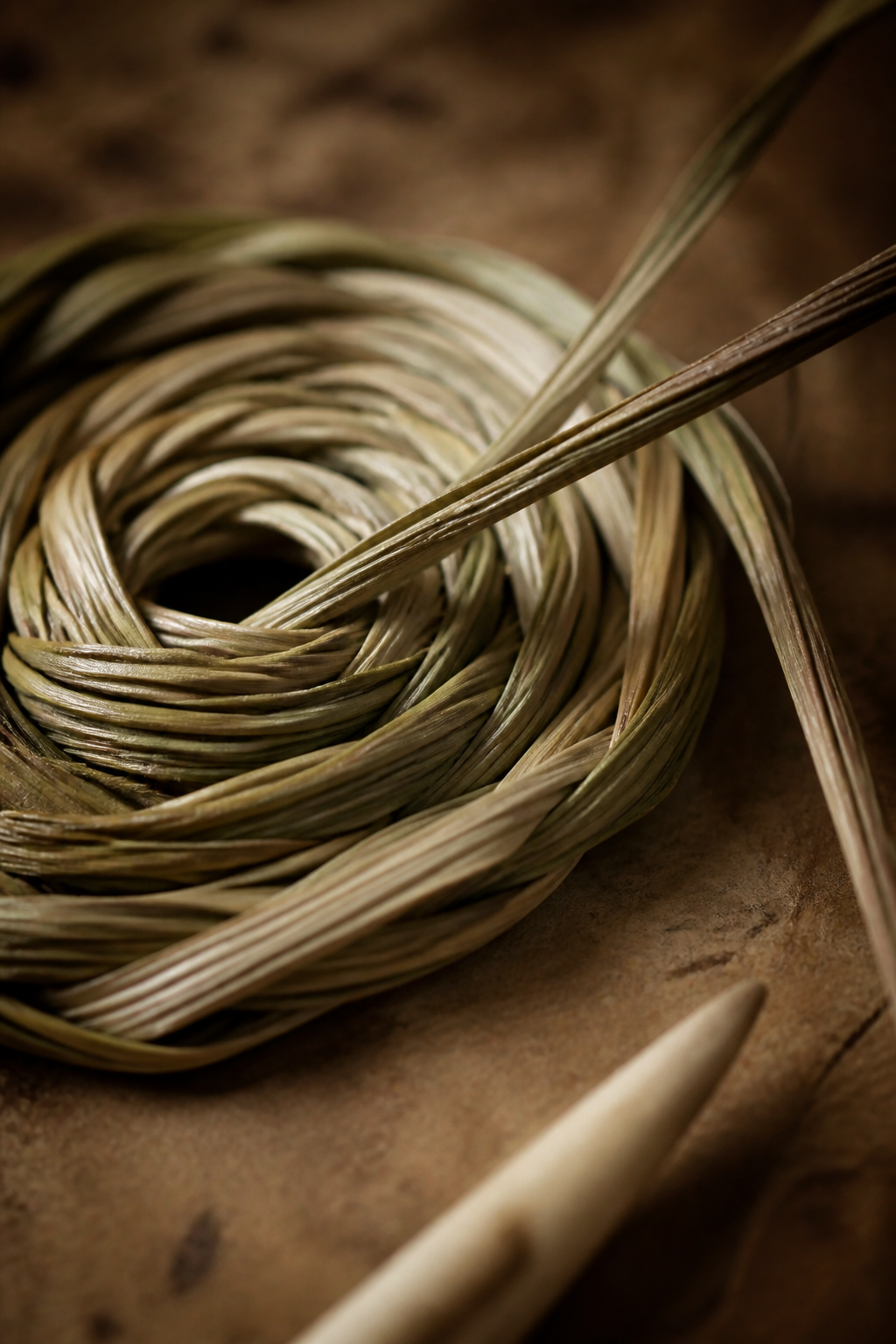
before it is anything else
A bundle of dried grass, bent once — and held while a split leaf is pulled through to keep the bend.
Present-day material study, generated for this page. Not a photograph of a person, a place, a basket, or any archive.
before it is anything else
A bundle of dried grass, bent once — and held while a split leaf is pulled through to keep the bend.
Present-day material study, generated for this page. Not a photograph of a person, a place, a basket, or any archive.
in the hand
Sweetgrass is soft while it is green and stubborn once it dries. A coil is that grass gathered into a bundle, curved, and sewn to the curve beneath it with a strip of palmetto pulled tight. The bend is not decoration. Everything above it inherits the tension you just chose.
Move the coil beside this text. Drag across it and it lays more fiber; drag left and the curve opens outward, drag right and it draws in. A tap sews a single join. Nothing resets.
where the material comes from
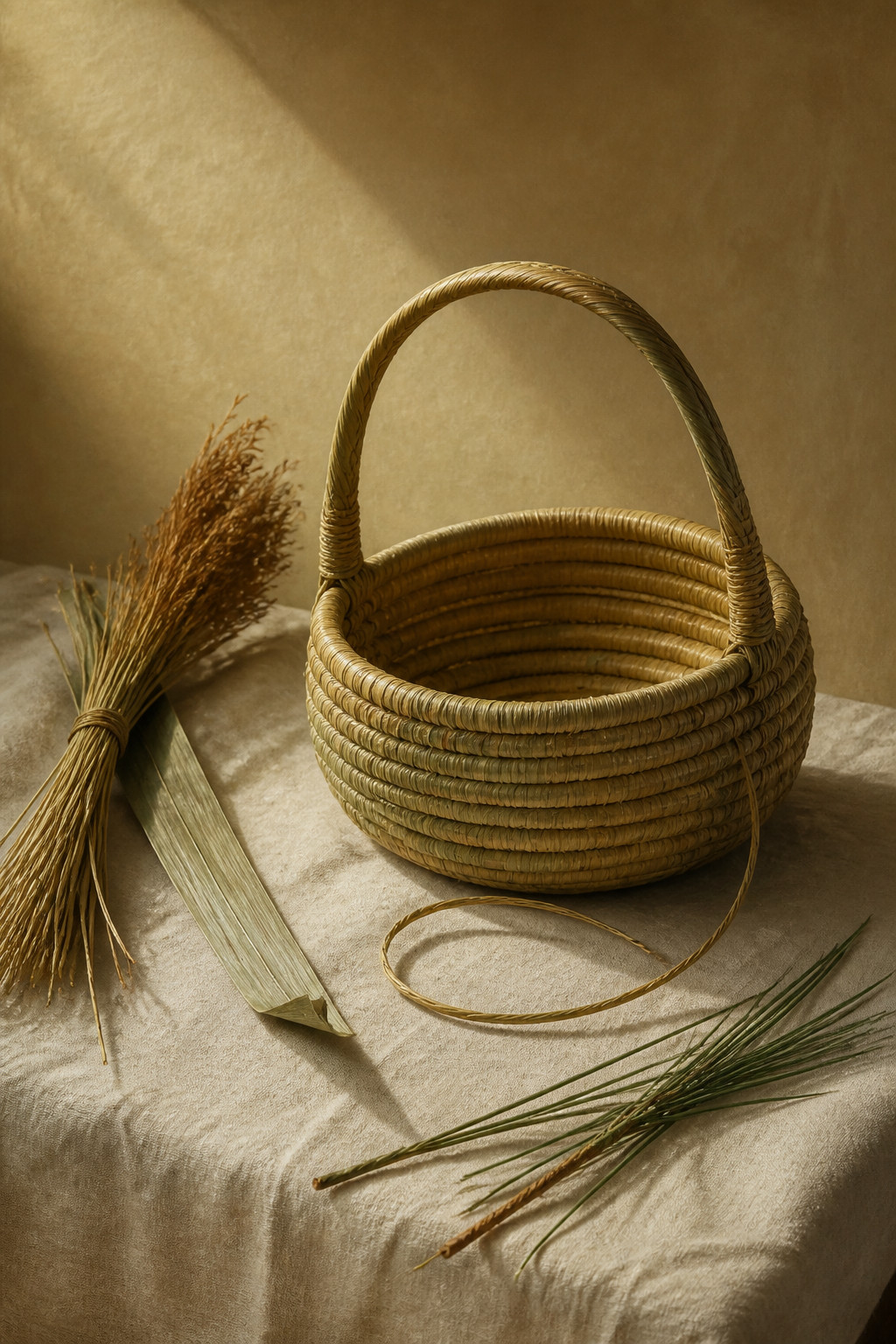
Sweetgrass grows behind dunes and along marsh edges in the South Carolina Lowcountry; bulrush stands in wetter ground; longleaf pine needles are gathered from under the trees; palmetto is cut and split for the binder that does the sewing. Gathering is skilled work — knowing where a stand is, when it is ready, how much to leave standing so it comes back.
documented Coastal development and private land have made sweetgrass harder to reach for Mount Pleasant makers; grass is now often gathered at a distance, or bought from others who gather it.
what happens before a stitch
The grass is dried and sorted; brittle blades are pulled out because they will snap in the curve. Pine needles are cleaned. Palmetto is stripped into narrow, even lengths — the binder has to be strong enough to pull without tearing and thin enough to pass through the row below. Only after that does anything look like a basket.
station interpretation Preparation is where the material teaches the hand what it will accept. The coil you are moving only bends the way it does because someone already decided which fibers stay.
how the rows hold each other
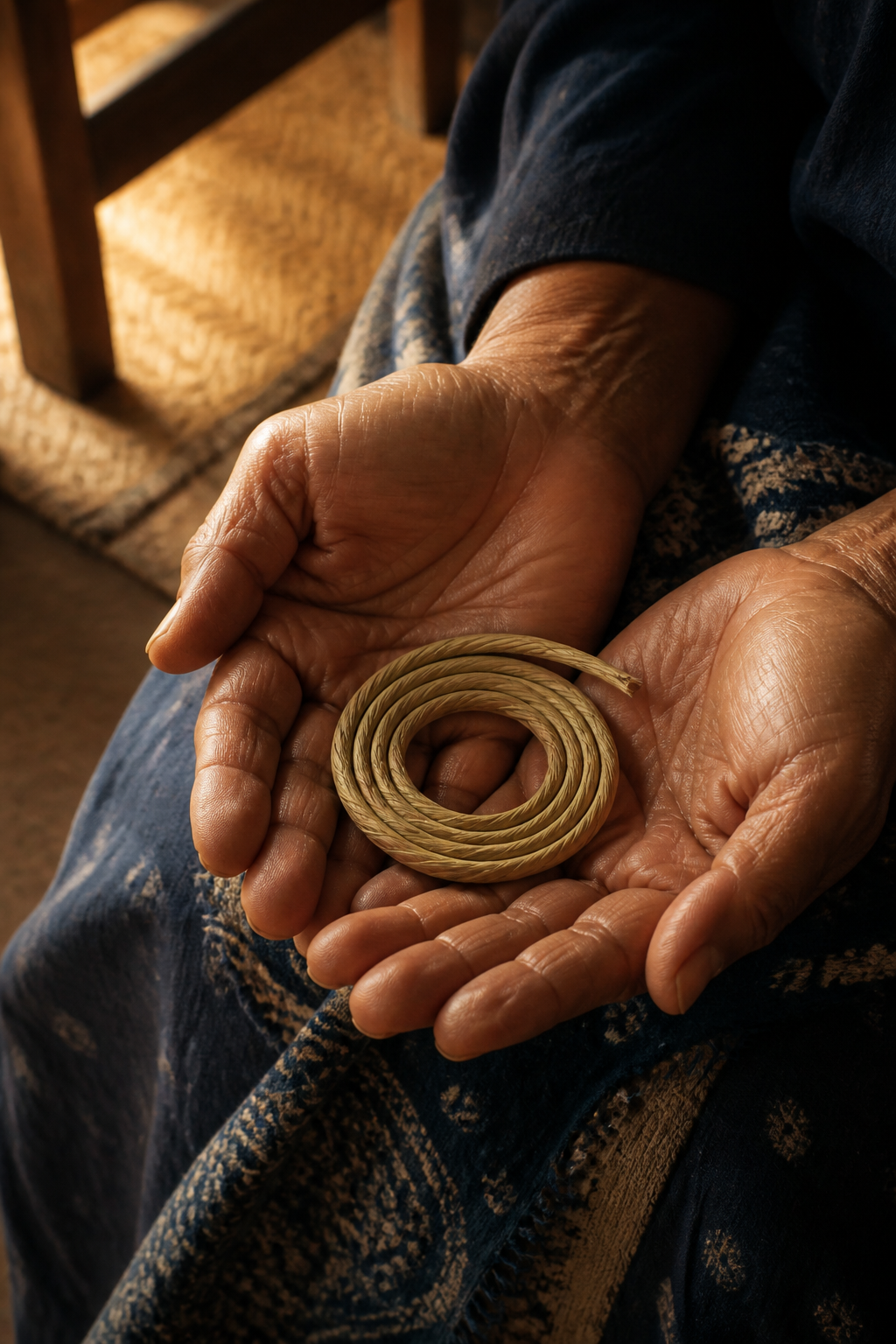
This is coiled sewn basketry: a bundle spiralled upward and stitched into the row beneath it, rather than woven over-and-under. In the Lowcountry it carries forward coiled basketry traditions from West and Central Africa, brought by enslaved people and worked here for generations — fanner baskets for winnowing rice, work baskets for the field and the house.
documented Makers commonly use a small tool — a filed spoon handle or a nail set in a handle — to open a space in the coil below so the binder can pass through. The join is what allows continuation: without it, the coil is only a curve.
documented Mary Jackson learned to sew baskets from her mother, beginning when she was four years old, with other family members teaching her as well. The knowledge moved by sitting close, watching hands, and repeating until the hands knew it.
station interpretation One maker's practice is not all Gullah Geechee basketry. This page follows one line of teaching, not a rule for everyone.

tension
Pull the binder a little tighter and the wall turns inward. Ease it and the row steps out. Nothing about the technique changed — only the hand's decision, repeated a few hundred times, until the decision has become a shape.
one maker
Mary Jackson, born 1945 in Mount Pleasant, South Carolina, sews in the technique she was taught as a small child and has taken its forms somewhere they had not been. Her titled works — among them Low Basket with Handle — are unmistakably hers: her proportions, her thinness of coil, her decisions about where a wall turns and how a handle meets the rim.
documented Jackson received a MacArthur Fellowship in 2008 and a National Heritage Fellowship from the National Endowment for the Arts in 2010. She was a founder of the Mt. Pleasant Sweetgrass Basketmakers Association. Her baskets are held in museum collections in the United States.
source-attributed interpretation Descriptions of her work as refined, sculptural, or formally inventive come from exhibition and press writing about it — that reading is not invented here, and it is not the whole account of her practice.
Innovation did not require leaving anything behind. The stitch in a new form is the stitch her mother put in her hands at four.
what a form is for
A fanner basket winnowed rice. A bread basket sat on a table. A low basket with a handle can be carried. The same coiled logic later stands in a gallery case and at a roadside stand where baskets are sold — held by collectors, by museums, by market communities, by families. None of those uses cancels the others out.
reconstruction Low Basket with Handle is not reproduced on this page. The coil you have been moving is an abstract present-day study of coil and tension only.
the coil closes
Your coil has turned in on itself and taken a handle. It is not her basket, and it is not anyone's tradition — it is only a record of the choices your hand made in the last few minutes, held by a structure that was worked out long before either of us.
That is the thing worth carrying away: one object can be entirely one artist's own work and still be full of other people's hands — the ones who gathered, the ones who prepared, the mother who sat beside a four-year-old, the makers still sewing now.