01space
Nothing was added.
The two actions have only been given room. What changed is not the unit; it is how long the unit is allowed to last.
In this tradition the smallest unit is not a short unit. It is a unit that can be dwelt inside.
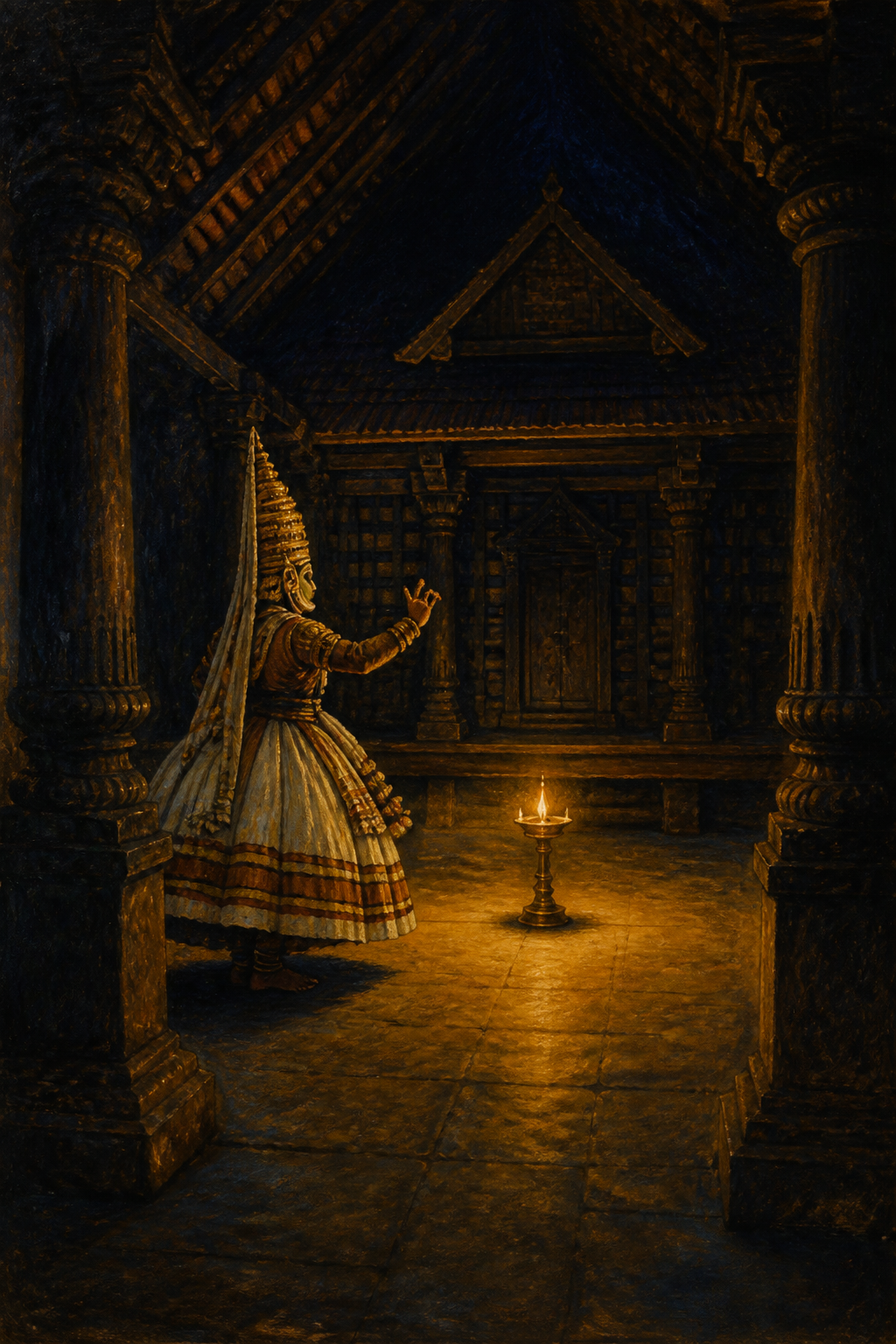
Abstract reconstruction written for this page. Not a verse, not a quotation, not an instruction from any manual or any staging.
Station voice Two actions, five words. Hold them and see whether they get shorter.
The order below is the order this station opened them. It is not an order that exists in practice, and it is not a syllabus. Each block is marked for what kind of claim it is.
01space
The two actions have only been given room. What changed is not the unit; it is how long the unit is allowed to last.
In this tradition the smallest unit is not a short unit. It is a unit that can be dwelt inside.
02eyes
Published descriptions of Kutiyattam training give sustained attention to the actor's eyes: eye technique is treated as a primary expressive resource, trained over years, not as ornament added to speech or gesture.
A glance can hold an action open long after the words for it have ended. That is the station's reading of why so little text can take so long.
03hand
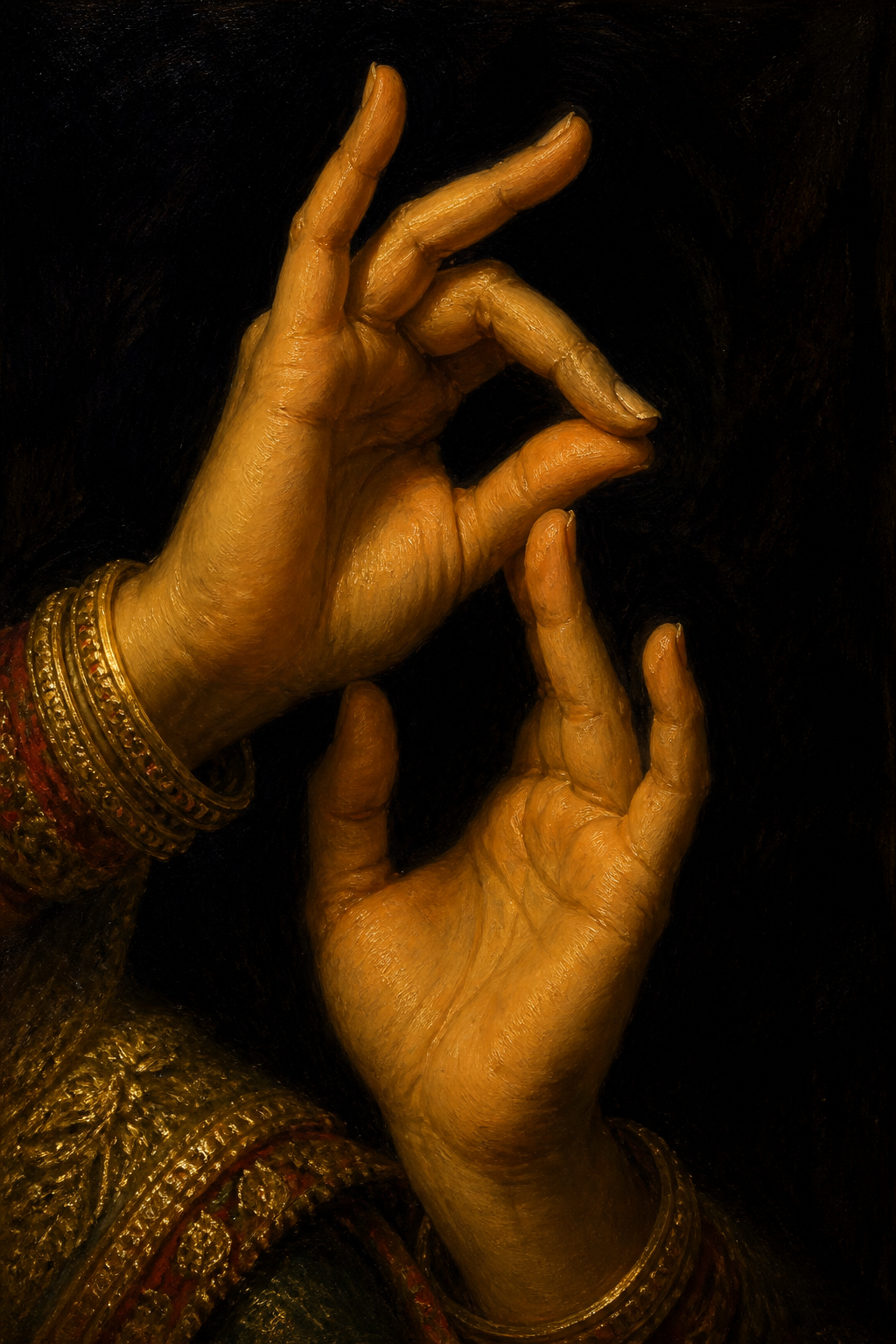
Hand gesture in Kerala performance traditions draws on a codified system. The Hastalakshanadeepika sets out twenty-four basic hand positions whose sense depends on combination, context, and the training of the person using them.
This page does not teach, name or translate them. A gesture separated from its context and its teacher is not knowledge; it is a shape.
04face
Facial expression is discussed in relation to rasa, elaborated in Sanskrit dramaturgical theory and in Kerala performance manuals. Scholarship on the form commonly describes rasa as something realised between performer and spectator across duration, rather than delivered in an instant.
If that is right, then length is not patience being asked of an audience. Length is the medium.
05pulse
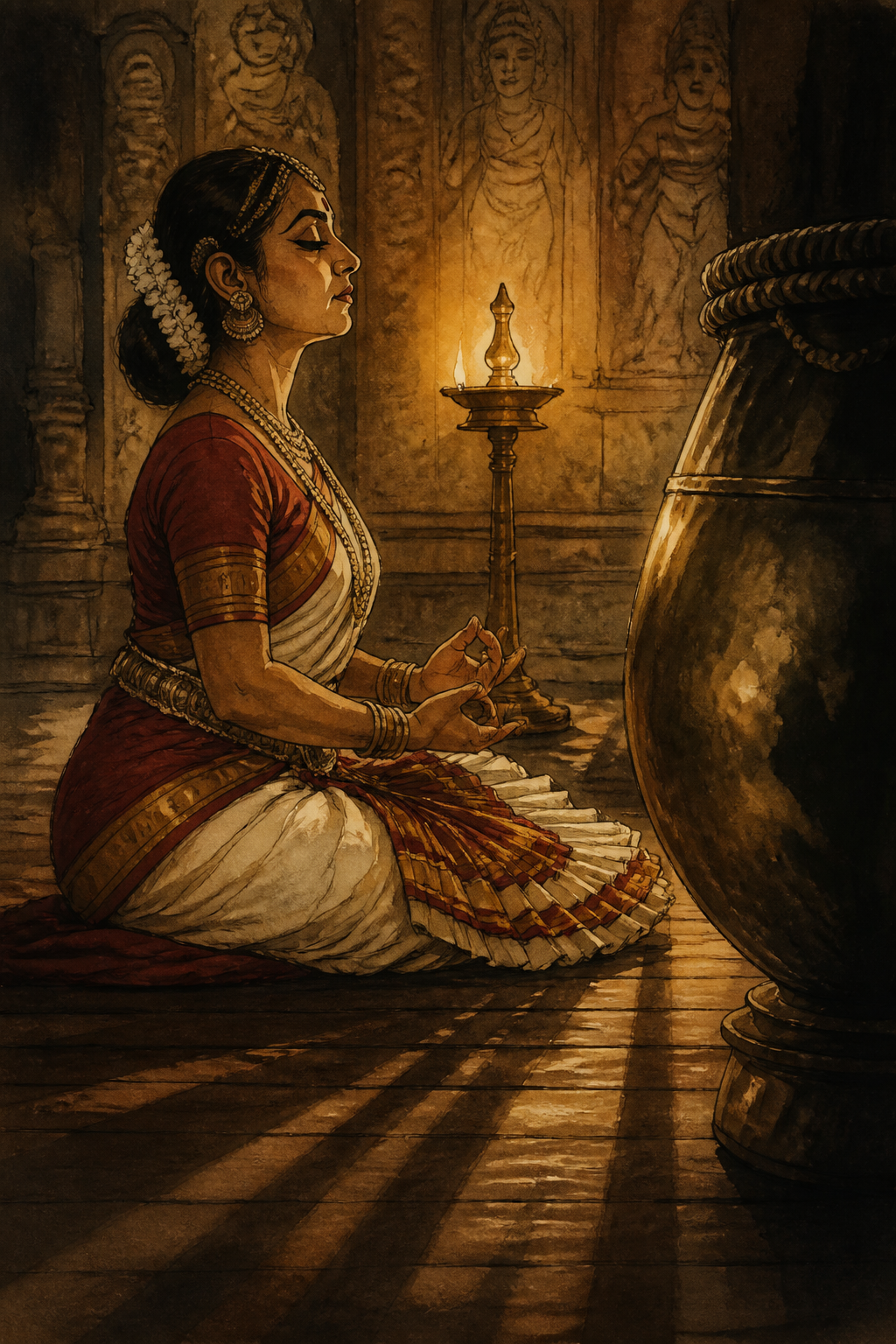
The mizhavu, a large copper drum, is the principal percussion of Kutiyattam and is traditionally played by men of the Nambiar community. The kuzhitalam cymbals are traditionally played by Nangiar women. These are distinct, inherited performing roles, not interchangeable positions in an ensemble.
The station's reading: percussion here does not accompany the action from outside. It is the actor's time, made audible.
06night
Staging is guided by written performance manuals — the Kramadipika for production and the Attaprakaram for acting — held, read and interpreted by trained teachers and performing families. Through nirvahanam, retrospective elaboration, a character can unfold what came before across successive nights.
Published accounts of Kutiyattam describe single acts staged over many consecutive nights; figures of roughly thirty-five to forty-one nights are commonly cited for particular acts. Practice varies between teachers, families, institutions and places.
·still open
A hand rises; the eyes follow. Six layers in, nothing has been finished. It has not been explained, translated or exhausted — it has only been attended to for a little while, by you, tonight.
You held it for something like forty-one seconds. Trained people can hold a comparable unit for nights, because the elaboration does not live in the words. It lives in bodies that spent decades learning where the words can be opened.
The difference between your minute and their month is not effort. It is transmission.
The same hand. Slower.
The eyes have not finished with it.
Duration is not delay.
You can keep holding. It will keep opening, and it will keep taking longer.
No script survives on its own. What survives is carried — by particular people, in particular communities, in particular buildings, under particular teachers. These roles are distinct, and the distinctions are part of the history.