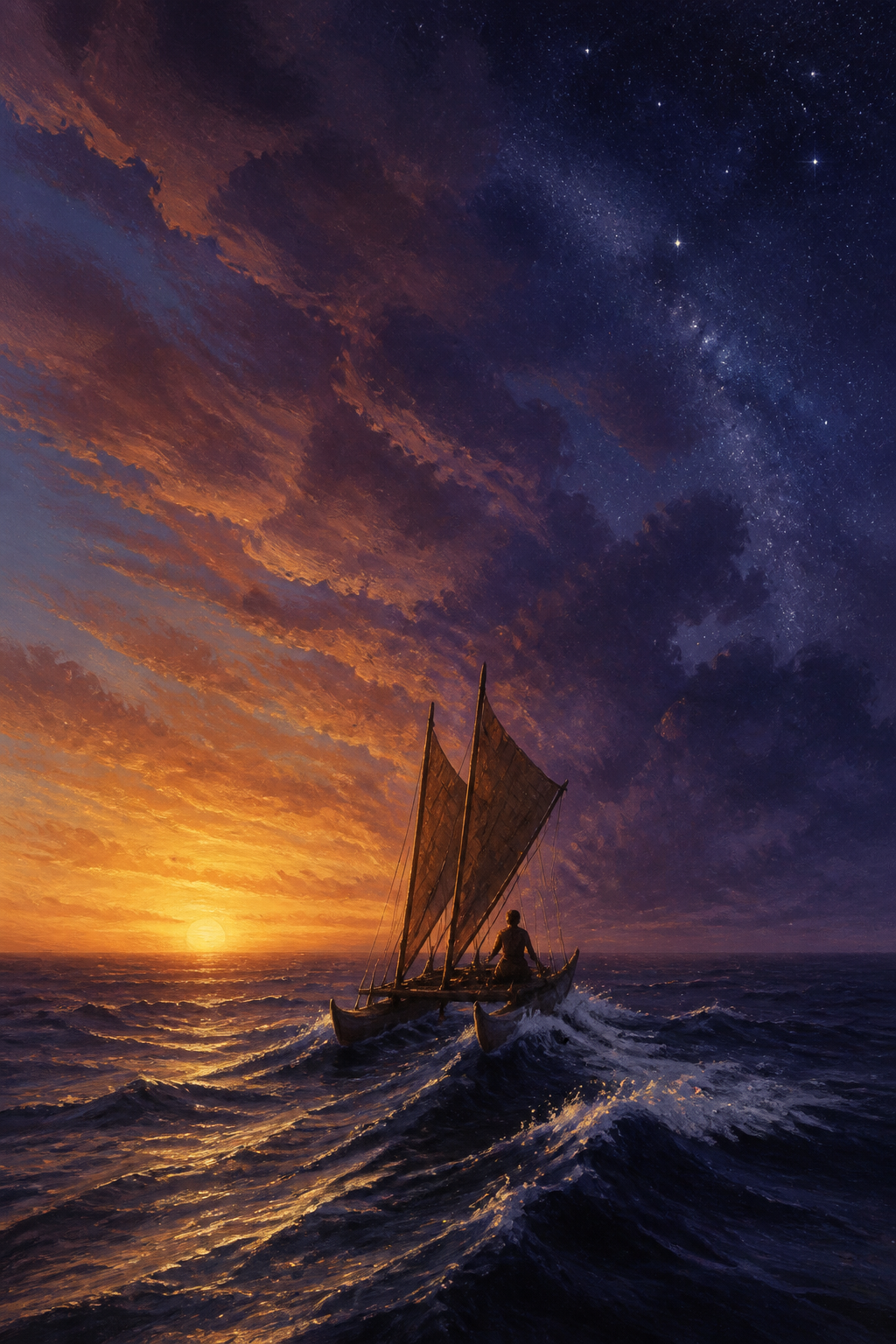
Open ocean under a wide sky, no land in any direction.

at sea — nothing legible yet

Navigation Was Taught Across an Ocean

Somewhere between two archipelagos, this water is doing everything at once. Swell trains cross beneath a hull. A star sets in a place that means something. Wind, bird and cloud are all pointing. None of it reaches you — not because it is hidden, but because nobody has shown you where to put your attention.

Modelled image, made for this page. Not an archival photograph.

Three people, a canoe, and a broken line

In 1973 the Polynesian Voyaging Society was founded on O‘ahu by the artist and historian Herb Kawainui Kāne, the anthropologist Ben Finney and the waterman and writer Tommy Holmes. Kāne designed the canoe and was her first captain. Hōkūle‘a — named for the star Arcturus, whose zenith stands over Hawai‘i — was launched at Kualoa on 8 March 1975.◇ documented

She was built to ask whether long ocean crossings could be sailed on purpose, without instruments. But the Hawaiian lineage of deep-sea navigation without instruments had been severed; no living Hawaiian carried it.◇ documented

So the knowledge arrived from elsewhere, and it arrived as a person. Mau Piailug — Pius Piailug — was a master navigator from Satawal, in what is now Yap State, Federated States of Micronesia. His knowledge is Satawalese and Central Carolinian. It is not Hawaiian, it never was, and it did not become Hawaiian by being carried aboard a Hawaiian canoe. In 1976 he navigated Hōkūle‘a from Hawai‘i to Tahiti without instruments.◇ documented

What crossed the ocean that year was not a technique. It was a teacher, and a teacher works on the learner, not on the sea.◯ station reading

What follows is a model, not a lesson

The four passages below are this page’s reconstruction of a single perceptual principle: that a relation, once taught, stays available. They are not Mau’s instruction and they do not reproduce it. Published accounts describe what he attended to; they do not hand us his teaching, and some of what he knew was never public and is not ours to stage.▭ model

◇ documentedVerifiable in the published record.
△ attributedA named person’s account, or a published interpretation of it.
◯ station readingThis page’s own reading. Argue with it.
▭ modelA reconstruction of a principle, not a record of anyone’s words.
The same open water, closer to the surface, swell running through it.

01 · the first relation

The teaching is pointing here — tap or drag on the light in the water▭ model

The teaching has not reached this relation yet.

The hull is the instrument

Tap, or drag a finger across the light. No hold, no correct answer — nothing changes until your attention goes where it is being sent.

Swell keeps its direction long after the wind that raised it has gone. Two or three trains can run through the same water at once, crossing at angles a body can learn. Lying in the hull, a navigator feels the canoe lift, twist and drop in a pattern; that pattern, not the horizon, holds the line. Mau held course this way beneath overcast sky, with nothing above him to steer by.◇ documented

The crossing lines you can draw out of this water are the station’s sketch of the relation — not a diagram of anything he said.▭ model
Right now this is only moving water. Two trains, crossing at a steady angle. They are in every stretch of water on this page now, including the one you started in.
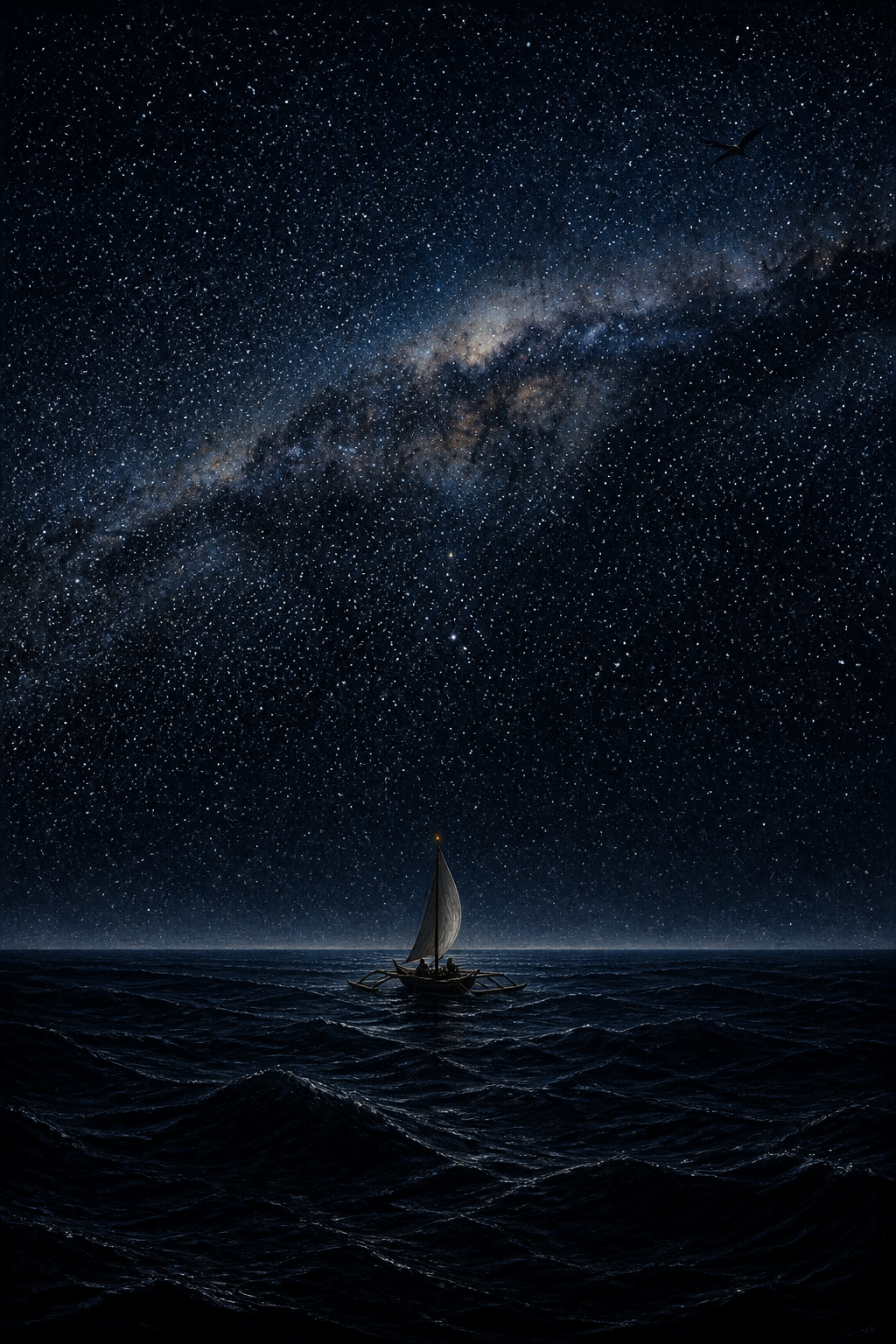
Night sky over the same ocean, stars banked toward the horizon.

02 · the second relation

The teaching is pointing here — tap or drag on the light in the sky▭ model

The teaching has not reached this relation yet.

A horizon divided by where stars come up

In Central Carolinian navigation the horizon is not measured in degrees. It is a ring of places where particular stars rise and where they set, held in memory and learned by long oral repetition before a student is trusted far from land. Published ethnography of navigators in this region — gathered on Puluwat and neighbouring islands — describes such systems in detail. Satawal, Puluwat and their neighbours share a sea and a region; they are not one interchangeable school.△ attributed

Later, Nainoa Thompson built something adjacent and deliberately distinct: a Hawaiian star compass of thirty-two houses, worked out over long nights in the Bishop Museum planetarium — a teaching instrument for a new lineage, not a copy of Mau’s.△ attributed

For now the sky is only bright and far away. Stars have addresses on the horizon — and one of them, Hōkūle‘a, passes overhead at the latitude of Hawai‘i.
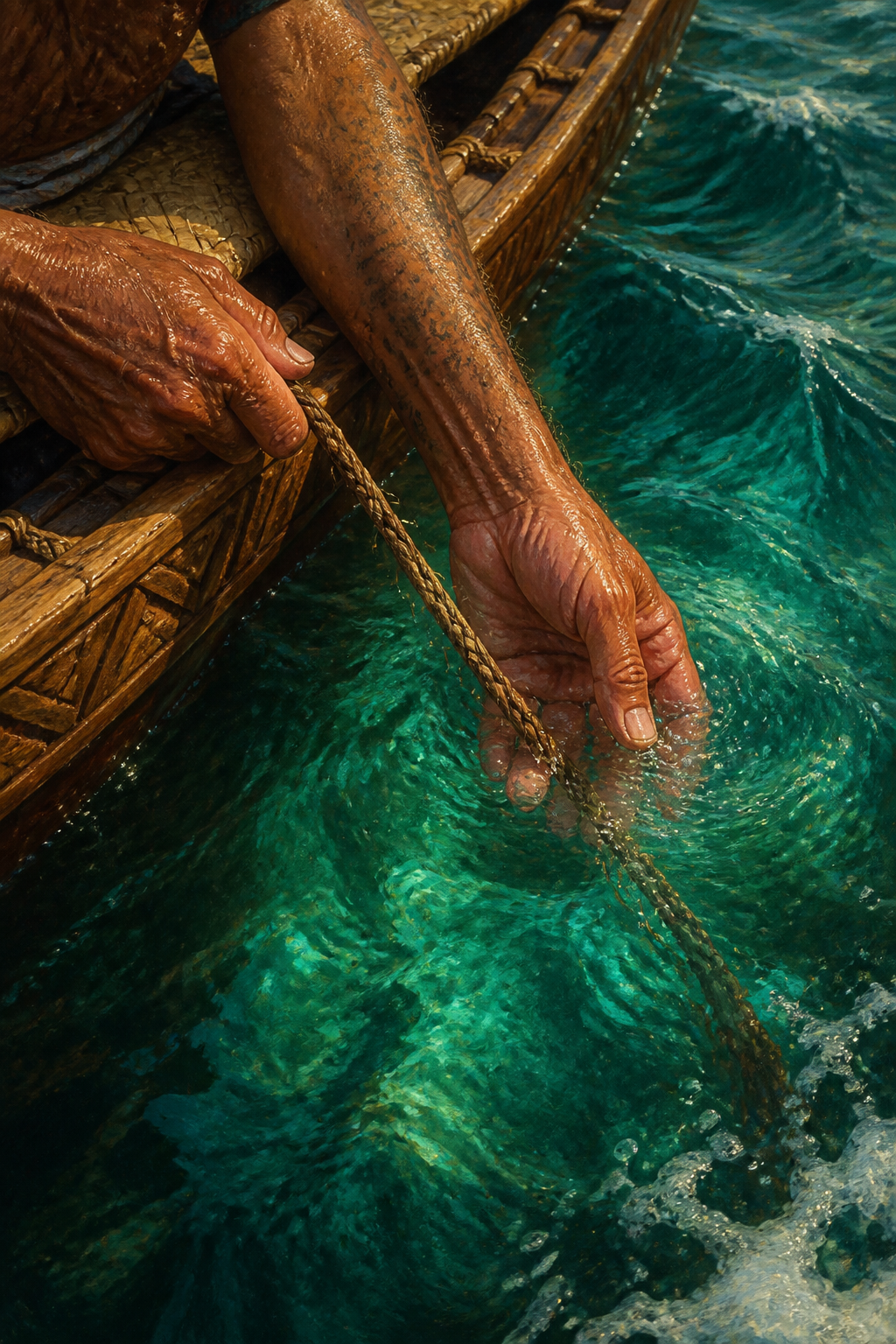
A person at work aboard a voyaging canoe, hand on the steering paddle.

03 · the third relation

The teaching is pointing here — tap or drag on the light near the crew▭ model

The teaching has not reached this relation yet.

Holding the line between one night and the next

The stars set. Cloud closes in. A day of open sea has no houses in it, so the day is carried by everything else: where the sun came up relative to the swell, how the wind sits on a cheek and in the sail, the drag of the wake astern, hours counted by a body that has not slept properly in weeks.

Nainoa Thompson has spoken publicly of holding position as a picture in the mind rather than a mark on a chart — knowing, without seeing, where he is.△ attributed

Someone is steering while all of this happens. Someone is cooking, bailing, patching sail, standing watch in the dark. Navigation is not a solitary act of genius; it is a crew’s unbroken labour around one person’s attention.◯ station reading

The wind is, so far, just weather. Wind and sun now hold an angle to the swell you already know. Two relations, working together.
The same ocean again, a long low horizon band.

04 · the fourth relation

The teaching is pointing here — tap or drag on the light above the horizon▭ model

The teaching has not reached this relation yet.

An island larger than itself

Manu-o-Kū, the white tern, and noio, the noddy, sleep ashore and fish at sea. In the morning they go out; in the late afternoon they come back, and their return is a bearing. A low island still hidden under the curve of the earth becomes findable much further out, because its birds enlarge it. Cloud stacks differently over land, and the colour of the water changes.◇ documented

These are two Hawaiian names for two specific birds doing one specific job in this relation — not ornament.

Birds, right now, are only birds. Birds are no longer scenery. They are the island, reaching much further out than it looks.

held so far, in the same water crossing swellhorizon ringwind anglebirds as island

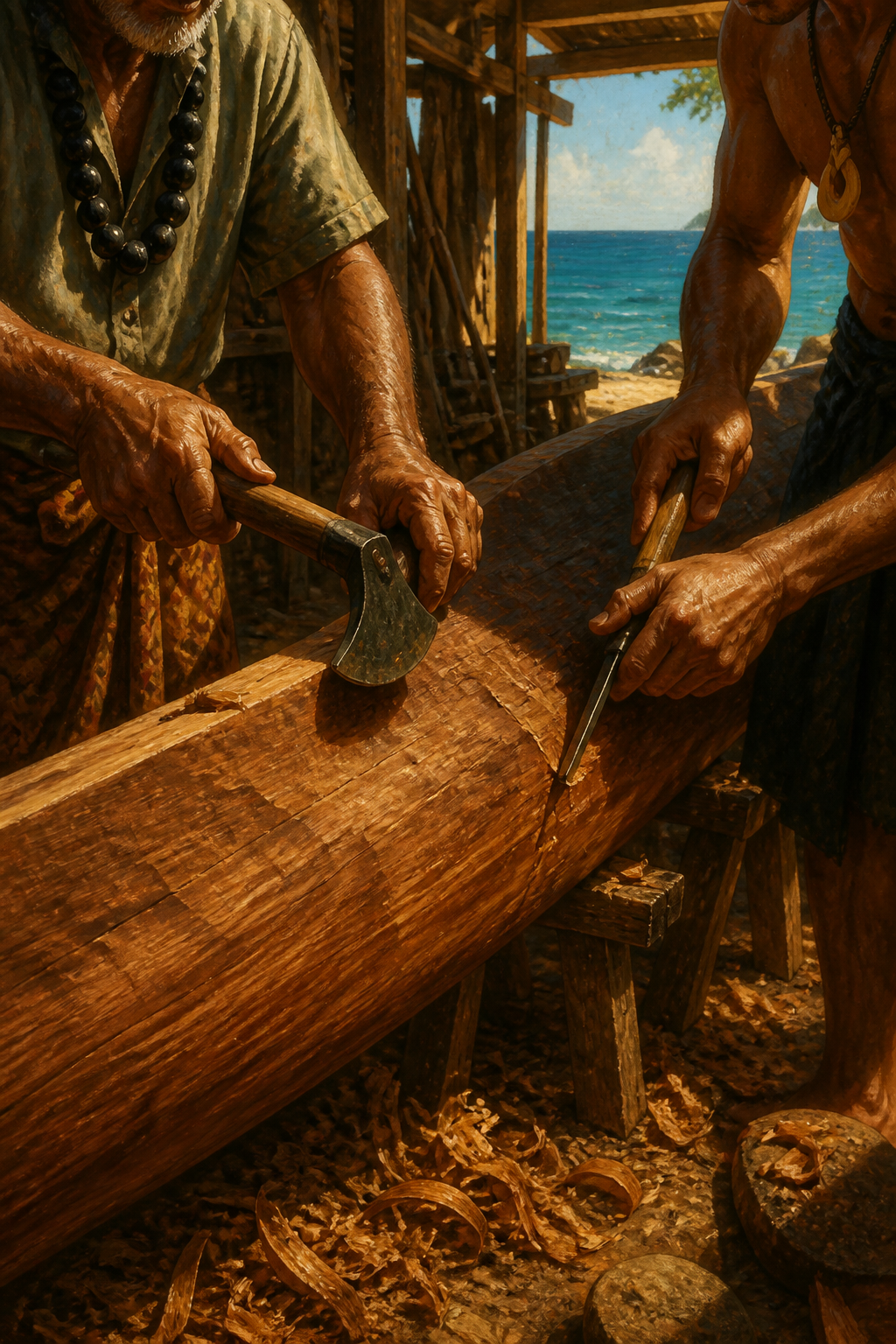
Hands and tools at work on a canoe hull: lashings, timber, resin, sanded surfaces.

Modelled image, made for this page. Not an archival photograph.

beneath all of it

What it costs, in hands

Hōkūle‘a is a performance-accurate reconstruction, not a museum piece: her 1975 hulls were built with plywood, fibreglass and resin, an adaptation nobody concealed. Hawai‘iloa, launched in 1993, was carved from two Sitka spruce logs gifted by Tlingit, Haida and Tsimshian people of southeast Alaska, because trees of that size no longer grow in Hawai‘i.◇ documented

Lashings need re-lashing. Sails need sewing. Hulls come out of the water to be scraped, faired, painted and put back. Escort boats need crews and fuel and paperwork. Most of this work is done by volunteers, in daylight nobody photographs, decade after decade.◯ station reading

Myron “Pinky” Thompson — Nainoa’s father, and a president of the Polynesian Voyaging Society — pushed the work toward schools and Hawaiian institutions, so that transmission would not depend on any single voyage or any single navigator.△ attributed

In March 1978, Hōkūle‘a capsized in the Moloka‘i Channel at the start of a voyage to Tahiti. Eddie Aikau, lifeguard and surfer, paddled his board toward Lāna‘i for help and was never found. The voyage was abandoned.◇ documented

Nothing on this page sits outside that.

the lineages, kept separate

Mau taught, and then Nainoa sailed

late 1970s — 1980

Mau Piailug taught Nainoa Thompson in Hawai‘i in the years after 1976. In 1980 Nainoa navigated Hōkūle‘a from Hawai‘i to Tahiti without instruments — the first Hawaiian in centuries to make such a crossing that way.◇ documented

Satawal is not a prologue

the same decades

Mau also taught at home, in his own language, to his own family and community; his son Sesario Sewralur is a navigator. Micronesian transmission continued on its own terms and is not a chapter in a Hawaiian revival.◇ documented◯ station reading

An initiation that is not content

2007, Satawal

Mau conducted a pwo ceremony — a sacred initiation of navigators — which included Hawaiians he had taught. This page does not describe what happens inside it. It is not ours, and it is not material for a screen.◇ documented◯ station reading

Then institutions carried it

2010 — 2017 — now

Mau died in 2010. Between 2013 and 2017 Hōkūle‘a sailed around the world, crewed and navigated largely by people trained inside the lineage he made possible. Pwo navigators teach today in Micronesia and in Hawai‘i.◇ documented

A cue is only a cue. What a teacher hands over is the relation between cues — and the obligation to hand it on again.

The same ocean as the beginning, unchanged.

the same water

Nothing out here has changed

You have, slightly. Four relations, sketched, in a few minutes on a page. A navigator’s training is measured in years of nights, of recitation, of being corrected by someone with the standing to correct you.

You have not learned to navigate. You have felt the difference between a cue and a relation — and between information and a teacher.◯ station reading

Modelled image, made for this page. Not an archival photograph.

what stayed with you

  1. 01Two swell trains crossing under the hullstill just watercarried — visible everywhere above
  2. 02Rising and setting points on the horizon ringstill just skycarried — visible everywhere above
  3. 03Wind and sun holding their angle to the swellstill just weathercarried — visible everywhere above
  4. 04Seabirds enlarging an island you cannot seestill just birdscarried — visible everywhere above

All four relations are open. Scroll back up: the ocean you could not read is marked now, and it stays that way.