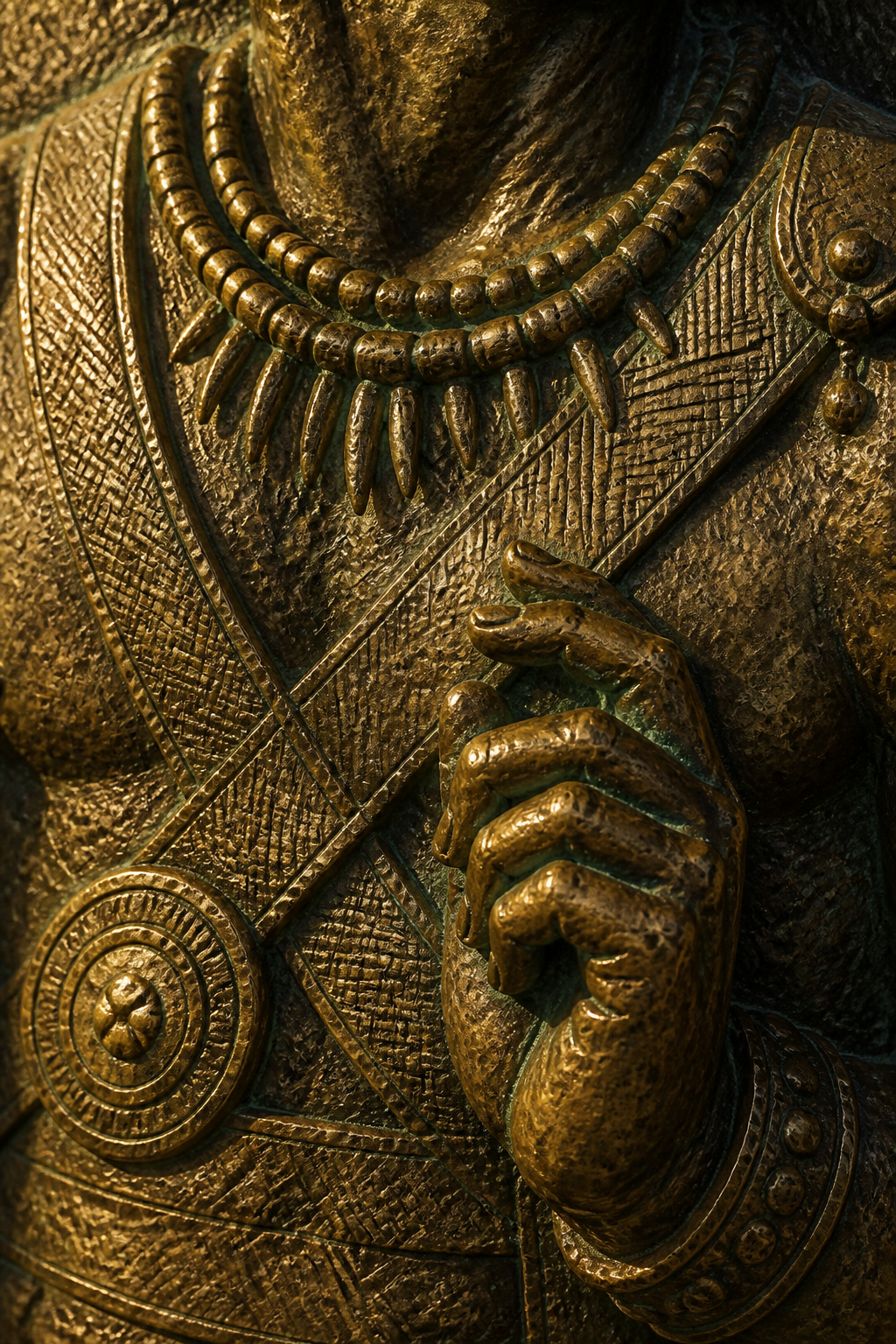
Brass, roughly three millimetres thick. Poured once, then worked by hand — chased, filed, punched into pattern. Four holes at the corners, driven for iron nails. A small burr left along the lower edge, where the metal was cut away.
Stay with the surface a moment before anyone tells you what it is.
generated image — station-made study of a plaque surface, not archival evidence
Nailed to the wooden pillars and beams of the courtyards inside the palace at Benin City — held up at eye level, in sequence, in the open air of a working court.
source-attributed interpretationOnly Igun-Ẹrọnmwọn, the brass casters' guild of Igun Street, working for the Oba. Casting brass was a royal prerogative: a caster did not take brass commissions from anyone else. The guild is hereditary, and it is still there.
documentedsource-attributedThe alloy travelled before the object existed. A 2023 study of trace elements and lead isotopes (Skowronek and colleagues, PLOS ONE) matched much Benin brass to manillas cast in the German Rhineland and shipped into West Africa from the sixteenth century. The metal is European; the object is Edo. Both facts are ordinary.
documentedWhat a plaque holds is rank and relation — coral regalia, a ceremonial ẹbẹn raised in salute, who stands beside whom and at what scale. It is part of a memory system for a court that recorded in metal, in dress and in speech rather than in books.
station readingreconstruction A composite of wording patterns common in registers from the 1890s to the 1970s. No accession number is asserted, and this is not any single museum's live record.
Nothing in these fields names a pillar, a courtyard, a guild or an Oba. The classification is not wrong about the metal. It is silent about the relation.
station reading
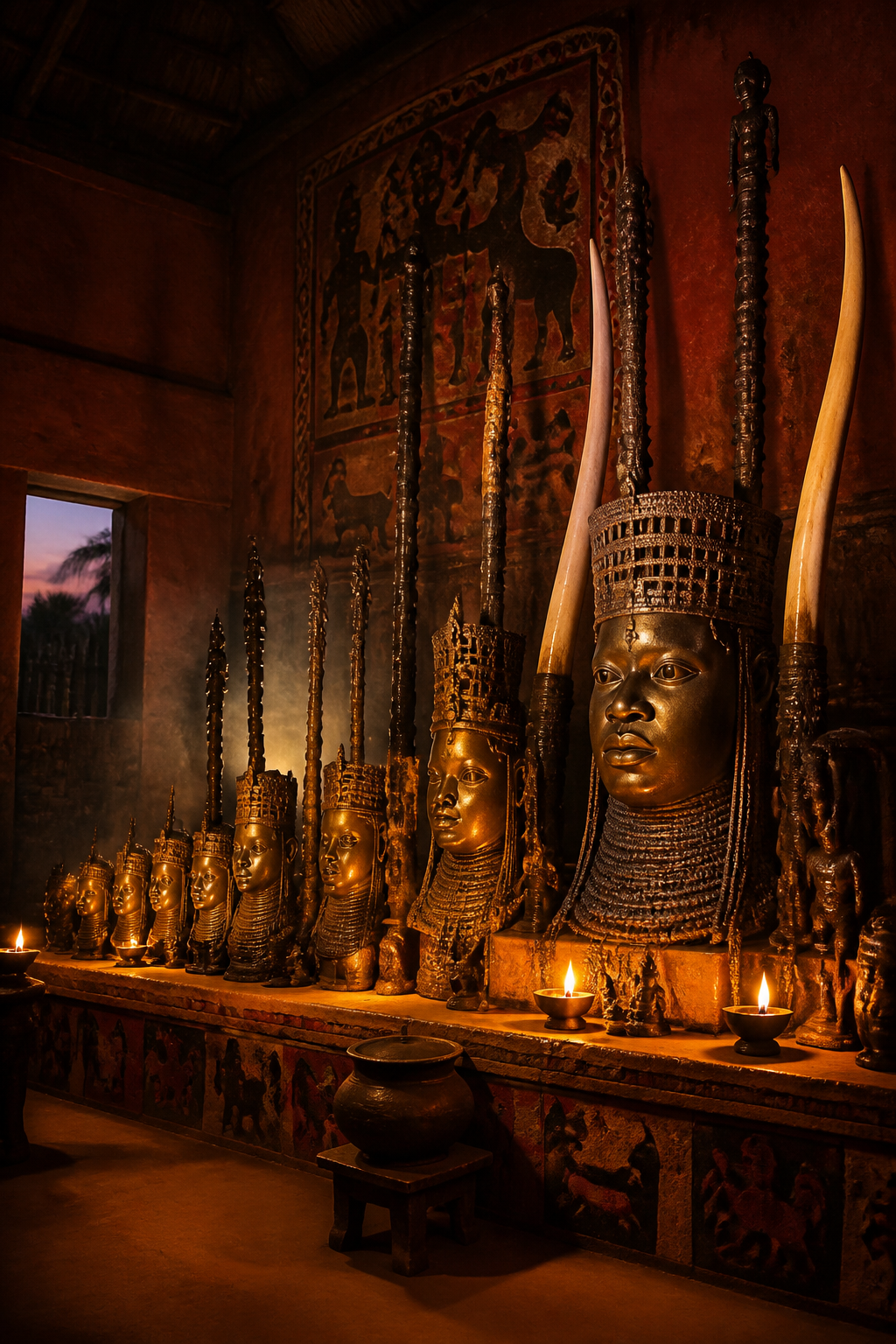
Behind the plaques, the palace held altars for past Obas: commemorative heads — uhunmwun elao, “head of the altar” — carrying carved ivory tusks; rattle staffs, ukhurhẹ, struck on the ground when ancestors were addressed; the swords ẹbẹn and ada raised in salute. Palace associations, among them Iwebo, Iweguae and Ibiwe, carried responsibility for regalia and its keeping. The casters' guild worked inside that order, not beside it.
source-attributed interpretationA Dutch compilation published in 1668 described galleries resting on wooden pillars sheathed in cast copper, showing war deeds. It is the earliest widely cited description — and it is a European book assembled from other men's reports, not Edo testimony. Paraphrased here rather than quoted, because the wording has passed through several translations.
documented publicationBy the late nineteenth century, accounts say many plaques were no longer on the pillars but kept in a palace storeroom. Why they were taken down, and when, is not settled. The gap stays open here.
gap in the evidencegenerated image — a composite reconstruction of an altar arrangement. It is not a photograph of any shrine, and it is not evidence of one.
A British force under Rear-Admiral Harry Rawson takes Benin City. The palace burns. Thousands of objects are removed, among them the brass plaques. documented
Objects arrive in London. A portion is retained by the Foreign Office; a portion is sold, in part to defray the cost of the expedition itself. Museums and private buyers acquire. documented
Berlin buys heavily through Felix von Luschan; dealers supply Vienna, Hamburg, Stuttgart, Cologne, Chicago, New York. Dispersal is not an accident of history — it moves along a market. documentedstation reading
Oba Ovonramwen is deposed and exiled to Calabar. The court that commissioned the plaque no longer holds it, and cannot ask for it back. documented
The word most often used in the records for all of this is acquired.
Figures as published by Digital Benin at its launch in November 2022. They are not final: research continues, holdings are still being identified, and some collections have never been fully listed.
source-attributedfigures changeA map is not the point of contact. The object is. What follows are the records that grew around it.
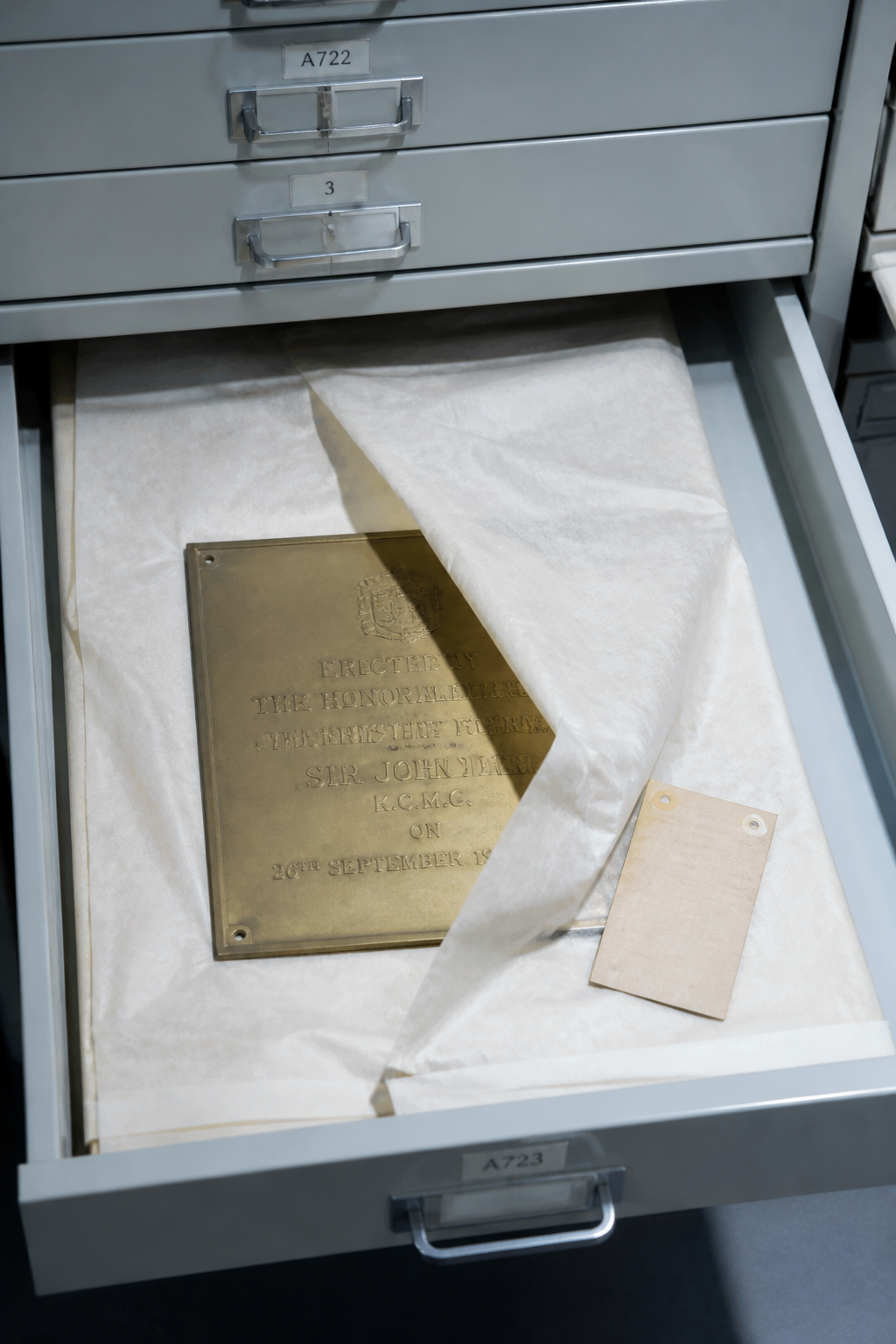
Foam, a shallow drawer, a number on a tag. This is where most of these objects are, most of the time, in most places.
generated image — reconstruction of museum storage. Not a photograph of any institution's store.
Open a record to see what the object is called there, and by whom. The names accumulate. Nothing you open closes again — that is the point.
The sixth record does not delete the second through the fifth. It sits alongside them. That is what a contested record looks like when nobody has cleaned it up.
Not a map. A list of rooms with keys, in institutions that each hold documented Benin collections. Touch a slip to see what kind of authority sits with it.
gap kept open Object counts per holder are published and continually revised by Digital Benin; this station does not reproduce them, because they move. Appearing here means a documented Benin collection — it is not a claim that this particular plaque is in that room.
A map makes dispersal look like geography. It is custody: keys, budgets, insurance, permissions and law.
Two plaques photographed five thousand kilometres apart can be set side by side in a second. An Edo designation can be read next to the colonial one that displaced it. A descendant, a student or a carver in Benin City can look closely at an object without a visa, a loan agreement or a reading-room appointment.
The object is still in a drawer in another country. Its temperature, its lighting, its insurance value, who may touch it, who may photograph it, whether it travels and who holds title — all of that is still decided there, by people the record names but does not govern.
Digital reunification is not restitution.It is a way of seeing precisely what is still missing.
Digital Benin was built by a team hosted at MARKK in Hamburg, funded by the Ernst von Siemens Kunststiftung, with Nigerian partners, Edo-language contributors and records supplied by cataloguers in holding institutions. Provenance researchers reconciled entries that did not agree. Nothing on that scale assembles itself, and no database found these objects on its own.
documentedJesus College, Cambridge, returns a brass cockerel, ọkpa, to Nigeria. documented
The University of Aberdeen returns a commemorative head. documented
Germany and Nigeria sign a joint declaration transferring ownership of more than a thousand objects held in German museums. documented
The Horniman Museum, London, agrees to transfer seventy-two objects; the first are handed over that November. documented
The Smithsonian's National Museum of African Art transfers twenty-nine objects. documented
Twenty objects are physically handed over in Nigeria under the German declaration. Ownership transferred earlier; the objects moved later. The two are not the same act. documentedstation reading
The British Museum, the largest single holder, has transferred no ownership; UK legislation constrains what its trustees may give away. documented
In March 2023 a Nigerian presidential declaration recognised the Oba of Benin as owner and custodian of returned objects. Edo State institutions, federal museum bodies and the palace have not read the question of the recipient identically. Whether “return” means transferred title or a long loan; where objects should be housed; who speaks for the objects; and how far digital access satisfies anyone — none of this is settled.
source-attributedcontested, left openThis station does not speak for restitution actors as a whole. Descendants, the palace, Nigerian institutions, Edo researchers and museum staff disagree among themselves, in public, for reasons of their own. They are participants. This page is not their representative and does not resolve them.
No conclusion is offered here
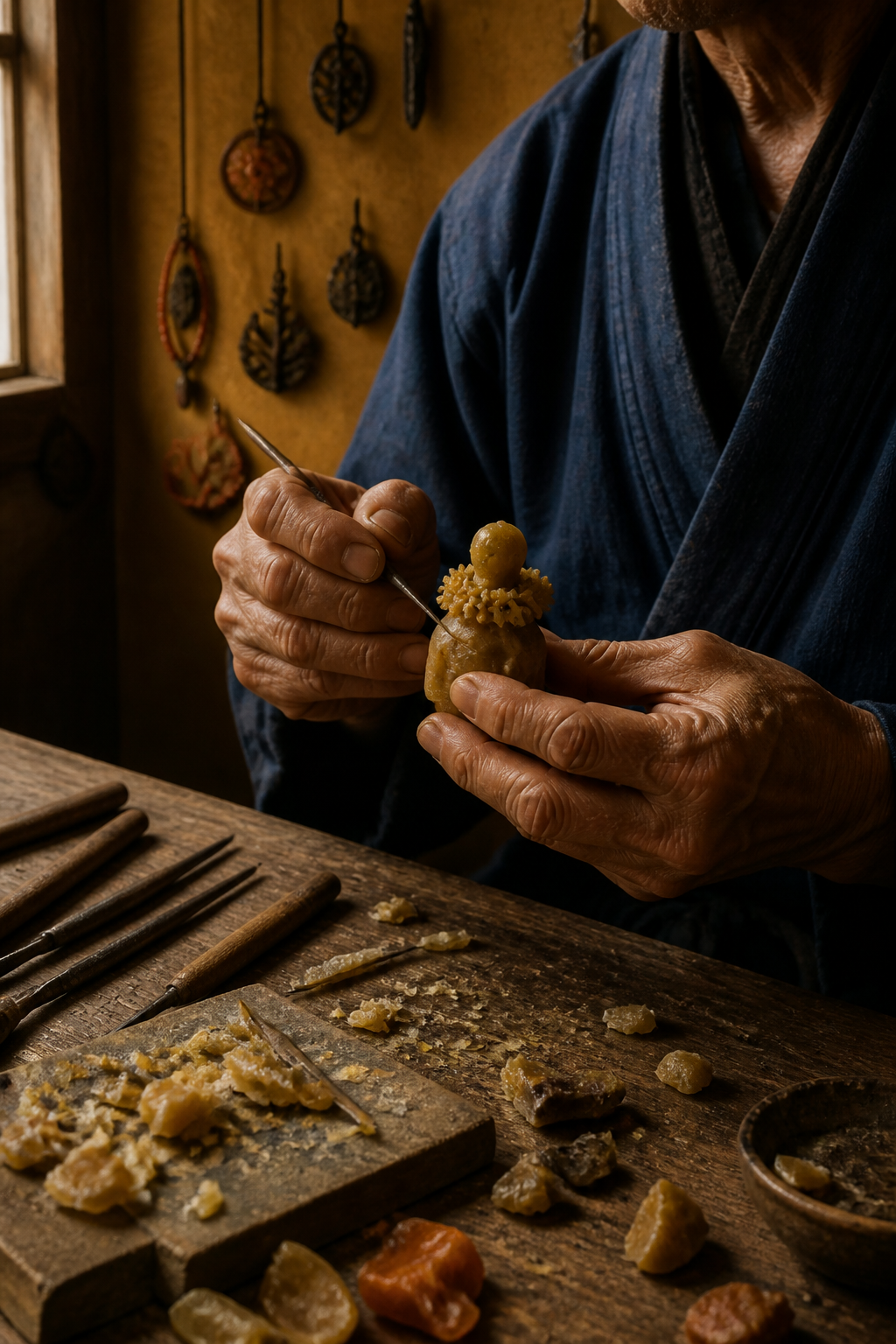
On Igun Street the wax is still modelled, the mould still packed, the metal still poured. The guild that made the plaque did not end in 1897 — it went on working while its earlier work was catalogued elsewhere, under other names.
You can recognise the object now: about three millimetres of brass, four nail holes, a burr along the lower edge, a figure with an ẹbẹn raised in salute, made by one guild for one court, from metal that crossed an ocean before it was ever an image. That much is whole.
Where it sleeps tonight, who holds title to it, who may decide, and what it will be called in the next register — those are not.
generated image — a station-made study of casting work. Not a photograph of any named artist, and not archival evidence.
cast in Benin City. catalogued elsewhere. adjacent on a screen; still apart in the rooms.