
Vienna · 1907

A person, represented

Adele
Bloch-Bauer

Born in Vienna, 1881. She sat for the painter Gustav Klimt. She died in 1925, at forty-three. Everything else on this page happened to a painting.

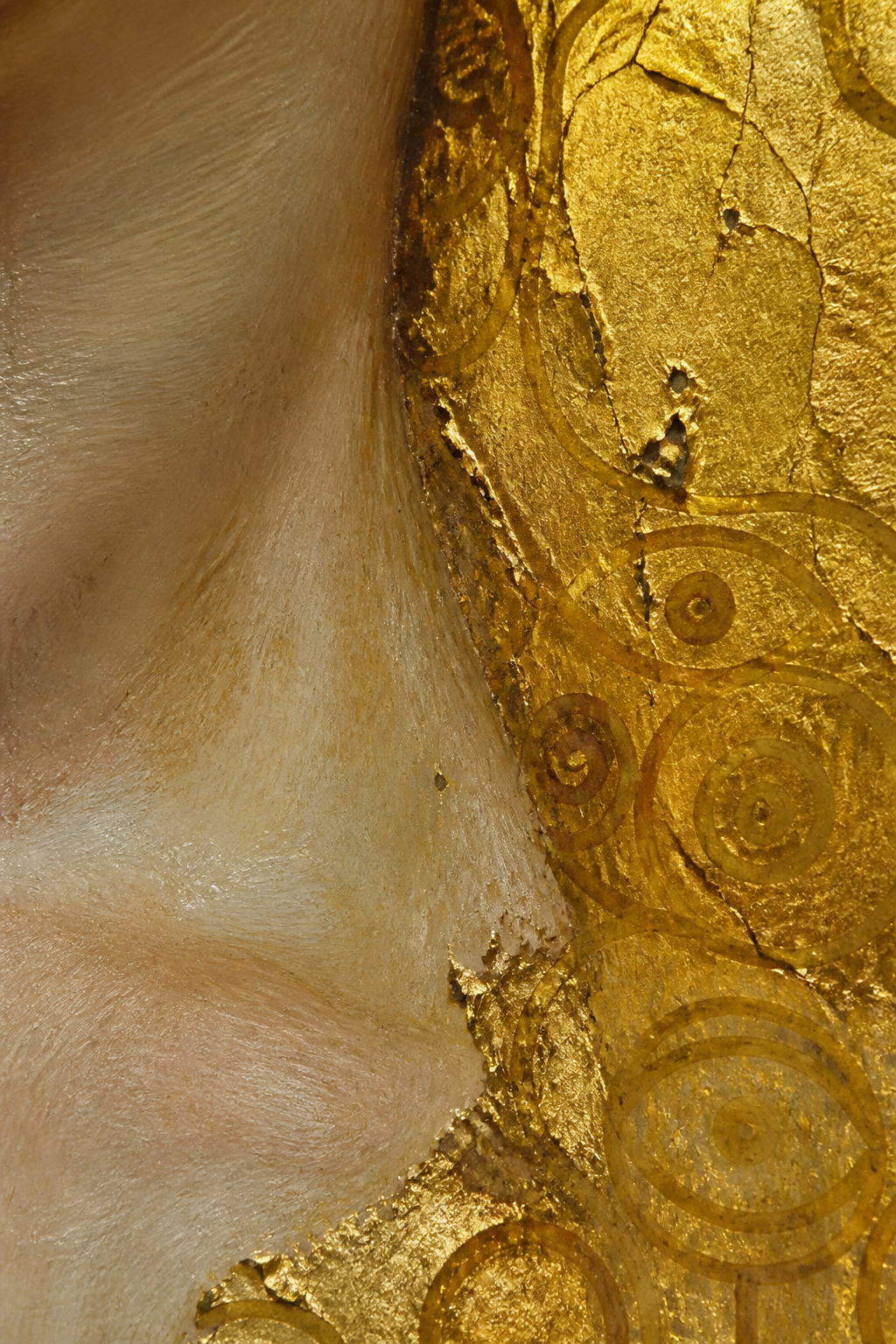
Modelled perceptual study: a seated woman's face and hands emerging from a field of gold and pattern.
Modelled perceptual study, made for this page. It is not Klimt's painting, not a reproduction of it, and not an archival image.

Keep going, slowly

The distinction this page keeps

Adele was not the painting’s provenance.

A portrait carries two things that are easy to confuse: a person, and an object with a history of hands.

The object went from an apartment on the Elisabethstrasse to a state museum to a gallery on Fifth Avenue. Along the way it was inventoried, willed, catalogued, seized, administered, exhibited, claimed, litigated, arbitrated, restituted and sold. Each of those systems produced a name for it, and each name was, inside its own language, complete.

None of them were her. She had already been dead thirteen years when the first of the violent ones was written.

Custody can change eight times. The woman in the picture does not become any of the documents that moved her.

Modelled perceptual study of a metallic leaf surface: gold and silver tesserae, cracked and burnished.

The other thing in the room

A square of canvas, silver and gold.

Klimt worked on the portrait across several years and finished it in 1907. It is oil with silver and gold leaf on canvas, roughly a hundred and thirty-eight centimetres on each side. It can be crated. It can be valued, insured, restricted from export, hung, delisted, re-labelled.

All of that is true of the object and none of it is true of her. The rest of this page is about the object — while she stays where she is.

  • PainterGustav Klimt
  • Completed1907
  • Commissioned byFerdinand Bloch-Bauer
  • Represented personAdele Bloch-Bauer

Descriptions, in the order they were made

Eight systems reached for the same painting. Watch what they hold, and what stays outside.

Open a record to read what the evidence actually supports. Where the sources disagree or the law was never settled, it is left unsettled here.

  • Documented record
  • Source-attributed
  • Institutional position
  • Reading offered by this page

Held byThe Bloch-Bauer household, Vienna

Described asan object among household property

The same modelled perceptual study, closely cropped on the represented woman's face.

Person representedAdele Bloch-Bauer — unchanged in every record below

The two lines above change as you read. The line beneath the picture does not. That difference is the whole subject of this page.

Household and collection listingDocumented

In the apartment, the portrait is property.

Read the evidenceClose

Ferdinand Bloch-Bauer, a sugar industrialist, commissioned the portrait of his wife from Klimt. In the family’s property and collection records the work appears as one item among others — furniture, porcelain, other Klimts.

Note: the earliest description available is already a description of a possession, not of a person.

Testamentary language, 1923Documented text · disputed effect

A sentence in her will asks her husband to give the Klimts to the state gallery after his death.

Read the evidenceClose

Adele Bloch-Bauer died in 1925. The paintings belonged to Ferdinand, not to her; the wording is a request addressed to him rather than a transfer of title by her.

What legal weight that sentence carried — a binding condition, a wish, a moral obligation — became one of the most contested questions of the whole affair, and was still contested eighty years later.

Unresolved here: the page does not decide the will’s legal effect. The parties themselves never agreed on it.

Catalogue entry and wall labelSource-attributed

For decades the work hangs under a title that does not carry her name.

Read the evidenceClose

Museum publications and later scholarship record display titles describing a lady, a portrait, a gold ground — not Adele Bloch-Bauer. Accounts of why her name fell away, and of who removed it, differ between sources.

Attributed, not settled: this page reports that such titles are documented and does not assert a single motive for them. The observable effect is narrower and enough: a label can keep a face and drop a person.

Seizure and administration, 1938–1941Documented

After the annexation of Austria, the Bloch-Bauer property in Vienna is taken.

Read the evidenceClose

Ferdinand Bloch-Bauer had already left the country; he died in Zurich in 1945. The record shows an attorney, Erich Führer, appointed under Nazi authority to administer the confiscated estate and to dispose of works from it. The portrait entered the Austrian state gallery in 1941.

Possession moved. Whether lawful title moved with it is exactly what the later proceedings had to decide — and the distinction between the two is the reason those proceedings were possible at all.

Roles are named only where records support them. Motives are not reconstructed here, and no words are put in anyone’s mouth.

State display and national claimInstitutional position

The painting is shown, published and defended as part of a country’s patrimony.

Read the evidenceClose

In the post-war decades the Republic’s position rested in part on the 1923 sentence in Adele’s will, and in part on export controls that kept the work inside the country.

A cultural claim, a legal title and a physical possession are three different things. They were often argued as if they were one.

Inheritance claimDocumented

Ferdinand’s heirs ask for the paintings back.

Read the evidenceClose

Ferdinand’s 1945 will named his nieces and his nephew as heirs. After Austria’s 1998 restitution legislation and the opening of ministry files, his niece Maria Altmann — who had fled Vienna and was living in California — pursued the claim with the lawyer E. Randol Schoenberg.

In 2004 the United States Supreme Court held that the case could proceed against the Republic of Austria in an American court. That ruling was about jurisdiction. It decided nothing about who owned the painting.

Arbitration and decision, 2006Documented

An arbitration panel in Vienna decides for the heirs.

Read the evidenceClose

The parties agreed to binding arbitration. In January 2006 the panel found that five Klimt works, this portrait among them, should go to Ferdinand’s heirs.

A decision resolves a dispute between parties. It does not undo 1938, it does not return the decades of display under another name, and it does not delete the record that preceded it.

Reading offered by this page: restitution is a legal outcome, not a restoration of the world before the seizure.

Sale and later display, 2006Documented · reported figure

The portrait is sold, and hangs in New York.

Read the evidenceClose

Later in 2006 the painting was acquired for the Neue Galerie in New York by Ronald S. Lauder. The price was widely reported as 135 million dollars; the figure comes from press accounts of the transaction.

This is a market transfer following a restitution — a further change of custody, not a conclusion. A film title would arrive later still and try to stand in for her name. It is not her name.

Modelled perceptual study: layered strata of stamps, ledger rules and overlapping typed lines accumulating into an opaque mass.
Modelled study of documentary accumulation. Not a photograph of any file, stamp or archive.

What the paperwork does

Every layer makes the last one look more like the truth.

A provenance line reads as a single sentence: household, gallery, heirs, gallery. It is built out of instruments that contradict each other — a request in a will and a confiscation order cannot both be describing a lawful chain.

Yet the record thickens, and thickness reads as authority. An inventory becomes a catalogue, a catalogue becomes a label, a label becomes common knowledge, and common knowledge becomes the caption under which millions of people meet a woman they are told is called something else.

The documents are not the villains here. Some of them are the only reason the seizure could be proved at all. They are simply not able to hold what they are constantly assumed to hold.

Modelled perceptual study: a wide field of gold dissolving at its edges, with an unfilled area where a figure would be.
Modelled perceptual study of what the records do not contain. Generated for this page; not archival material and not a reproduction of the painting.

Three things, kept apart

The person

Adele

A woman in Vienna who sat for a painter, wrote a sentence about pictures in 1923, and died in 1925. She never saw a seizure order, a claim form or a saleroom. She is not available for revision.

The object

The painting

Canvas, oil, silver, gold. Held in an apartment, taken, hung by a state, awarded to heirs, bought by a gallery. Its custody changed repeatedly and may change again.

The systems

The naming

Inventory, will, catalogue, confiscation record, statute, court, arbitration panel, invoice. Each named a relation between people and a thing. Each was complete in its own language. None of them reached her.

The provenance is long now, and careful, and mostly right. It still ends in the wrong place.

How claims are marked

Documented record: supported by primary or well-established documentation. Source-attributed: reported by identified sources whose accounts differ, and left as reports. Institutional position: what a body asserted, not a finding of fact. Reading: an interpretation offered by this page, marked as such.

Disputed legal questions — above all the effect of the 1923 will — are left unresolved rather than smoothed. No quotations, conversations or motives have been invented.

About the images

All four images on this page are generated, modelled perceptual studies made for it. They do not depict Klimt’s Portrait of Adele Bloch-Bauer I, they are not reproductions of it, and they must not be read as archival evidence, museum documentation or photographs of any real document.

They stand in for a looking that a rights-bounded reproduction could not have carried here.