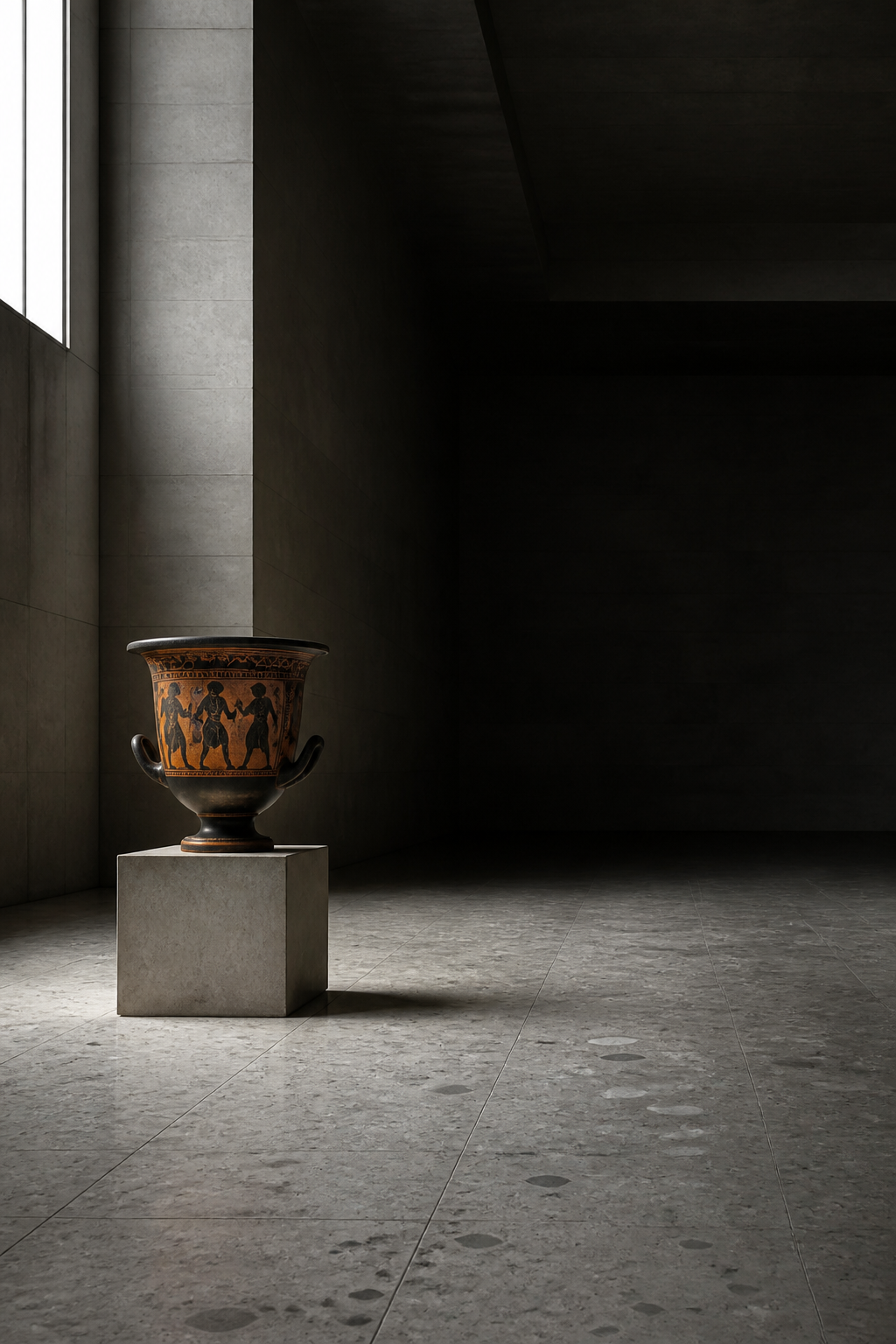
Attic red-figure calyx-krater about 46 cm high, 55 across signed twice found where: —
A red-figure Greek krater lit against a dark ground, the painted figures legible across its belly.
modelled image — not archival evidenceThe vessel first: clay turned on a wheel in Athens, painted with a brush and a raised line, fired three times to hold black. Everything on this surface is still here to be looked at.

The Vase Returned,the History Did Not Reset

What the surface carries

A body being lifted off a battlefield

Sarpedon, killed at Troy, carried away by Hypnos and Thanatos while Hermes stands at the edge of the scene. On the other side, Athenian youths pulling on armour. documented

Look for a while and the object gives up a great deal on its own: two hands, a technique, a mythology, a taste for wine mixed in company. Scholars place the painting around 515 BCE on the evidence of style and of the letters themselves — a reading of the object, not a date written on it. attributed to a source

None of that is a location. The vessel can tell you who painted it. It cannot tell you the shape of the hole it came out of.

Source layer — inscriptions on the vessel

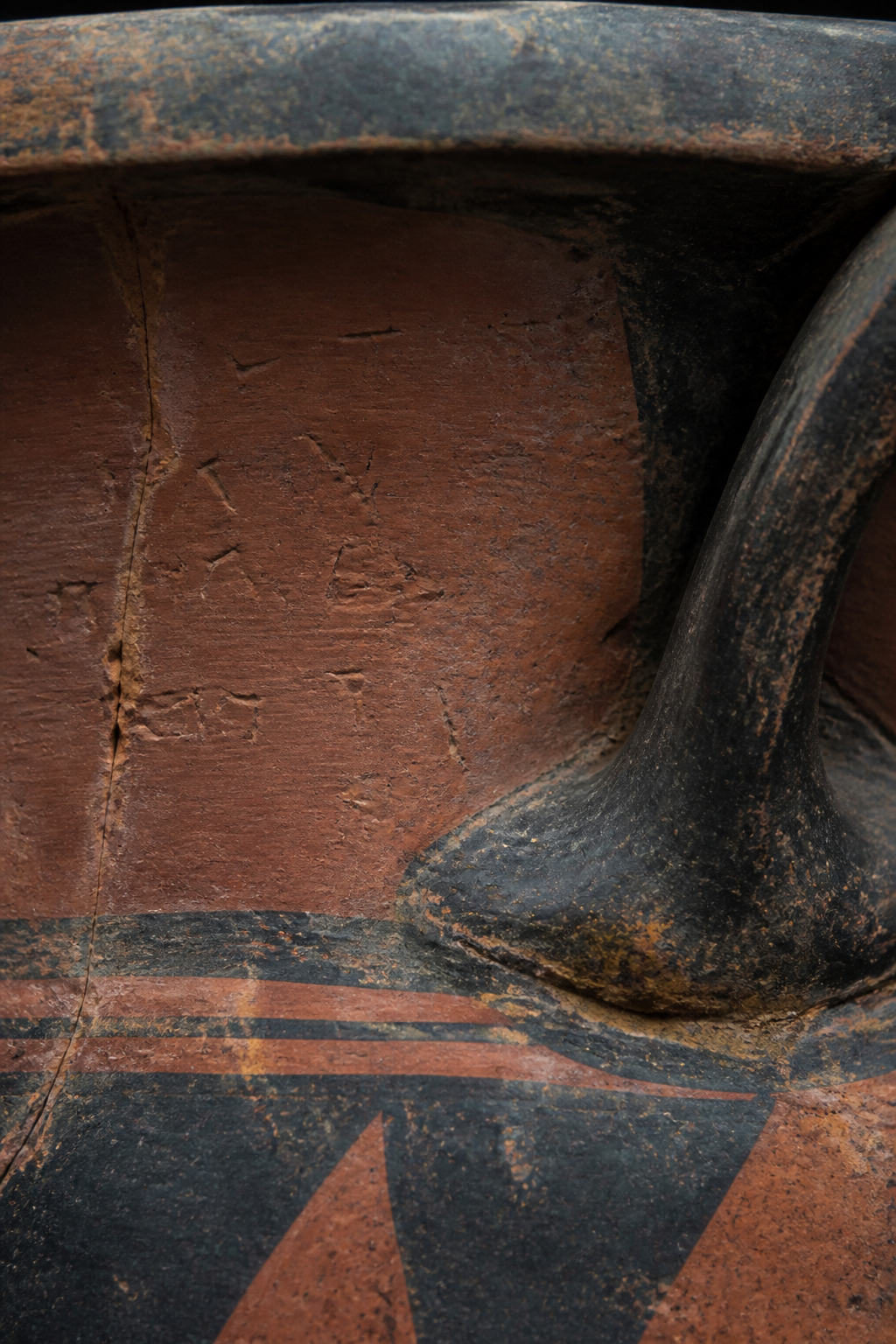
ΕΥΦΡΟΝΙΟΣ ΕΓΡΑΦΣΕΝ

euphronios egraphsen

“Euphronios painted it.”

ΕΥΞΙΘΕΟΣ ΕΠΟΙΗΣΕΝ

euxitheos epoiesen

“Euxitheos made it.”

Read as evidence, not as ornament: these are the only two names this object supplies by itself. The potter, the painter. Not the person buried with it, not the person who took it out. station reading

Close detail of incised and painted letters in fired clay, a human mark left in the surface.
modelled image — not archival evidenceA human trace held in the clay. Two men in the Kerameikos put their names on this pot; twenty-five centuries later those names are the best-documented facts about it, and they were never the facts anybody argued over.
A dark, emptied cavity in earth and tufa, the space where objects once lay in an arrangement.
modelled image — not archival evidenceNot a mystery to be solved. A quantity of information that stopped existing.

Beside the object

The thing next to the vase is not empty by accident

A tomb is a single arrangement, made once. Position of the body. Which pots touched which. The ash, the metal, the bone, the depth of each thing relative to the next.

Read together, those relations date a burial, place a household, trace a trade route from Athens to Etruria and name the living people at both ends of it. Lifted out separately, at night, they become objects with prices — and the relations are simply gone. Not mislaid in a store-room. Gone. documented

Italian investigators alleged that this krater was dug clandestinely near Cerveteri in late 1971 and moved out through the antiquities trade. No court ever returned a verdict establishing that for this vessel. attributed to a source What holds either way is narrower and worse: no excavation record for it exists. Whatever the truth of the route, the archaeology was never written down. inference

So the panel beside the vase stays the size it is. No document on the following pages makes it smaller.
Records around one vessel

A signature names a hand. A purchase names a price. Neither names a place in the ground.station reading

Marked throughout — documented · attributed to a source · station reading · inference · modelled imagery.

record: the object itselfroute: ancient greek

Two signatures in fired clay

establishes
A potter, Euxitheos, and a painter, Euphronios, in Athens. A workshop practice in which authorship was declared. documented
cannot establish
Ownership, export, burial, or removal. A signature is a claim about making, and only about making.

record: condition & conservationroute: english / italian

The breaks, and the joins that hide them

establishes
The krater reached the Metropolitan Museum of Art in fragments and was reassembled; the joins and fills are part of its documented physical history. attributed to a source
cannot establish
When or how it broke. A fracture is legible as a fracture; it does not carry a date or a cause. Conservation stabilises an object — it does not testify. station reading

record: acquisition file, 1972route: english

One million dollars, New York

establishes
In 1972 the Metropolitan Museum of Art bought the krater from the dealer Robert E. Hecht Jr. for about one million dollars. A price, a date, a legal transfer of title. documented
cannot establish
Where the object was before it was Hecht’s. A purchase record begins at the seller; it has no field below that line.

record: a stated provenanceroute: english

A letter about a family collection

establishes
What was claimed at the time: Hecht said the krater came through Dikran Sarrafian, a Lebanese collector, from a family holding said to date to 1920. attributed to a source
cannot establish
That the claim is true. Italian investigators disputed it, and the account rested on statements rather than on export papers or an early photograph. A provenance story is a document about a story. station reading

record: gallery label & pressroute: english

Thirty-five years on view

establishes
How the public was taught to see the object: an Athenian masterpiece, named makers, a famous scene. Journalists began asking about its origin almost immediately after the purchase became known. documented
cannot establish
Anything about the ground. Display is a very powerful way of making an object look like it belongs where it stands. station reading

record: investigation & court fileroute: italian

Indagine, processo, prescrizione

establishes
A long Italian criminal inquiry into the antiquities trade, pursued by prosecutors with the Carabinieri’s cultural-heritage command. The dealer Giacomo Medici was convicted of trafficking offences in 2004. Robert Hecht was indicted in Rome in 2005; his trial ended in 2012 when the limitation period expired, without a verdict. documented
cannot establish
A judicial finding on how this particular krater left the ground. And no investigation, however thorough, recovers a stratigraphy. Evidence of a crime is not a record of an excavation.

record: agreement & transferroute: italian / english

Accordo, 2006 — restituzione, 2008

establishes
In February 2006 the Metropolitan Museum of Art and the Italian Ministry of Culture reached an agreement; in January 2008 the krater was transferred to Italy and went on public view in Rome. Reports describe a later move to the national museum at Cerveteri in 2014. documented attributed to a source
cannot establish
A findspot. The agreement moves custody between institutions. It writes nothing into the excavation record, because there is no excavation record to write into.

Two languages, two objects

The paperwork never met in the middle

Each route is complete on its own terms and silent about the other. Nothing in either vocabulary has a word for the arrangement in the tomb. station reading

route: english — new york

The language of title

  • acquisitiona lawful transfer, dated and priced
  • provenancea chain of owners, as stated by owners
  • titlewho may lend it, insure it, display it
  • attributionthe hands that made it

A chain of title can be unbroken and still say nothing about earth. That is not a flaw in the form; it is what the form is for.

route: italiano — roma

Il linguaggio del territorio

  • indagineinvestigation
  • sequestroseizure of goods or premises
  • rogatoriaa formal request for evidence abroad
  • prescrizionelimitation: a case that closes without concluding
  • accordoagreement between museum and state
  • restituzionereturn of custody

This vocabulary can name unlawful export and state patrimony, and it can move an object across a border. It has no term that restores context, because Italian law cannot legislate a stratum back into existence.

The krater standing in a bright new gallery, a plain grey blank beside it in the same light.
modelled image — not archival evidenceNew room, better light, correct country. Same object, same silence beside it.
  • custody italy
  • findspot
  • stratum
  • associated finds
  • burial

After

Something real happened. Investigators, negotiators, lawyers, curators, conservators, crate-builders and museum staff on both sides moved a fragile object across an ocean and changed how acquisitions are made. That work matters, and the people who did it should be named more often than the dealers are.

It did not, and could not, undo the first act. The krater is a survivor of an event that consumed everything around it: other pots, a body, a depth, a date, an entire small paragraph of Etruscan and Athenian history that would have been readable if anyone had written it down. There is no version of the story in which that comes back. station reading

The vase returned. The history did not reset.