00Čuvanje/Custody, performed1894 —
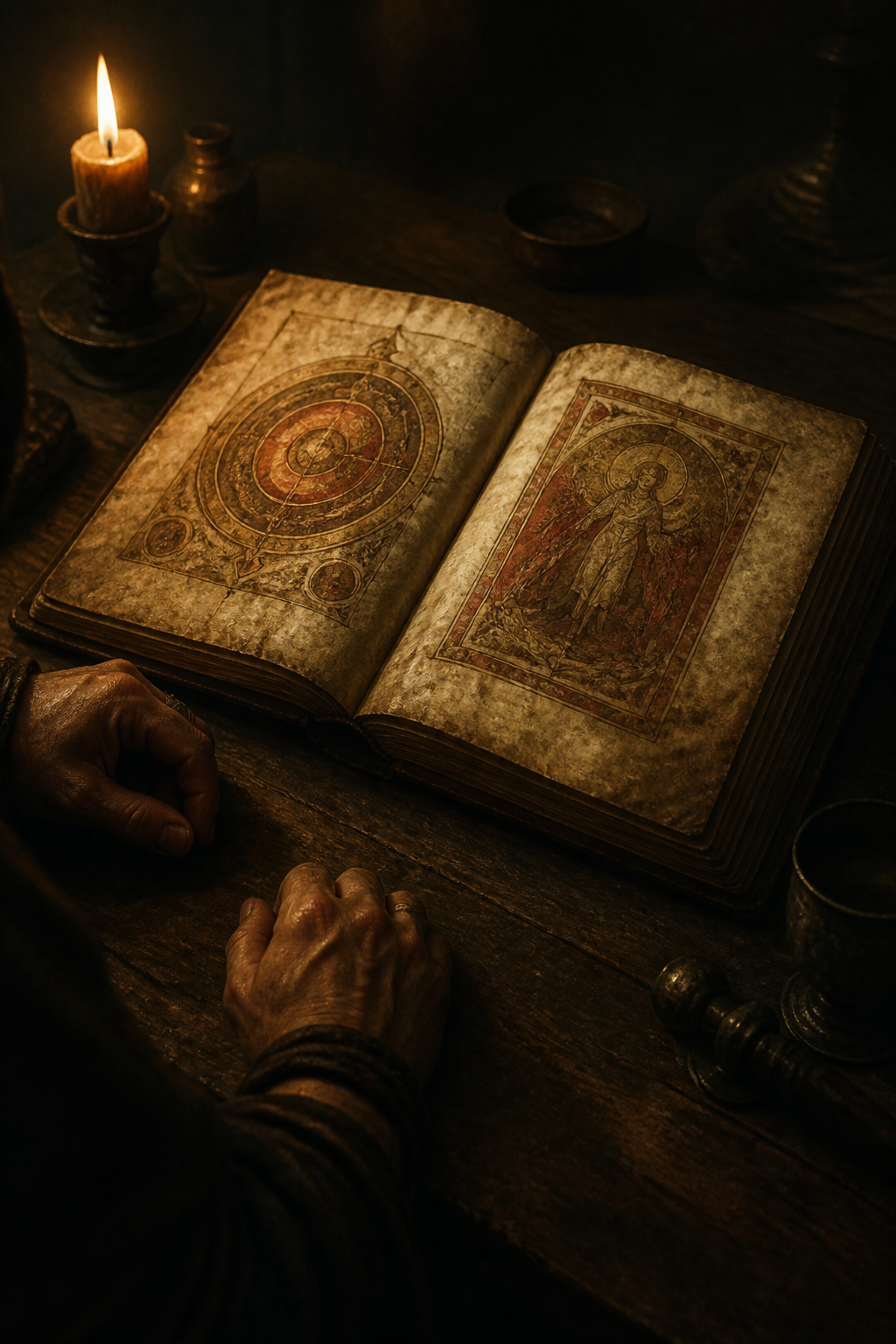
The book is on the table. Everything that keeps it also marks it.
Before any names arrive: put your hands on the thing itself. Tap the book. Move what is lying around it — the card, the cloth, the strongroom door, the bench, the case. Each of those is something a real person did to this manuscript, and each one costs it something.
There is no right order and no safe state to leave it in. Nothing here resets: what you change stays changed, and the record of it stays beside you.
Tap the book · tap or drag what is around itModelled image · not an archival photograph
This book, as your hands have left it
- Where it is
- on an open table, indoors
- Who is holding it
- an institution, in office hours
- How findable
- obscure — one object among many
- Condition record
- continuous
- Surface
- as it arrived, 1894
- Times looked at
- 0
Traces on the pages: wine · a child's hand · an inspector's signature, 1609 · soot · a lifted fibre · a modern fingerprint
1894. It is already bought, already indoors, already somebody's job. Nothing you do here starts the story.
Documented The National Museum in Sarajevo acquired the manuscript in 1894 by purchase from a member of a Sarajevo Sephardic family. Money changed hands; the book stayed in the same city.
Your order, not the record's: —
01Kupovina/Acquisition1894
A purchase settles who owns a book. It settles nothing about whether the book is safe.
In 1894 the manuscript stopped being a household object and became an institutional one. It had been in a Sarajevo family; it went into the National Museum of Bosnia and Herzegovina, then run under Austro-Hungarian administration. Money changed hands. The book stayed in the same city.
Before that, it had been in use. It was made in Catalonia in the middle of the fourteenth century, for a table, to be read aloud once a year. Whoever carried it out of Iberia, and whoever kept it through the four centuries that followed, left no name in the record reproduced here.
Acquisition ended one custody relation — a family, in possession, in use — and opened another, in which the book is held by an office that outlives any single person and answers to whichever state is standing.
Evidence, this stage
DocumentedThe 1894 acquisition
The National Museum in Sarajevo acquired the manuscript in 1894 by purchase from a member of a Sarajevo Sephardic family. Published accounts give the seller's name as Joseph Kohen; the spelling Koen also appears. Both forms are left standing here rather than resolved.
InferenceWhy a family sells a book
Household need is the reason usually given. The sources available here do not establish it. The motive is treated as unknown rather than repeated as fact — a family's decision under pressure is exactly the kind of thing archives do not keep.
Not recordedIberia to Bosnia
How the manuscript travelled from Catalonia to Sarajevo after the expulsions from Iberia is not documented. That gap is roughly four hundred years long. Someone kept the book through all of it; the record holds no keeper's name.
02Katalogizacija/Cataloguing1894 — 1898
Cataloguing makes a thing findable. Findable is not the same as protected.
The manuscript was sent to Vienna to be studied, measured, described and photographed. In 1898 a facsimile edition with scholarly commentary appeared there, and the book returned to Sarajevo carrying something it had not had before: a public description, a price range, a reputation, and a name that could be spoken by strangers.
Description is a form of care. It is also a form of exposure. Every accurate entry in a register tells anyone with the register where to go.
After 1898 the book could no longer be quietly misplaced among other objects. Obscurity had been an accidental defence, and cataloguing spent it.
Evidence, this stage
DocumentedVienna, 1898
The manuscript was sent to Vienna for study. A facsimile edition with commentary by David Heinrich Müller and Julius von Schlosser was published there in 1898. The manuscript itself went back to Sarajevo.
Station readingA described object can be asked for
This page reads the 1898 publication as the reason a stranger could later arrive and request the book by name. That is a reading of consequence, not a claim about anyone's intention. Scholarship and exposure were produced by the same act.
Attributed readingValuation as custody
Published accounts from the twentieth century onward place the manuscript among the most important illuminated Hebrew books known. Valuation is itself a custody act: it decides what is worth guarding, and to whom it is worth taking.
Tap to uncover · tap again to coverModelled image · not an archival photograph
03Skrivanje/Concealment1942
Concealment is not ownership. Whoever holds it can no longer be seen to hold it.
In 1942, with Sarajevo under an administration allied to Nazi Germany, an officer came to the museum for the Haggadah. What happened in that room reaches us as testimony rather than as paper: the director said the book was already gone; the librarian took it out of the building.
Concealment is the strangest custody relation in this sequence. The institution keeps legal title and loses physical hold. The people who actually have the book cannot be named, cannot be thanked, and cannot be protected. The record of those months is therefore thin exactly where the risk was greatest.
Hiding bought time and cost knowledge. There is no inventory of those years, no condition report, no photograph. Some of the hands the book passed through are simply not in the sources.
Evidence, this stage
AttributedThe request at the museum
Accounts published after the war describe a German officer arriving at the museum in Sarajevo in 1942 and asking for the Haggadah, and the museum's director, Jozo Petrović, telling him it had already been given to another officer. The exchange survives as recollection, transmitted through later writers. No wording is quoted here, because no wording can be verified.
DocumentedDerviš Korkut
Korkut was the museum's chief librarian. He was later recognised by Yad Vashem as Righteous Among the Nations for sheltering Mira Papo, a young Jewish woman, in his household together with his wife, Servet. His risks were not taken for a book alone, and it distorts him to remember only the book.
ReconstructionWhere the book went
Accounts place the manuscript, once it left the museum, in a village in the mountains above the city — Bjelašnica is named in several of them — kept in a household, or among Islamic manuscripts. The accounts differ on the place, the keeper, and how long it stayed. Where they disagree, the disagreement is kept.
Not recordedWho else held it
The people who kept the manuscript while it was outside the museum are only partly named in the available sources. This page does not supply names to make the sequence feel complete.
AttributedAfterwards
Published accounts record that Korkut was later imprisoned by the postwar authorities. The survival of the manuscript did not settle the fate of the man who carried it out. The two outcomes are separate, and joining them into one triumph is a mistake.
04Vraćanje/Retrieval1945 · 1992 · 1995
Retrieval moves risk from one place to another. It does not remove it.
The book came back to the museum after the war, and half a century later it had to be moved again. During the siege of Sarajevo it was taken out of the museum and put into a bank vault in the city — shelled buildings and fire being the immediate danger, and a steel room being the closest thing available to an answer.
A vault solves fire and looting. It does not solve damp, heat, or the slow harm of never being examined. And a book nobody can see becomes a rumour: through the war, the story circulated that the Haggadah had been sold. In 1995 it was brought out and shown at a seder, in the middle of the siege, partly to answer that.
כָּל דִּכְפִין יֵיתֵי וְיֵכוֹל
“Let all who are hungry come and eat.” From the Aramaic passage read near the opening of the seder — the manuscript's own text layer, the reason the book exists as an object to be used.
Once it was in a vault, the museum could guarantee its existence and no longer its condition. Proving the book was still there required exposing it.
Evidence, this stage
DocumentedBack in the museum
After the Second World War the manuscript was again in the keeping of the National Museum in Sarajevo, where it remained through the following decades.
Attributed1992 — into a bank vault
Accounts of the siege credit museum staff, and the then director Enver Imamović, with removing the manuscript from the museum and placing it in a bank vault in the city. Descriptions of the escort, the route and the timing differ between accounts.
Attributed1995 — shown at a seder
During the war the manuscript was brought out and shown at a Passover seder in Sarajevo. Accounts describe the appearance as a response to rumours that the book had been sold, and record the president, Alija Izetbegović, as present.
Station readingTrading one safety for another
A vault is better than a shelled museum and worse than a controlled store. Parchment needs stable temperature, stable humidity and periodic inspection; a locked strongroom offers none of those. Each move in this sequence buys one kind of safety with another.
05Konzervacija/Conservation2001
Conservation changes the object in order to keep it. Nothing comes back untouched.
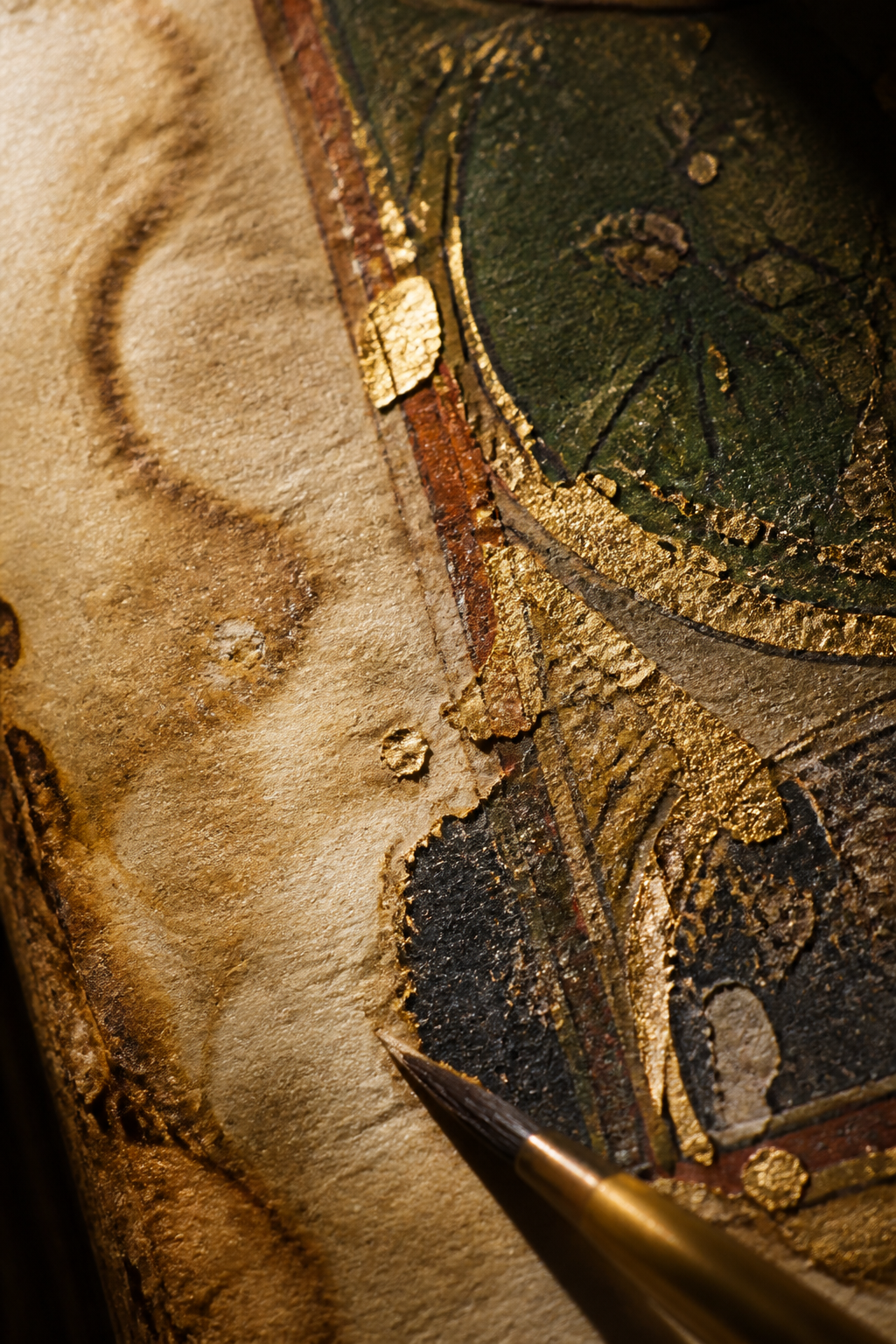
In 2001 the manuscript was conserved in Sarajevo. This is the only stage in the sequence where the book is deliberately altered — cleaned, stabilised, its binding addressed — by someone whose whole training is in knowing which damage to leave alone.
The pages carry their own custody record: marks of use, stains, a child's hand, and an inspector's signature from 1609 that let the book pass. Every one of those traces is evidence of a moment when the manuscript was somebody's responsibility. To conserve is to decide which of those moments the object will go on showing.
Stabilising means selecting. A cleaned surface no longer reports what was on it; a repaired binding fixes one arrangement of the leaves. The book gained decades and lost some of its own testimony.
Evidence, this stage
DocumentedThe 2001 campaign
The manuscript was conserved in Sarajevo in 2001. The work was carried out by the conservator Andrea Pataki; published accounts describe international support for the project, including UNESCO, and the involvement of the Jewish community of Bosnia and Herzegovina.
DocumentedAn inspection note, 1609
The manuscript carries a note dated 1609 signed by Giovanni Domenico Vistorini, a censor working in Italy. Transcriptions differ slightly between published readings, so none is presented here as the exact wording. The signature that cleared the book is part of the reason there is anything left to conserve.
AttributedTraces of use
Published descriptions record marks of household use on the pages, including staining consistent with wine and writing in a child's hand. The present binding is modern; earlier bindings do not survive. This was a book at a table before it was a book in a case.
Station readingRepair is an editorial act
Conservation is the one custody decision in this sequence made calmly, with time and expertise — and it is still irreversible. That is the point: careful custody is not the absence of loss.
06Izlaganje/Display2002 —
Display gives access and takes away cover.
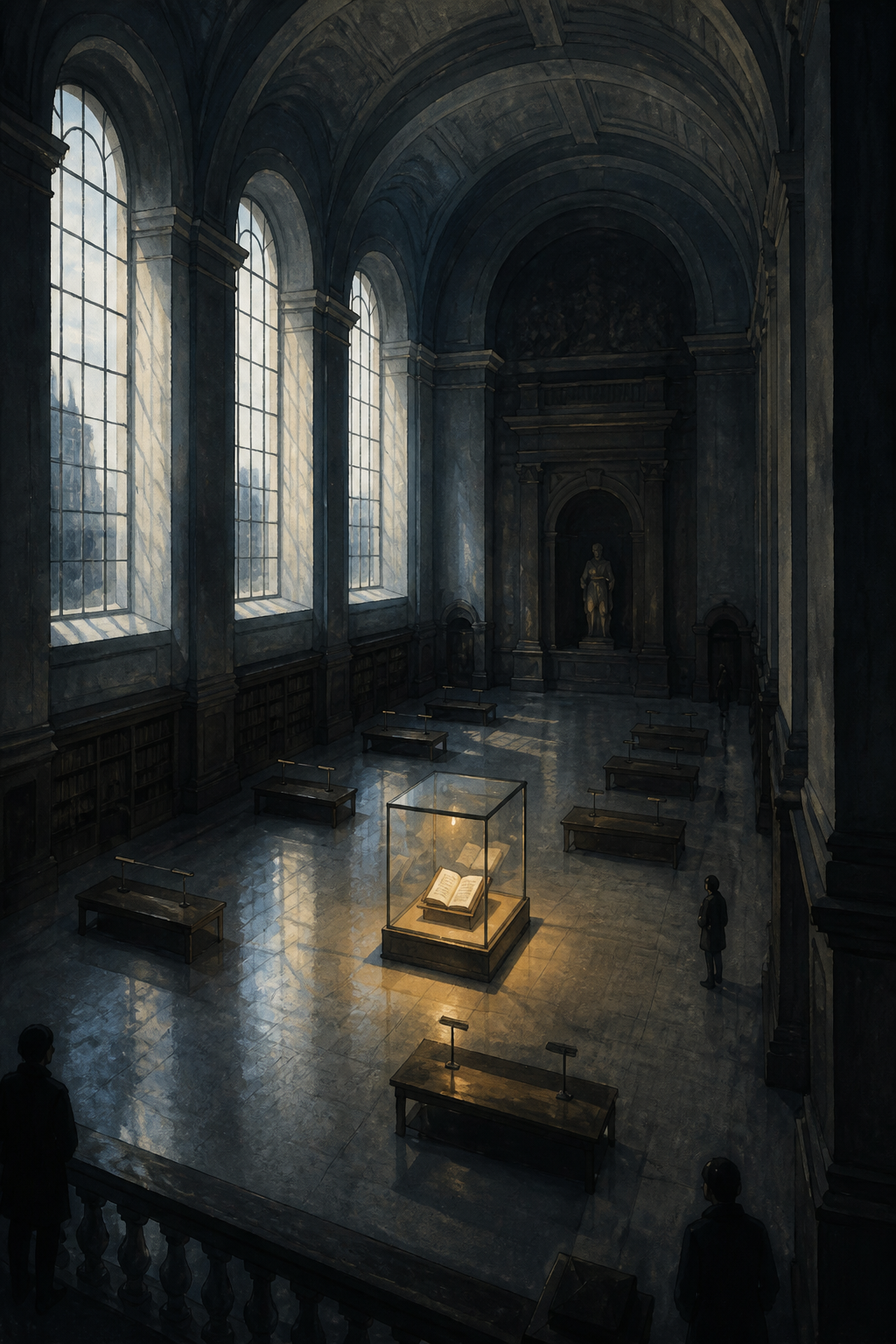
Since conservation the manuscript has been kept in a controlled, secured room and shown only on limited occasions; in the galleries a facsimile usually stands in its place. Visibility is rationed, deliberately, because looking at a book costs the book something.
The threat at this stage is not an officer at a door. Between 2012 and 2015 the museum's own doors were shut, its funding and legal status unresolved. Custody in those years was a matter of salaries, statutes and whether anyone was contractually obliged to open the building.
Nothing here has concluded. Access, exposure and money are still being decided, by people whose decisions will not be described as heroic and may matter as much as any of the others.
Evidence, this stage
DocumentedVault, and a stand-in
Following the 2001 conservation the manuscript has been held in a purpose-built, climate-controlled and secured room in the National Museum, and shown to the public only on restricted occasions. A facsimile serves for general display.
DocumentedClosed doors, 2012 — 2015
The National Museum of Bosnia and Herzegovina closed to the public in 2012 with its funding and legal status unresolved, and reopened in 2015. The building's condition, not any single confrontation, was the risk of that decade.
Station readingAccess and cover compete
Showing the book answers doubt, sustains support and teaches; it also means light, handling, attention, and public knowledge of where the object is. Both cannot be maximised at once, and choosing between them is the work.
Not recordedThe present arrangement
How often the manuscript is currently visible, and on whose authority, changes. This page does not state a present schedule it cannot verify.
Ownership was settled in 1894. Safety has never once been settled.
Six changes of custody, and not one of them is the moment the book was saved. A purchase moved it indoors. A catalogue made it known. Concealment made it unknowable. Retrieval traded one danger for another. Conservation kept it by altering it. Display keeps it useful and keeps it exposed.
Each decision closed a door behind it. That is what a decision is — and whatever order you took them in on the table above, the book still carries all of it.
The title of this station is the version that travels: two museum workers, one refusal, a treasure preserved. Refusal was part of it. So were a family's sale, a scholar's description, a village household, a bank clerk's strongroom, a conservator's scalpel, and years of unglamorous argument about who pays to keep a building open.
Some of the people in that list are named above. Some are not named anywhere. The book is not here because it was owned. It is here because, repeatedly, and without knowing the outcome, people decided either not to hand it over or to hand it on.
How to read the notes on this page
Established by the record: dates, holdings, publications, formal recognitions.
Reported or recollected in published accounts, transmitted through others, not verifiable here as document.
This page's own interpretation of what a decision meant. Argument, not evidence.
A reasonable conclusion from what is known, marked as conclusion rather than fact.
Assembled from accounts that disagree. The disagreement is left visible rather than resolved.
A real gap. Nothing has been invented to fill it — no names, no places, no words.
Every image on this page is modelled: made for this station to hold an atmosphere. None is an archival photograph, and none should be read as evidence of a place, a person, a page or a moment. The lines that appear as you handle the book on the table use the same six classes as the notes. No speech is quoted from any person in this account. The one quotation is from the manuscript's own text layer.