Move it south by road
reduces
Exposure to search, seizure and fire in an occupied town.
creates
Roughly a thousand kilometres of checkpoints, loading, re-loading, and hands that are not the family's.
Not yet done to this trunk.
Modelled reconstruction. Not a photograph.
Timbuktu, Mali · paper / metal / moisture / distance
Before this is history, it is an object in a room: a hinged steel footlocker, a stack of loose leaves and bound volumes, and a person who has to decide whether to lift it.
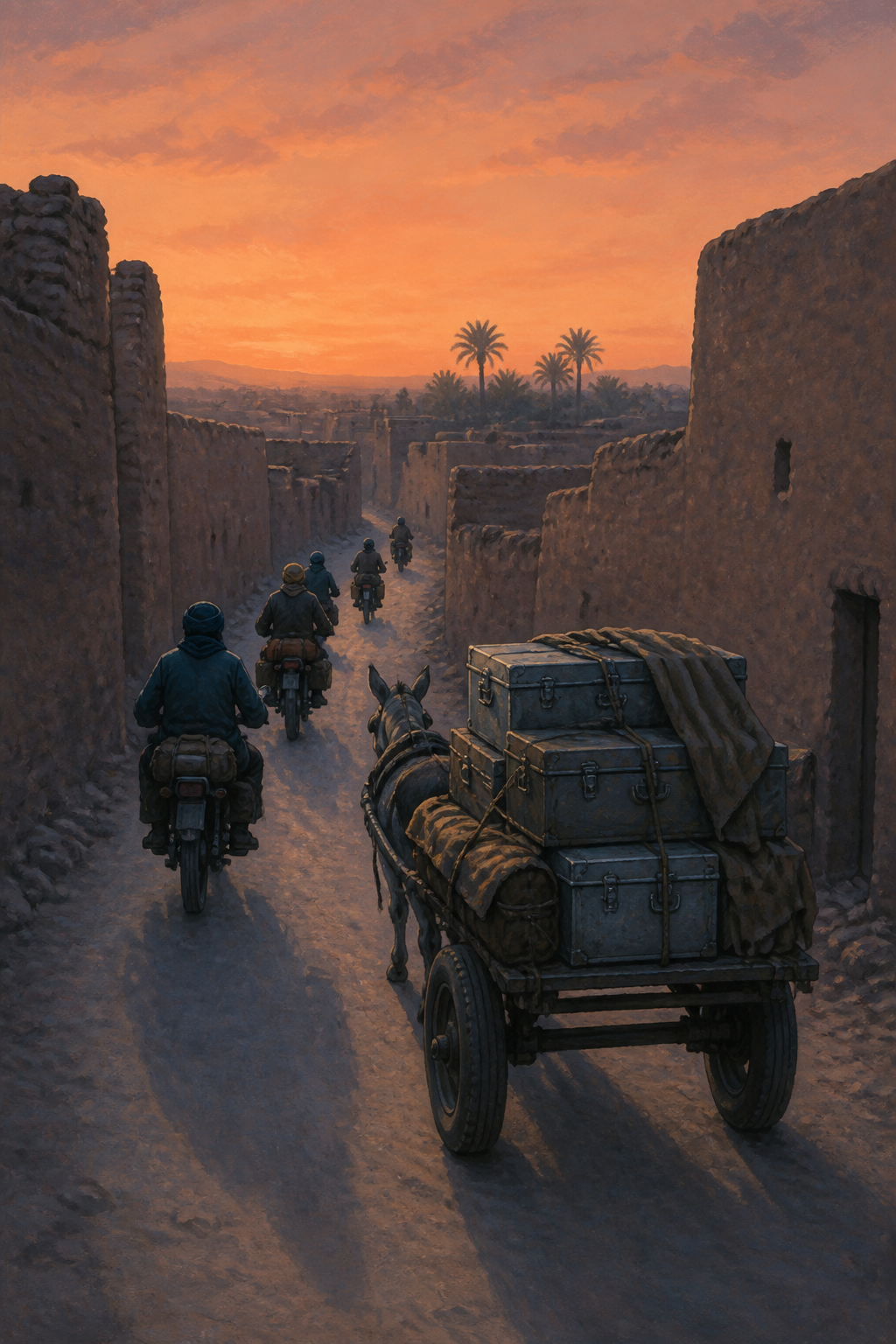
Between 2012 and 2013, family collections in Timbuktu were packed and carried south. Not by one person. By many households making unlike decisions, and by couriers, drivers and boatmen whose names the record mostly does not hold.
One of those trunks is a few lines below. It is the only one on this page, and it keeps what you do to it.
First contact · the trunk
A trunk is not a symbol. It has a hinge that rusts, a lid that will not close past a certain height, and a lock that tells anyone watching that something inside is worth locking. Handle this one first. The explanations are underneath.
Nothing inside. Lid open to the air. Standing in the room. Dry air. Inside: dry. Unnoticed.
The bundles on the shelf can be dragged, or tapped.
Modelled object. Nothing here is a photograph, and nothing you do to it can be undone.
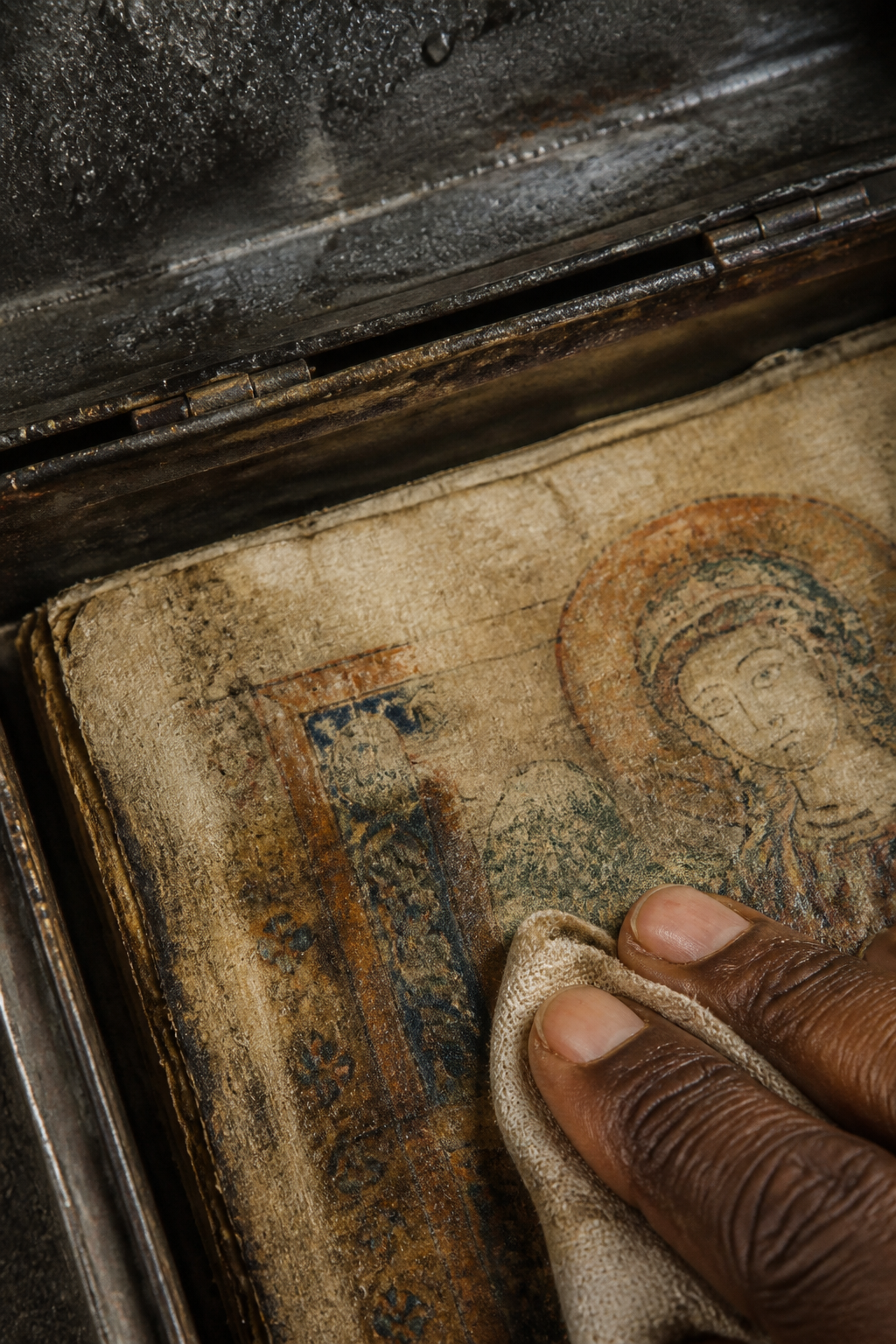
Every choice that saved this paper also cost it something.
The ledger · tradeoffs, not routes
There is no correct line to follow here. Each decision below reduces one danger and manufactures another. Nothing on this page records a decision for you: these entries are stamped by what you actually do to the trunk, and once stamped they stay.
Exposure to search, seizure and fire in an occupied town.
Roughly a thousand kilometres of checkpoints, loading, re-loading, and hands that are not the family's.
Not yet done to this trunk.
Handling. Nothing is lost to a road, a river or a stranger's van.
Total dependence on one building and on silence. If the room is opened, there is no time left to move.
Not yet done to this trunk.
Road checkpoints, and the number of times a trunk must be explained.
Days in an open boat: spray, night damp, and a sealed steel box that cannot dry.
Not yet done to this trunk.
The chance that one fire, one raid or one flooded room ends everything.
A library that exists in fragments across many addresses, with its order broken and its inventory in several heads.
Not yet done to this trunk.
Rumour, and the number of people who could give the trunk away.
Isolation. If a courier does not arrive, nobody can look for the right thing — including the family's own next generation.
Not yet done to this trunk.
Some of these cannot both be true of one trunk. Across thirty-two family libraries, all of them were true at once.
Custody · households that did not agree
The collections were private and inherited — held in households, sometimes over generations, alongside coordination by the Timbuktu manuscript association and staff of the state institute. Custody was collective in logistics and separate in decision. Your trunk is one household's. It is not all of them.
Packed in stages over weeks; relatives travelled with the trunks rather than sending them ahead. The collection arrived comparatively whole and comparatively far from home.
Held everything in place at first — floors, wall cavities, the same rooms that had kept it for generations — and released a portion only once the risk in the town changed. Part of that collection never left.
Some leaves went south, some stayed with kin outside the town, some stayed put. No one address held the library; no one person held the list.
Not one action by one hero. These decisions are kept apart here because they were made apart, under different roofs, with different things to lose.
Abdel Kader Haïdara, a manuscript custodian and organiser of the Timbuktu manuscript association, is widely and correctly credited with coordinating much of the movement and the funding behind it. He is one node in a network — one that also required families willing to hand over their inheritance to strangers, and drivers willing to carry it.
Reported totals for manuscripts moved vary widely between accounts, from the low hundreds of thousands upward, and remain contested. We do not settle that number here.
Labour · unnamed in the record, load-bearing in fact
Nothing on the route moves without paid, risked, unrecorded work. These four descriptions stay closed until the trunk has actually been lifted and carried — because before that, there is nothing of theirs to credit.
Sealed. The trunk above has not yet been carried anywhere. Nobody has done anything for it yet.
The journey is currently described without the people who performed it.
Cataloguing · what naming does
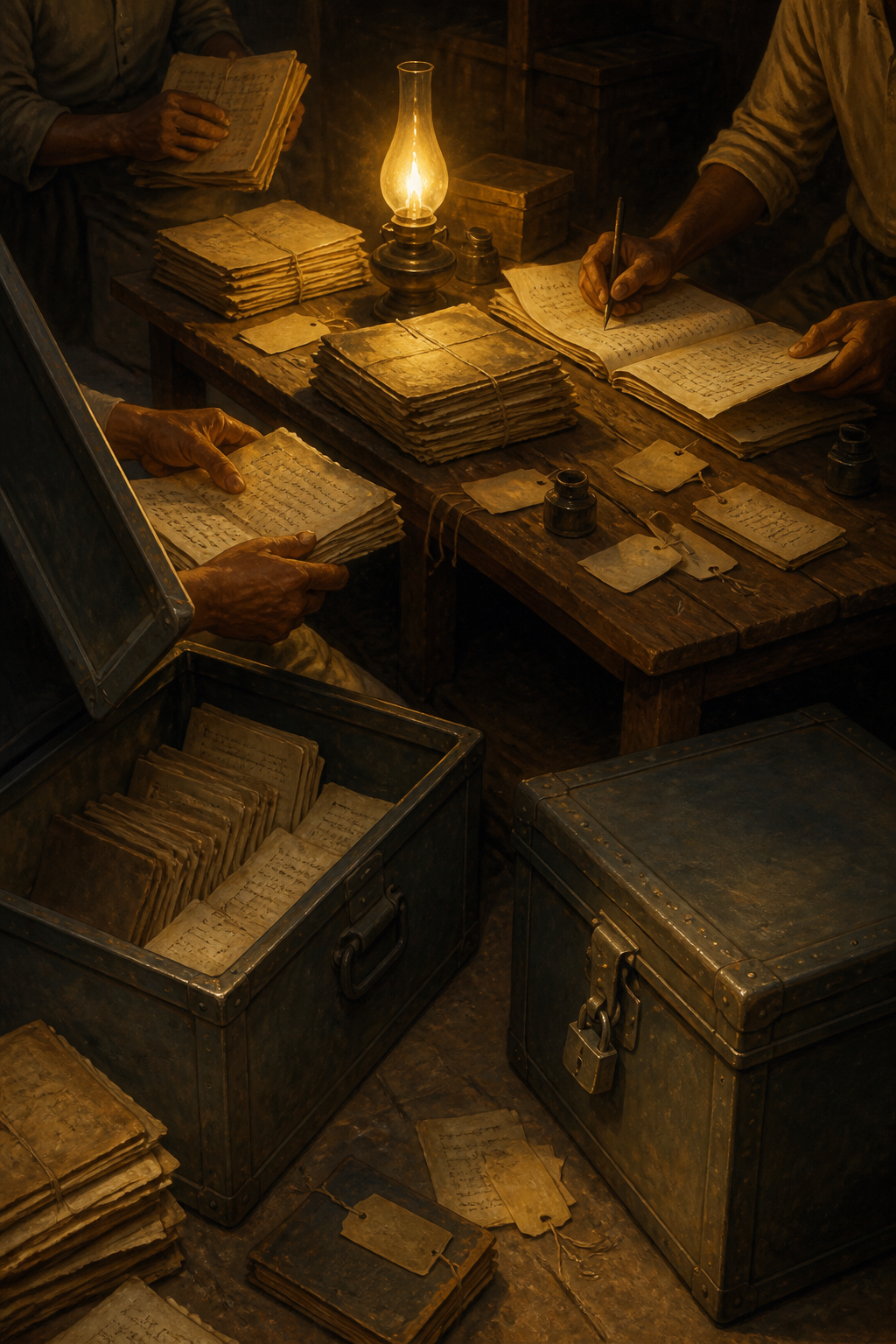
An uncatalogued leaf cannot be searched, requested, insured, conserved or returned to a named owner. It also cannot be found by anyone reading the list for other reasons. Both of those are the same sentence.
Your trunk carries a chalk mark and nothing else. Nothing in it can be requested, funded for treatment, or matched to an heir.
Before description, the whole of what is known is written on the lid: a chalked number, a household, a count that may be approximate.
Nothing here can be requested by a reader, funded for conservation, or matched to an heir.
Description turns a box into items: subject, script, date range, owner, damage, priority for treatment. Conservation becomes possible because the paper is now legible as specific paper.
And the collection is now findable by name — by conservators, by researchers, by anyone at all. Cataloguing does not neutralise risk. It changes who can act, in both directions.
Afterwards · not a reset
Much of what left Timbuktu stayed in the south for years after the occupation ended: stored in rented buildings, boxed, dehumidified, described and treated, through rainy seasons the paper had never met before.
Some material has gone back. Some has not. Return means the same trunks, older paper, weakened bindings, and a second set of decisions about buildings, security and who now holds the list. The library that comes home is not the library that left, and it does not arrive all at once.
Your trunk has not been brought back to the room. If you do bring it back, it will not arrive empty of what happened to it.
reading of the record
What this adds up to is not a rescue with an ending. It is custody: continuous, expensive, shared unevenly, and still being paid for.
How to read the marks on this page