The Computer Sang
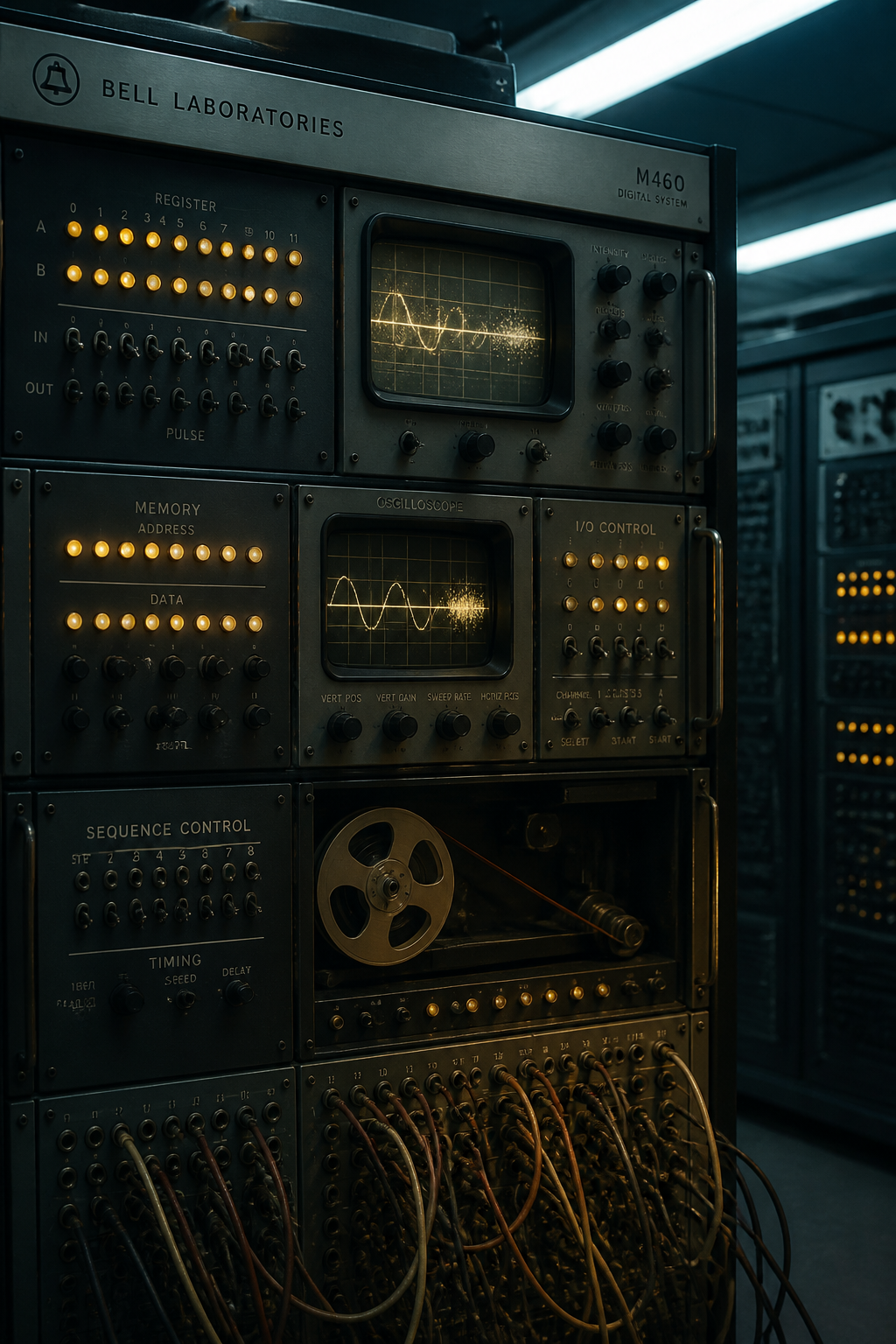
An unfinished machine in a research room: racks, cabling and a paper tape reel, waiting for someone to decide what it should do.
Bell Labs · Murray Hill · 1961

The computer sang because several people taught it

Right now this system can only breathe. Four decisions were made by different people, in different rooms, for different reasons. Bring one in and listen to what is still missing.

Present-day reconstruction. No 1961 recording is played, copied or imitated here — the sound is newly generated for this station: a pulse, three resonances, a plucked accompaniment, and a melodic contour written today. It is a model of the principle, not archival evidence.

Breath and room noise only. Nothing here can hold a pitch, and nothing here is a song.

documented · source-attributed

A throat made of numbers

John L. Kelly Jr. · Carol Lochbaum

Before anything could sing, someone had to describe a voice as a set of quantities: a pulse for the vocal folds, resonances for the tract, a way to move between them. Published accounts of the Bell Labs speech-synthesis work name Kelly and Lochbaum for the vocal-tract synthesis behind the 1961 demonstration.

What that gives you is the possibility of a voice. A vowel. A hum that leans toward a mouth. Not yet a performance — you can hear it drift, because nothing is holding it in time.

Roles here are reported consistently across the main accounts, which is why they are stated plainly. That is not true of everything below.
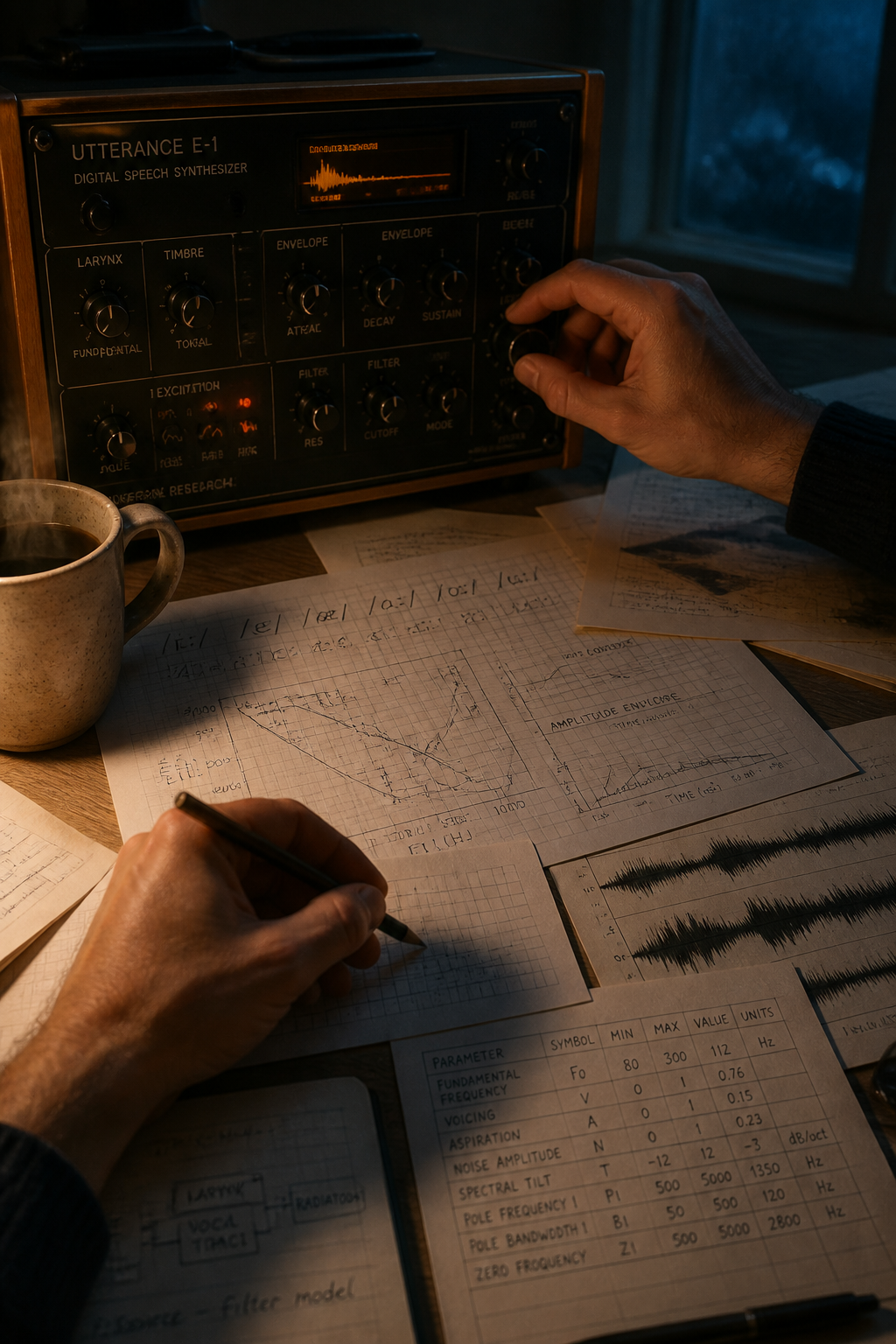
A researcher leaning close to a control panel, one hand on a dial, adjusting the parameters of a synthetic voice.
Present-day illustration · the intimate scale of the work: one person, one parameter, listen, change it, listen again.
documented · machine identity varies

Nothing about it was instant

an IBM computer at Bell Labs · digital-to-analogue conversion

The singing was not produced live at a keyboard. Sound samples were computed, written out, and converted to audio afterwards. The machine's contribution is arithmetic and a clock: only now does the drifting vowel become discrete, in tune, countable — a thing that can be scored.

Accounts differ on which machine did the work — an IBM 704 is most often named, other sources say a 7090-series computer. This Station does not settle it, and does not need to.

credit contested · accounts differ

The accompaniment came from a different decision

Max Mathews · Joan Miller

The voice and the music under it were not one act. Max Mathews had built the software that let a computer be treated as a musical instrument; a person then had to program an accompaniment, choose its harmony, decide how it would sit beneath a synthetic singer.

Crediting differs by institutional account. Some sources attribute the musical accompaniment to Mathews; others credit Joan Miller with programming the singing computer and its accompaniment. Both readings are surfaced here, and neither is merged. Whichever way the record settles, the point stands: the accompaniment was authored separately from the voice.

interpretation · inferred from practice

Somebody kept listening

Bell Labs colleagues · largely unnamed

Between a set of parameters and something a visitor would recognise as singing, there is an act the archives record worst: a person hearing the result, deciding it was wrong, and changing a number. Then hearing it again.

No source hands us a name for every adjustment. This channel is therefore marked as interpretation, not fact — but it is the one that finally brings the two sides of the room into the same place.

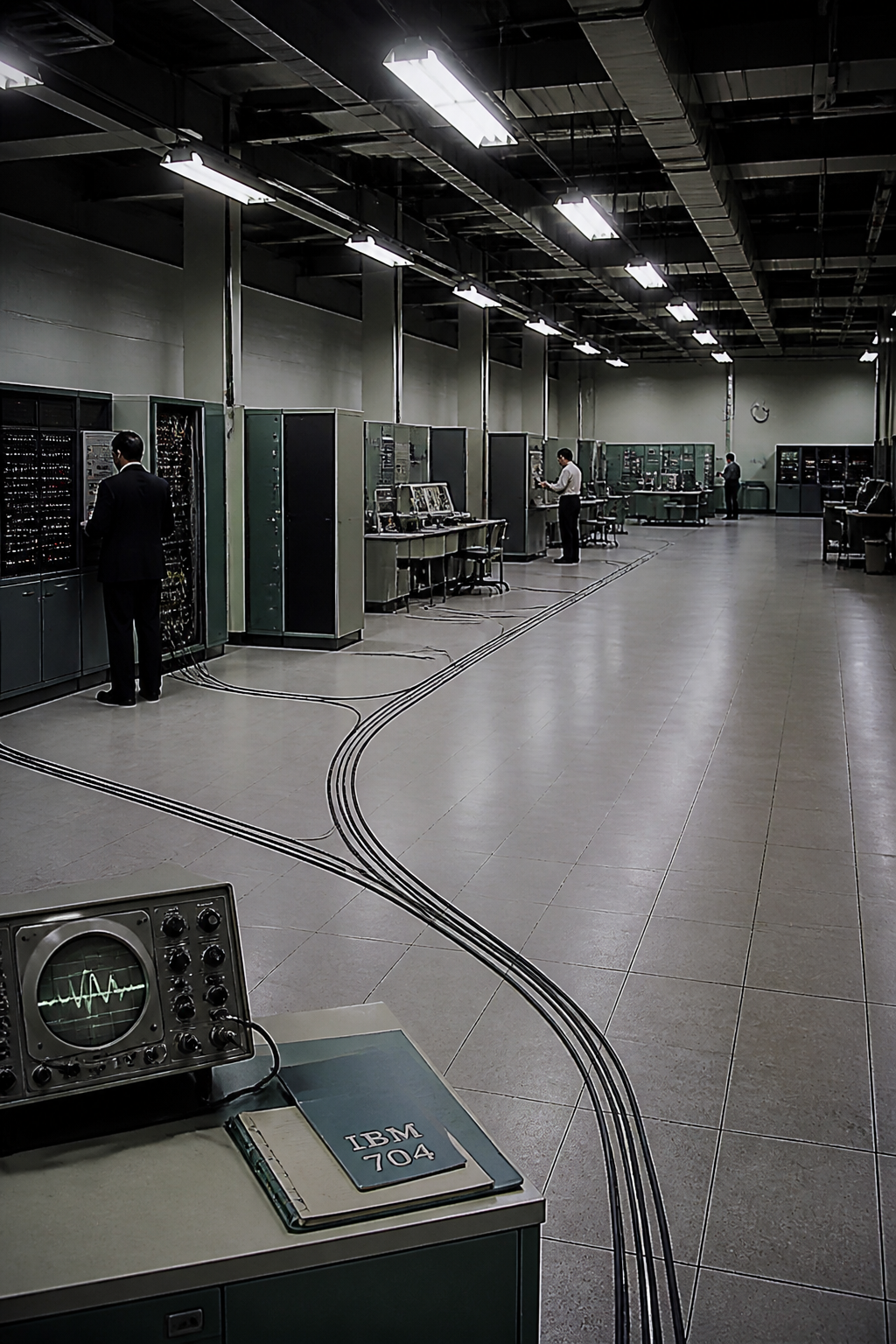
A vast institutional laboratory hall, rows of equipment under high ceilings, where separate projects met.

what one short sentence hides

The computer sang.

later · cultural transmission

A visitor takes the memory out of the building

By his own telling, Arthur C. Clarke heard a computer sing at Murray Hill while visiting Bell Labs, and never forgot it. Years later, a machine in a film loses its mind and its voice slides down into a song. That is how most people meet this event: not as a 1961 acoustics demonstration, but as a memory someone kept.

Clarke's own recollection is the principal source for his presence, and the retellings vary in date and occasion. Treat it as reported memory, not as documented attendance. The film belongs to another Station; here it matters only as evidence that remembering is also a human contribution.

A single listener alone in a dim room, head tilted toward a speaker, carrying the sound forward.
Present-day illustration · the last channel is the one that leaves the building.

source paths & how to read this station

Bell Labs

“The Computer as a Musical Instrument” — institutional account of the music and speech programme. Used here as a starting path; crediting there differs from other accounts.

Acoustical Society of America

“Daisy Bell” — documentation surrounding the 1961 recording. Referenced as evidence and context only.

Arthur C. Clarke

Later recollections of hearing the singing machine. Self-reported, secondary, and inconsistent between retellings.

Audio rights

Reuse of the historical recording is not clearly cleared, so it is not embedded, cloned or imitated. Everything audible on this page was synthesised for this Station today.

Layers are kept apart on purpose: documented fact, source-attributed interpretation where accounts disagree, and editorial interpretation or inference. Where the record is contested, this Station leaves it contested. The Station works silently: if you never turn the sound on, the four channels still light and converge on screen, and every panel is readable as text.