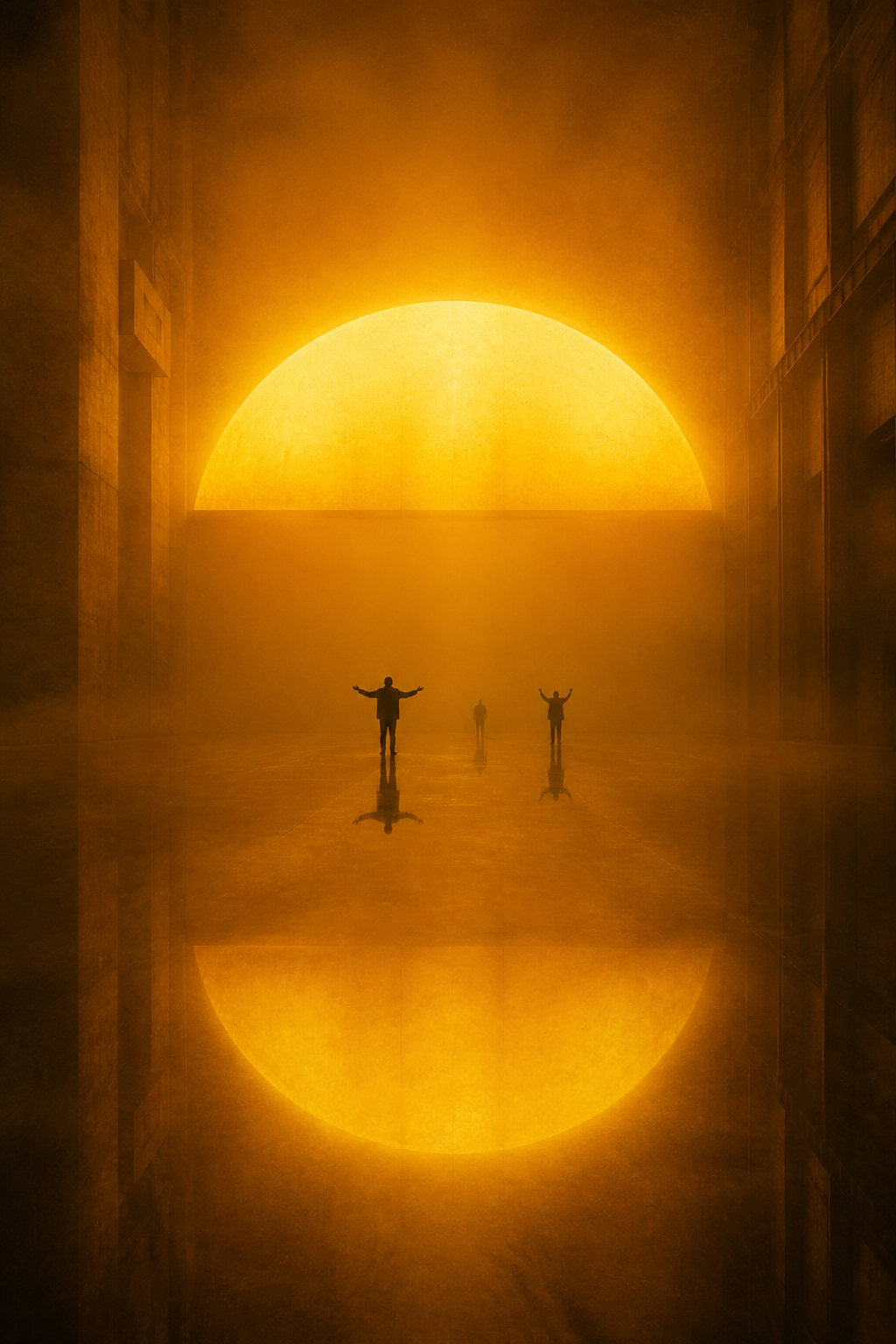
warmthIt is not the sun. It is a bank of mono-frequency lamps set behind a screen — light so narrow in wavelength that every colour in the hall collapses into yellow and black.
airThe atmosphere is being made. A fine mist of sugar and water is released into the hall, thin enough to breathe, thick enough to give the light a body.
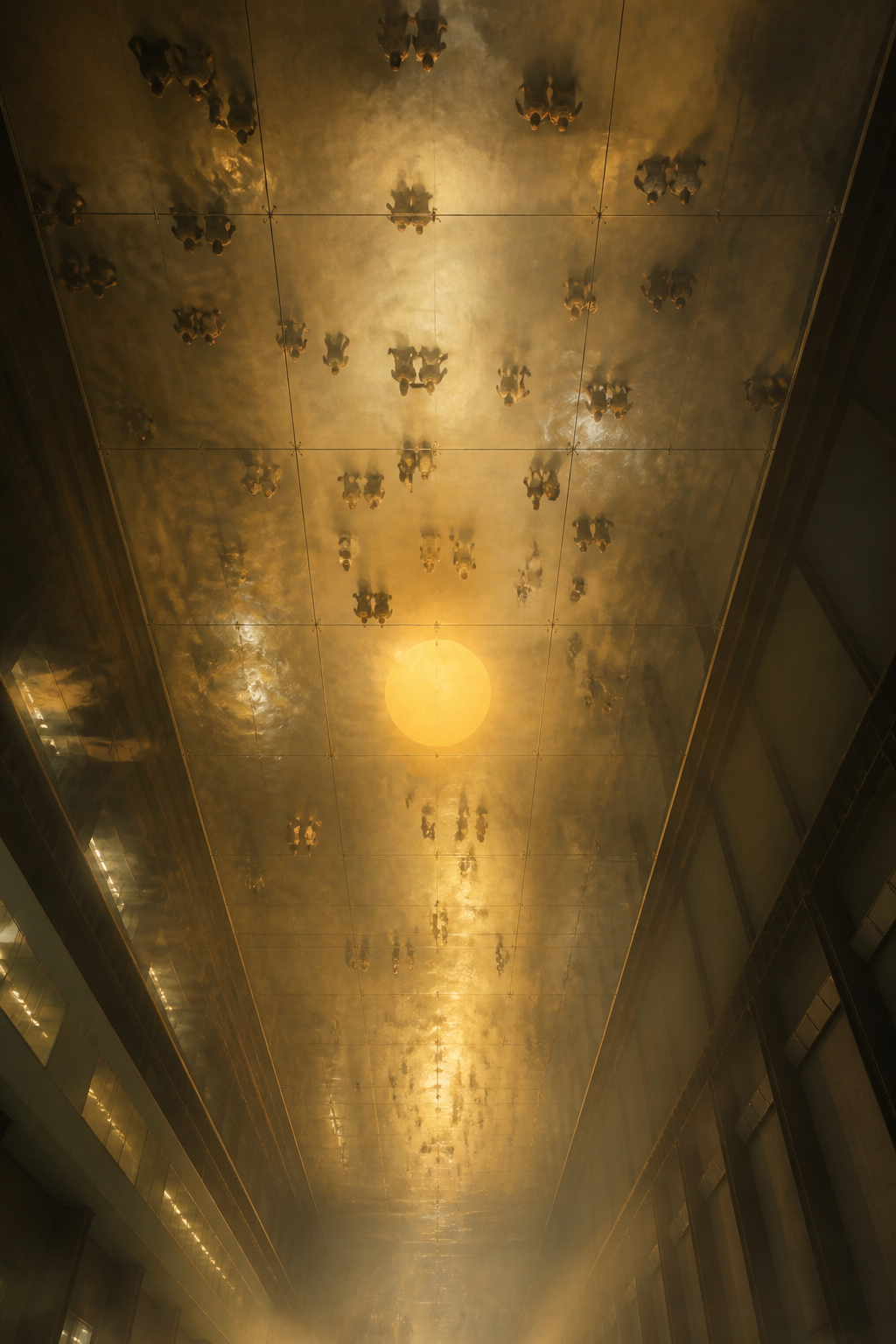
skyThere is no sky. The ceiling is lined with mirror foil, so the half-disc meets its own reflection and closes into a whole sun. You are standing under yourself.
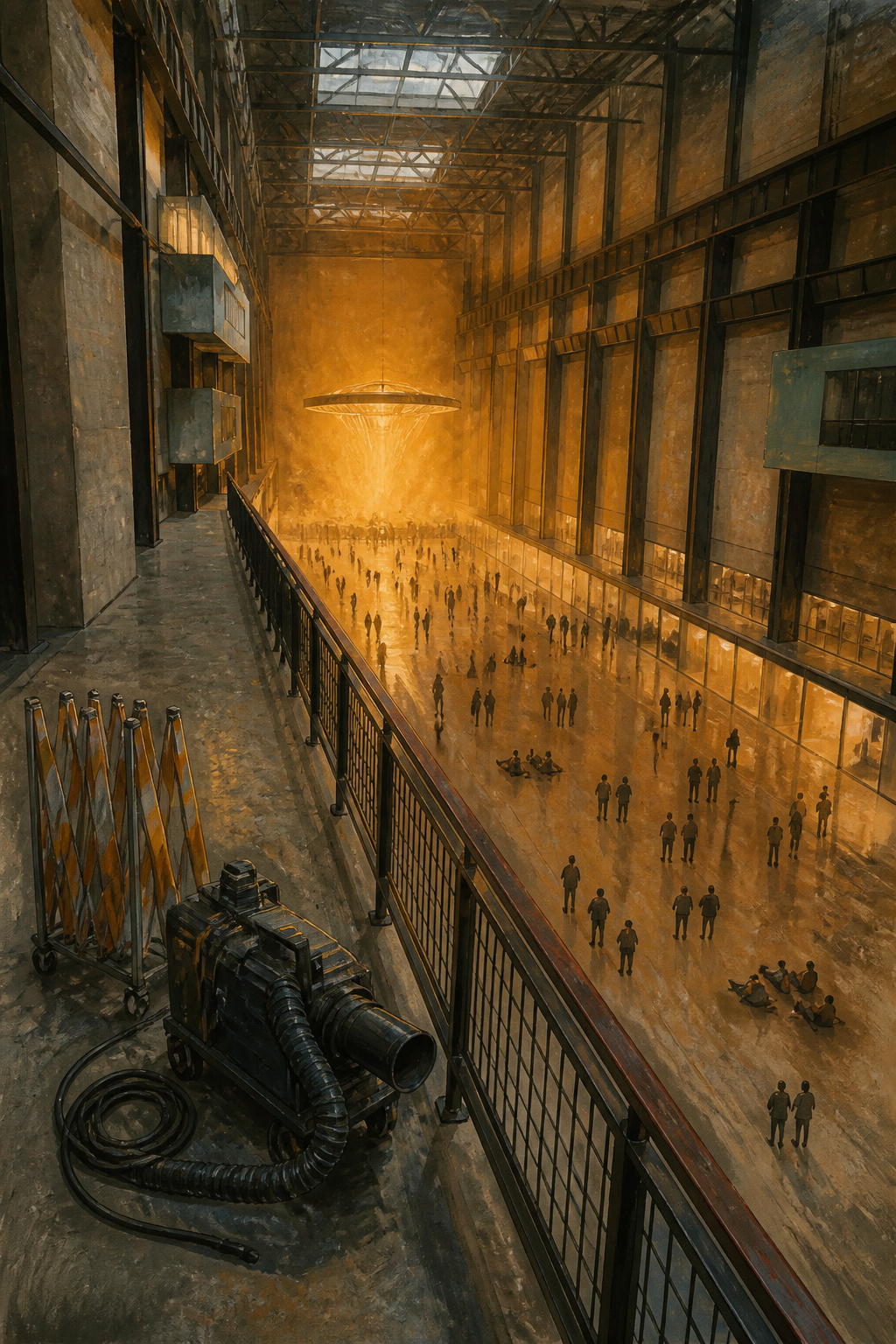
scaleThe horizon is architecture. A hall 155 metres long and 35 metres high, built to hold turbines. Everything overhead had to be hung, checked, and held.
bodiesThe other visitors lie on the concrete, looking up to find themselves small, dark and doubled. They are not the audience. They are part of the material.
You followed everything you could feel back to a person. Now the sun can have a name.
a field, read backwards
The Sun Was a Construction
Olafur Eliasson, The Weather ProjectTurbine Hall, Tate Modern, London16 October 2003 – 21 March 2004
the warmth
→→→
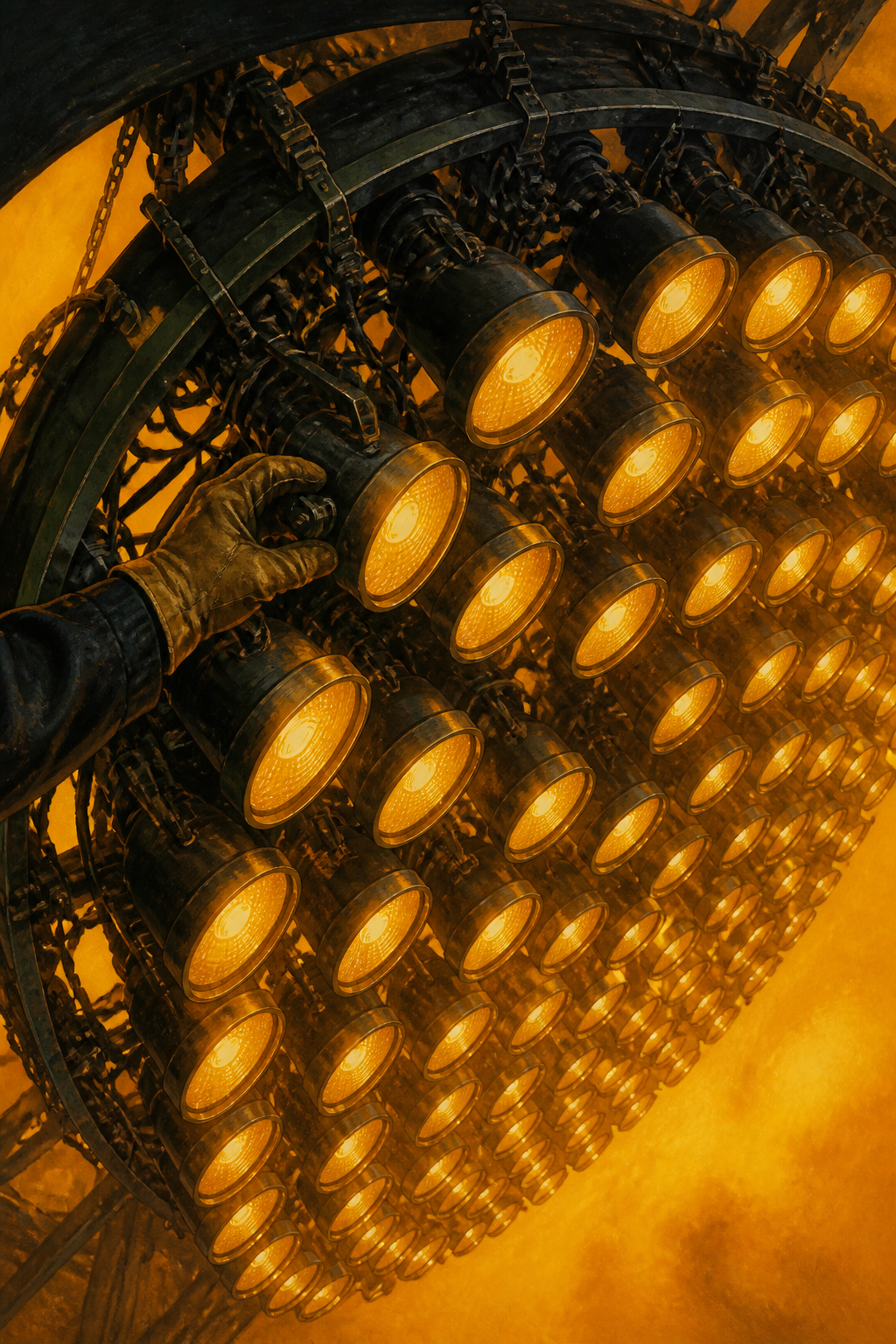
was a lamp bank, and someone had to reach it
documented The apparent sun was a semi-circle of mono-frequency lamps mounted behind a translucent screen at the far end of the hall. Mono-frequency light occupies a band too narrow to describe colour: a red coat, a green scarf and a blue bag all arrive as the same yellow, and every person in the room becomes a silhouette of themselves.
station reading This is why the room felt uncanny before it felt beautiful. Your eyes were not failing. Your eyes were being given less to work with, deliberately, by an instrument.
gap left open How many lamps, how often they were replaced, and who went up to them across five months — this station could not verify. It leaves the space empty rather than filling it in.
reconstruction Modelled for this station to study haze density. Not documentation, not archival.
the air
→→→
was manufactured weather, held at a threshold
documented A fine mist of sugar and water was released into the hall. The haze is what made the light visible as a substance rather than a glare — it gave the beam edges, depth, and something like temperature.
inference Haze like this lives on a threshold. Too thin and the atmosphere vanishes; too thick and the hall becomes fog nobody can walk through, and sightlines and safety start to matter. A threshold is not a setting. It is a judgement, made by a person, repeated every day the doors opened.
the sky
→→→
mirror foil, tensioned overhead
documented The ceiling of the Turbine Hall was covered with mirror foil. The half-disc of lamps met its reflection and read as a complete sun; the crowd read as a second crowd, far away and upside down.
inference Reflective material at that span does not hang itself and does not stay flat. It is measured, lifted, tensioned, inspected — and returned to when it moves. Every clean reflection in every photograph of this work is somebody's completed task.
station reading The most quoted fact about this room is that the sky was a mirror. The less quoted one is that a mirror needs maintaining, and a sun does not.
reconstruction Modelled to study impossible scale and what has to be suspended to produce it. Not documentation.
the scale
→→→
a load-bearing case before it was an image
documented The Turbine Hall runs roughly 155 metres in length and rises around 35 metres — a room built for machines, not for people lying down in it. The "distance" to the sun was the length of a former power station.
inference Anything suspended above a moving public crowd is an engineering and safety case first: fixings, weights, access routes, inspection intervals, what happens if. The sublime, here, arrived downstream of a rigging plan.
the crowd
→→→
visitors, plus the people who kept the room enterable
widely reported Roughly two million people came, and a great many of them lay down: alone, in couples, in long rows, in the shapes of letters and words legible only in the ceiling. They looked up to find their own bodies in the sky.
station reading Do not flatten them. Someone lay there on a lunch break. Someone came back four times. Someone brought a child who would not lie still, and someone stood at the edge and did not lie down at all. The work's most famous material was a set of individual afternoons.
inference And the floor they lay on was swept before they arrived and after they left, and somebody stood in the yellow light for a full shift, answering the same question about the sun, so that the room stayed enterable.
Nobody's name is in this station.
Not because nobody had one. Because this station will not invent one. There were named people here — Olafur Eliasson and Studio Olafur Eliasson, Tate's curators, conservators and technical staff — and there were roles this environment could not have existed without, whose holders are not documented in what could be verified from the anchors below.
So the roles are listed as roles, honestly, and the names are left as a task for whoever researches further. An empty line is more truthful than a plausible one.
reconstruction Modelled to study the service side of an atmosphere: access, cabling, lamp maintenance. Not documentation, and no depicted individual is a real person.
Lighting techniciansKept a narrow band of light burning for five months. inference
Riggers & access crewPut the sky up, and went back up when it moved. inference
Haze operatorsHeld the atmosphere at the threshold where light becomes visible. inference
Safety engineersMade a suspended sun legal above a crowd. inference
Cleaners & floor maintenanceMade a concrete floor somewhere you would willingly lie down. inference
Visitor assistantsStood inside the work all day and explained it standing up. inference
Studio Olafur EliassonDesigned the instrument and the conditions it produced. documented
Tate staffCurated, installed, conserved and ran the hall through the run. documented
VisitorsArrived, lay down, and completed the image. widely reported
what the field was
The warmth on your face was not a trick. It was labour, arriving as light.
Say it carefully: not that the sun was fake. The light genuinely reached you. The haze genuinely carried it. The mirror genuinely put your body into the sky, at a distance you could measure in metres of former power station.
What was engineered was the condition — and a condition that people design, hang, monitor, sweep, staff, inhabit and answer is not an illusion. It is the most ordinary kind of real there is. The atmosphere held because someone was holding it.
You came in and felt weather. Every part of that feeling had a hand on it.
How to read the marks
documented Stated in the primary anchors below, kept narrow.
widely reported Consistently reported figures; treat as approximate.
station reading This station's interpretation, not the artist's or the museum's.
inference Reasoned from what such an environment requires. Not evidence of a specific person's act.
reconstruction Images modelled for this station. Never presented as archival record.
gap left open Something the station could not verify and refuses to invent.
Starting anchors
Open these yourself; this station points, it does not stand in for them.
Studio Olafur Eliasson — The Weather Project
Tate — Olafur Eliasson exhibition pages
No worker names, quotations or dates have been fabricated anywhere on this page. Where evidence ran out, the station stopped.