Scripting is off, so the machine cannot be started here. What follows arrives flattened: every surviving trace laid out at once. The choosing — and the missing — is the part you don't get.
The machine has already run here.— It does not reset.
Reconstruction · generated for this station · not an archival photograph
point of contact: Homage to New York
The Machine Was Built to Disappear
Jean Tinguely’s self-destroying machine, made with the engineer Billy Klüver, presented in the garden of The Museum of Modern Art, New York, on 17 March 1960. It was never meant to still be here.
Nine things happened. Human attention could reach three of them. This page holds only what attention reached.
Phase 01 · it runsReconstruction · modelled
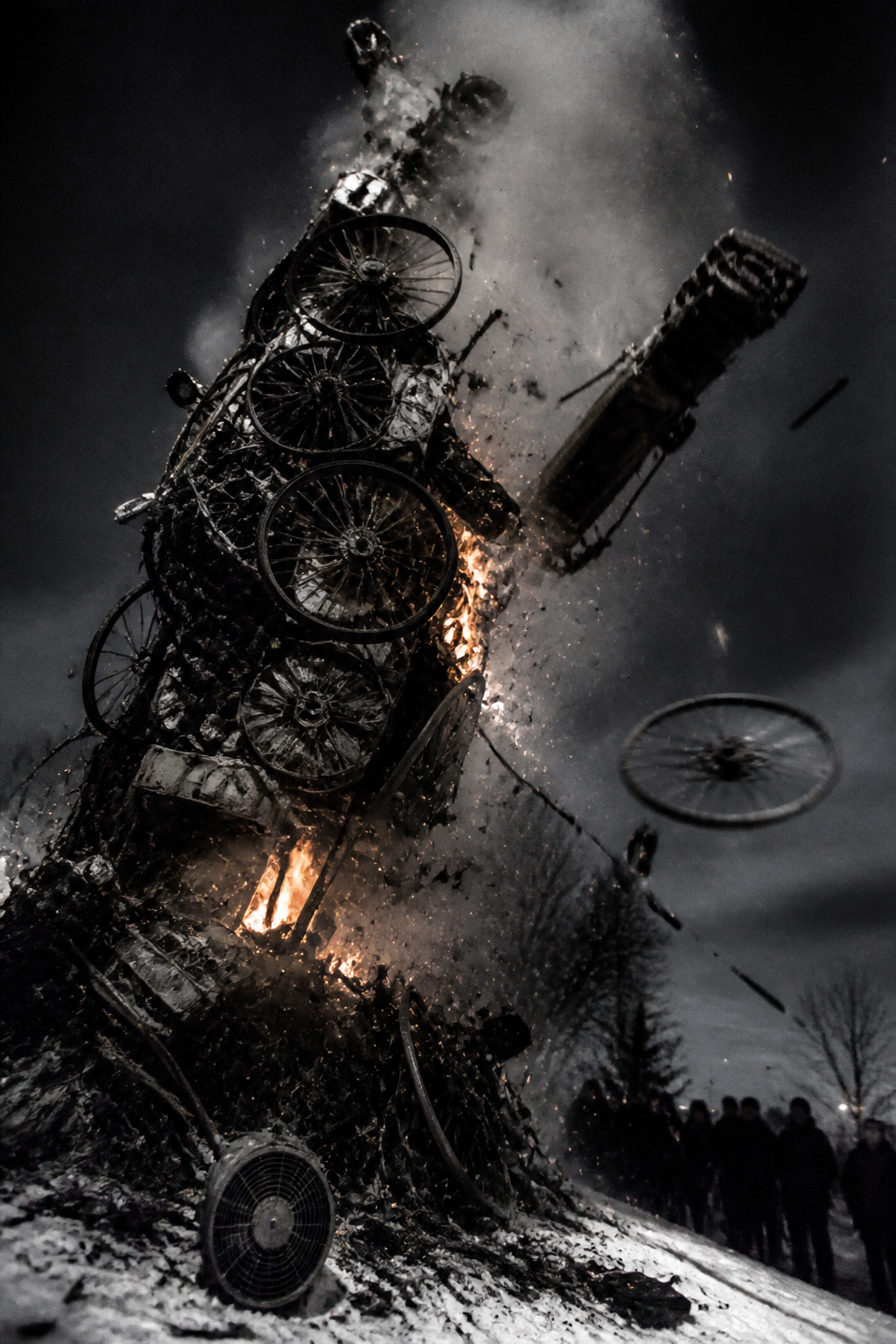
A wheel keeps turning
You followed one motion and lost the rest of the machine to it. That was always the arrangement: bicycle wheels, motors, salvaged metal and gathered junk, assembled by many hands into something engineered to come apart.
The particular wheel you watched has no record anywhere. This station can only model it, and says so.
01 · movement · unattendedNothing was directed here. No record was made from this angle, and none is supplied later.
Phase 01 · it runsWitness trace · described
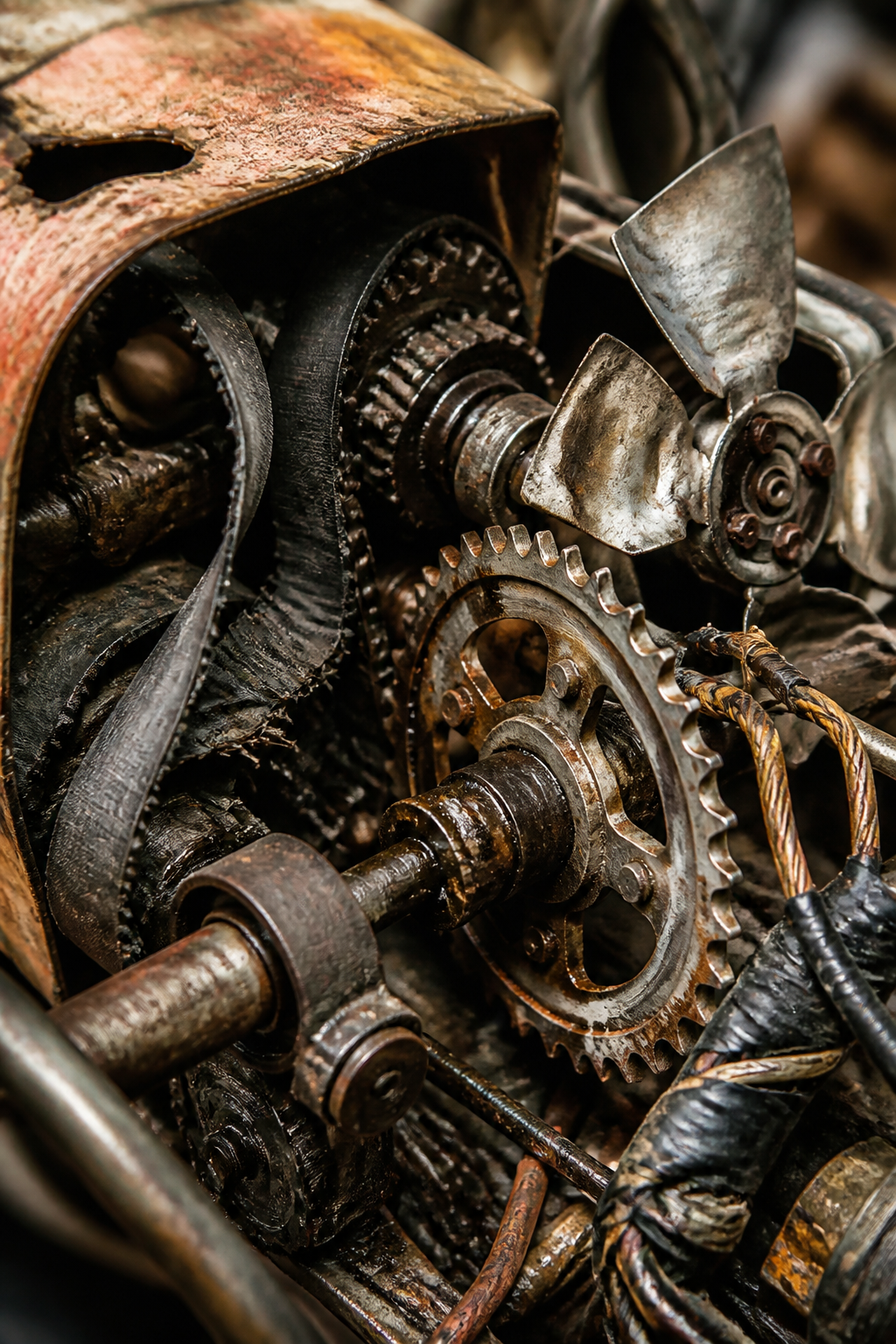
A klaxon under the noise
Noise was part of the work — horns, bells and struck metal among the assembled parts. Which sounded when, and in what order, survives only in the way people afterwards described the din.
No recording is anchored here. Sound is the first thing a self-destroying machine takes with it.
01 · sound · unattendedThe noise passed unlistened-to. It stays unknown at this station.
Phase 01 · it runsDocumented · narrow
Smoke leaving the garden
MoMA’s own account records Homage to New York as a machine built to destroy itself, staged in the Museum’s sculpture garden. Smoke belongs to every telling of that evening.
Where the smoke went, and who in the city it reached, does not.
01 · movement · unattendedNo one here watched the smoke leave. Its direction remains absent.
Phase 02 · it breaks downDocumented · narrow
The piano catches
An upright piano stood inside the assembly, and it burned. That much the accounts carry, MoMA’s among them.
How long the flame held, what the strings did as they went, and how it sounded from exactly where you were standing — none of that is fixed anywhere.
02 · event · unattendedThe fire happened without a witness at this station. Only that it happened remains.
Phase 02 · it breaks downRecord exists · not reproduced
A shutter, left of the ropes
The photographer David Gahr is one of the human traces attached to this evening. Photographs and film exist because people chose to point instruments at something that was ending.
This station holds no rights to show them, so the frame below stays honest and empty rather than filled with a look-alike.
Photograph withheld rights not held by this station
02 · documentation · unattendedYou did not follow the camera. Whose recording this was is not resolved here.
Phase 02 · it breaks downWitness trace + reconstruction
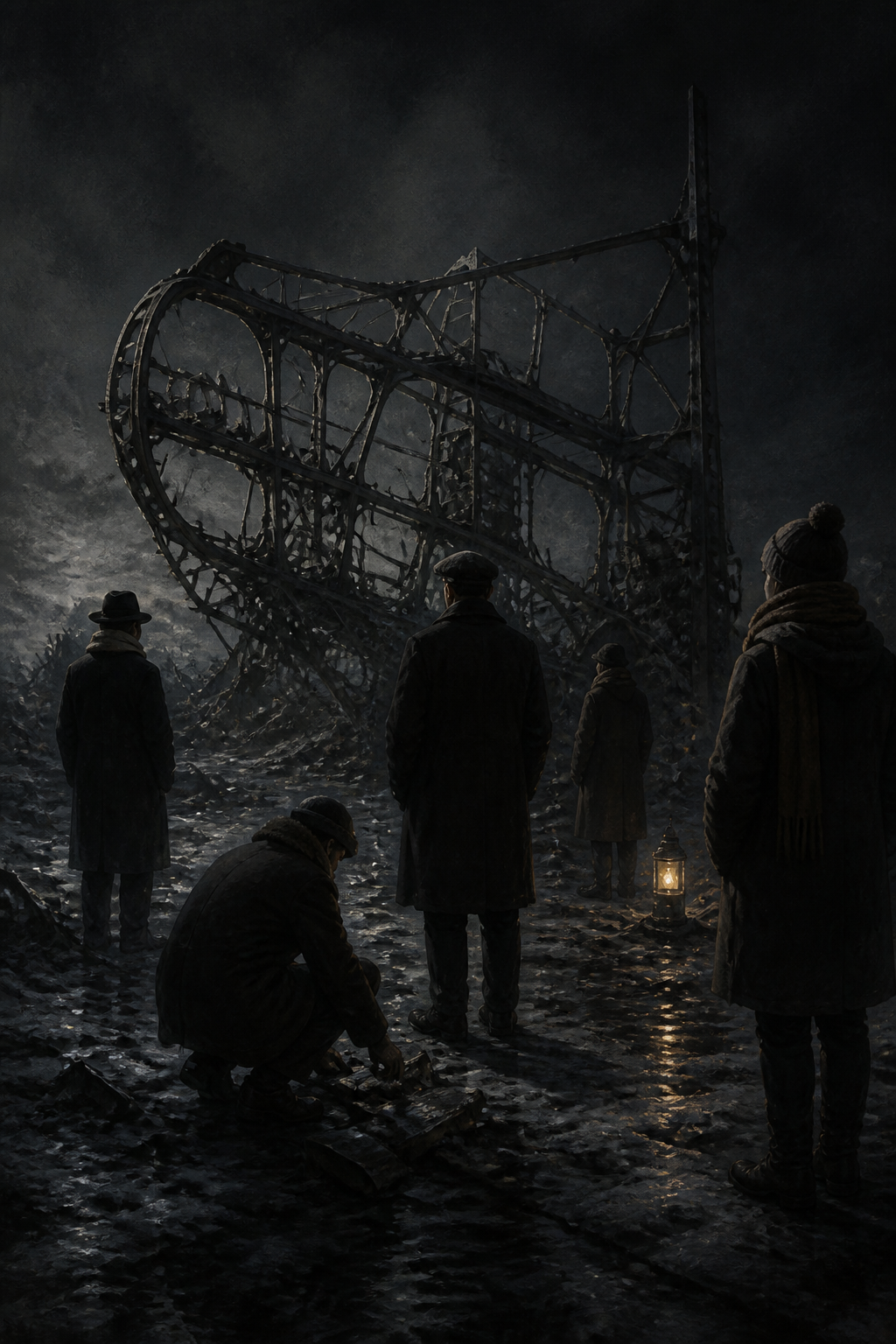
Someone steps back from the heat
An audience stood close. Robert Rauschenberg contributed to the work; builders and material gatherers found its parts; MoMA staff let it happen in their garden. Hundreds of others only watched — and their recollections are the widest, least verifiable part of the record.
Reconstruction · generated · figures are modelled, not photographed, and impersonate no known person
02 · witness · unattendedNo face was watched. The crowd stays a number without features.
Phase 03 · it is stoppedDocumented · narrow
A hose, then other hands
The machine did not finish the job alone. Accounts describe firemen stepping in before the destruction had completed itself — a work made to vanish, interrupted by people responsible for the garden it stood in.
So even the disappearance is partly somebody else’s decision.
03 · intervention · unattendedHow it ended went unobserved from here. The last minute is missing.
Phase 03 · it is stoppedFragment · conserved
A strip of metal, pocketed
Pieces of it survive, and conservators have kept them alive since. A fragment is not the machine; it is the part of the machine that someone decided to pick up, carry off and look after.
Whether anything left the garden that night inside a coat pocket is not a claim this station can support.
03 · object · unattendedNothing was watched being saved. Which fragments these are is not settled here.
Phase 03 · it is stoppedWitness trace · described
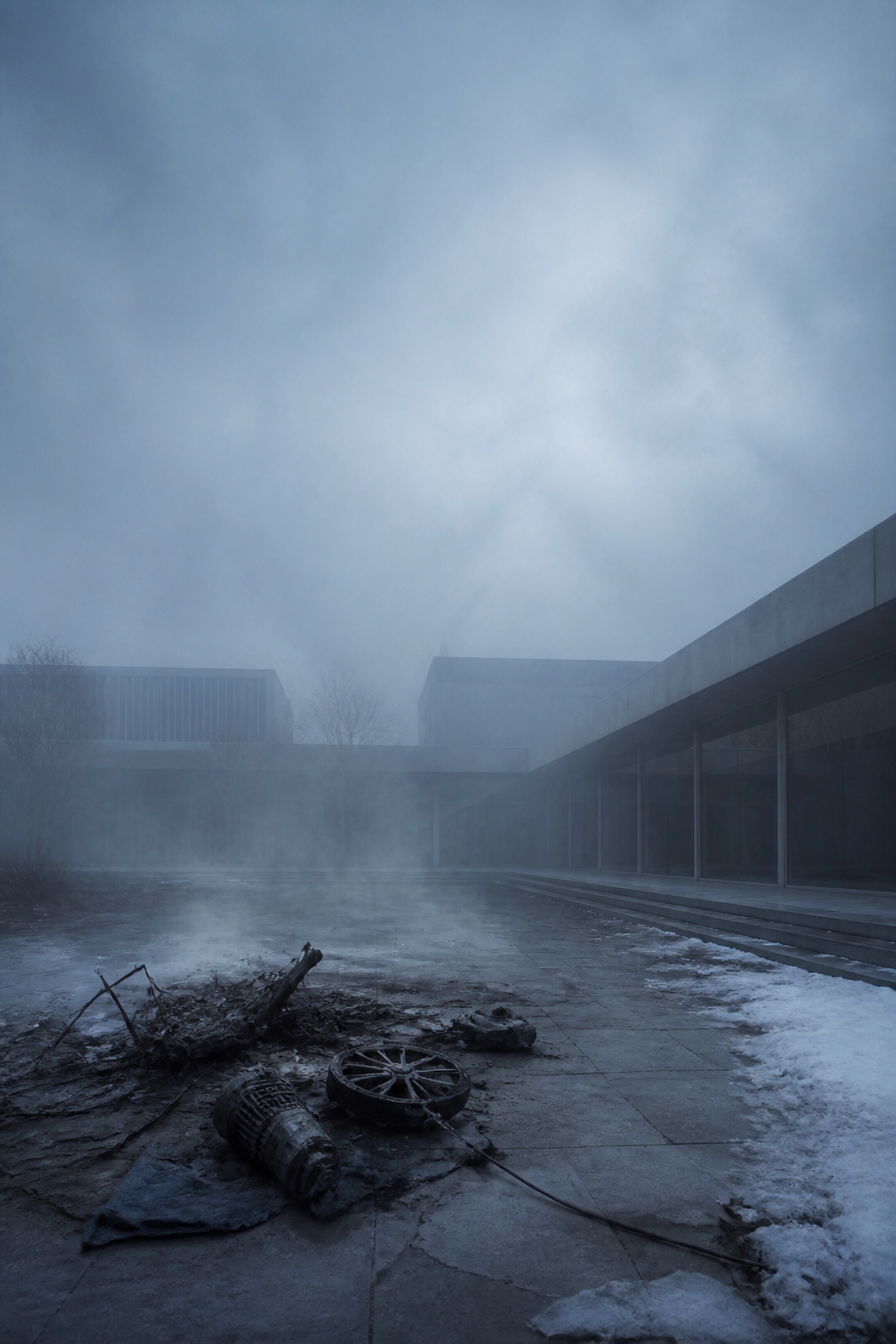
The garden going quiet
Then the noise stopped and the garden had to be swept. What each person took home was the version they had happened to be able to watch.
Every account of this evening is a partial one — including the one you just made.
03 · after · unattendedThe silence afterwards has no witness here. It is simply gone.
Reconstruction · generated for this station · the aftermath as modelled, not as photographed
Documentation is not the event. Without those human acts the memory would be far smaller.
Reconstruction
Where the evidence stops
All four images on this page were generated for this station. None of them is an archival photograph, none reproduces one, and none should be cited as a record of the event. They are shown marked so the boundary is visible at a glance.
Where a claim rests on the sources it is tagged DOCUMENTED · NARROW and kept deliberately small. Where memory is only carried in description, it is tagged as a witness trace. Nothing on this page invents a quotation, a name, or an action.
What you were able to watch decided what appears above. The gaps were not withheld to be unlocked later — nothing was recorded there.
Evidence anchors
The Museum of Modern Art — Homage to New York (work page)
MoMA Magazine — “A Garden Party for the Machine Age”
Claims are held to what these anchors carry. Anything narrower, softer or unverified is labelled as such in place.
Human-trace leads · verify, never invent
Jean Tinguely
Billy Klüver
Robert Rauschenberg
Builders and material gatherers
MoMA staff
David Gahr, photographer
Audience witnesses
Conservators of surviving fragments
Station note
The machine is gone. What remains of it depends on where human attention, recording, telling, collecting and conservation happened to land — and on where they didn’t.
This station will not restore the whole machine for you. The absence is the finding.