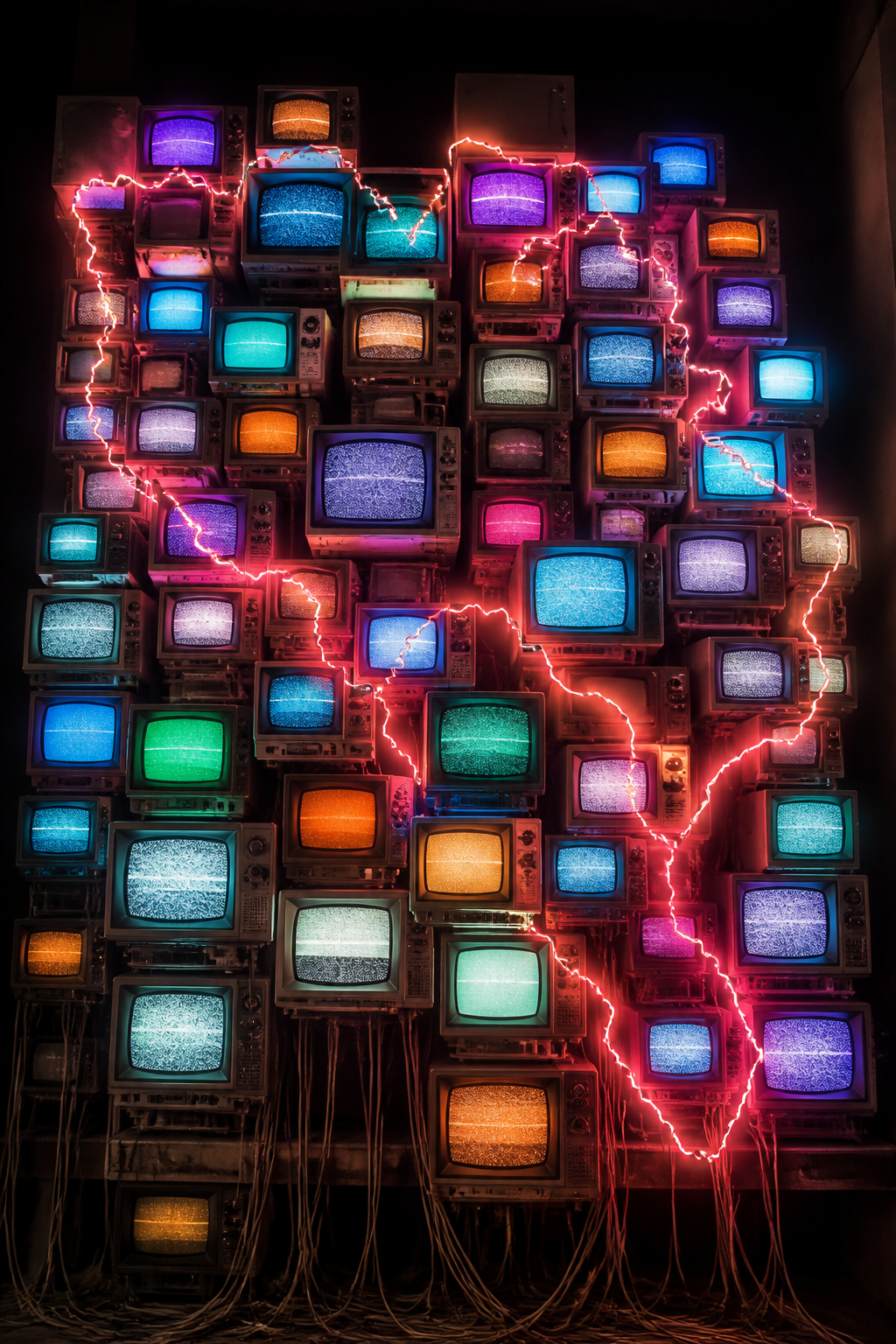
The field is running. Somewhere in it, a set is beginning to fail.
ON 30 · DRIFTING 0 · NEW TUBES 0 · EMULATED 0 · DARK 0 · FIELD DRIFT +0 MS
new tubeemulatedrestruck / driftingdark socket
Thirty screens stand in for three hundred and thirty‑six. Watch the wall: one of them will not hold its picture.
In the museum you would hear it: transformers, fans, the hum of hundreds of sets. Here the model is silent, and that is a loss too.
Keyboard and assistive access
The same four acts, as buttons. They become available while a set in the model above is failing, and they change the model in exactly the same way.
With focus on the failing set: Enter strikes it, N fits a new tube, M moves its image, U or Down arrow unplugs it. If nothing in the model is moving, the written account below carries the whole encounter.
What your hands did
Nothing yet. The record begins with your first intervention.
What you have been touching
A Work of 336 Televisions Must Be Kept Alive
Nam June Paik
Electronic Superhighway: Continental U.S., Alaska, Hawaii, 1995–96
Smithsonian American Art Museum
Paik built a country out of electronics: hundreds of television sets stacked into the shape of the United States, laser‑disc players feeding them, neon tubing bent into state borders, and channels of moving image assigned to place. The work has no single material. Its identity is spread across picture tubes, consumer players, cable, mapped space — and time, because the images move, and moving means running, and running means wearing out.
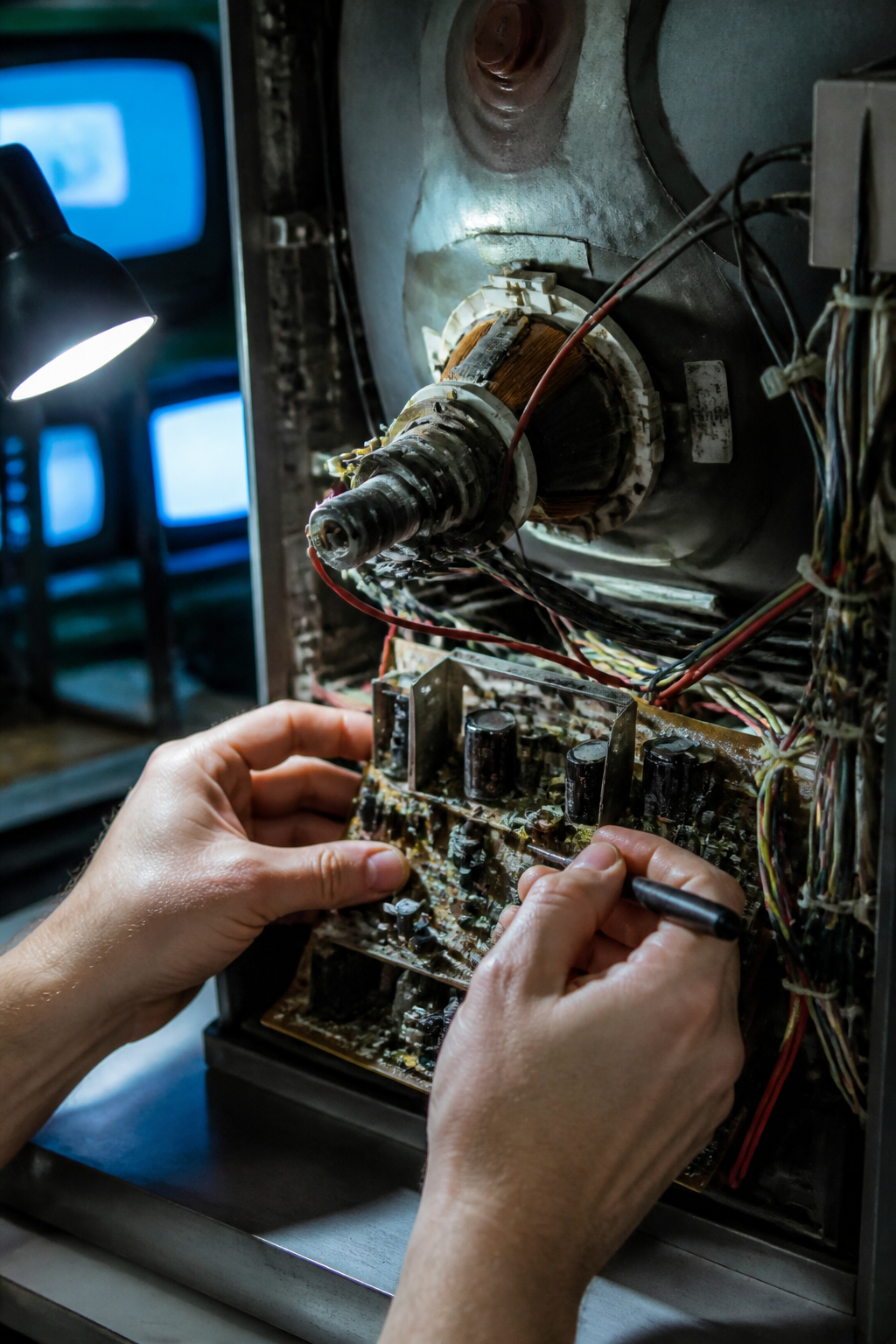
Every item on that list fails on its own schedule. Tubes dim and lose geometry. Players stop tracking. Neon transformers give up. Most of these parts have not been manufactured for decades. So the work is not simply stored; it is kept — by people who make judgments, in the dark, with their hands in the wiring, one set at a time.
That is what you were doing a moment ago. Not answering a question about conservation: doing conservation, in a small abstract model of it, and living with what it cost.
Keeping an electronic work alive can require changing parts of the thing you are trying to preserve.
Five things pulling at once
Preservation is not neutral
When one screen goes, five obligations pull in different directions. No decision satisfies all of them, and the decision cannot be postponed forever — the gallery opens in the morning.
- Function
- The picture must come on. A work that cannot be switched on cannot be encountered.
- Original hardware
- The tube in that cabinet is the artist's material, not a spare part. Once it leaves, it is an object in storage.
- Appearance
- A new screen beside an aged one is a visible edit. Brightness, colour and geometry are part of what the work looks like.
- Timing
- The rhythm of the piece is made of imperfect machines running slightly apart. Perfect sync is also a change.
- Loss
- Sometimes the most truthful act is a dark socket, chosen deliberately and written down.
No two of these can be maximised at once. That tension is the work of keeping the work.
Hands that keep it on
The people the work depends on
Electronic Superhighway remains encounterable because of continuing technical and curatorial labour — decisions made repeatedly, by people, over decades. Named here only where the evidence names them; described by role where it does not.
- Nam June Paikartist
- Studio assistants and fabricatorsbuilding and wiring the field
- Neon workersbending and maintaining the borders
- Video editorsassembling the channels of moving image
- Electronics technicianssets, players, transformers, cable
- Dan Finnmedia conservator, Smithsonian
- Michael Mansfieldconservator
- Hugh Shockeyconservator
- Installersplacing and re‑placing the sets
- Rights holders for embedded mediapermissions for the moving images the work carries
Roles are listed only as far as the source account supports them. No titles, attributions or biographies have been added beyond that, and no individual has been assigned an action they are not documented as taking.
What this page is, and is not
Evidence and limits
- The conservation situation described here begins from, and stays inside, the Smithsonian's own published account of preserving Electronic Superhighway. Nothing beyond that account has been asserted as fact.
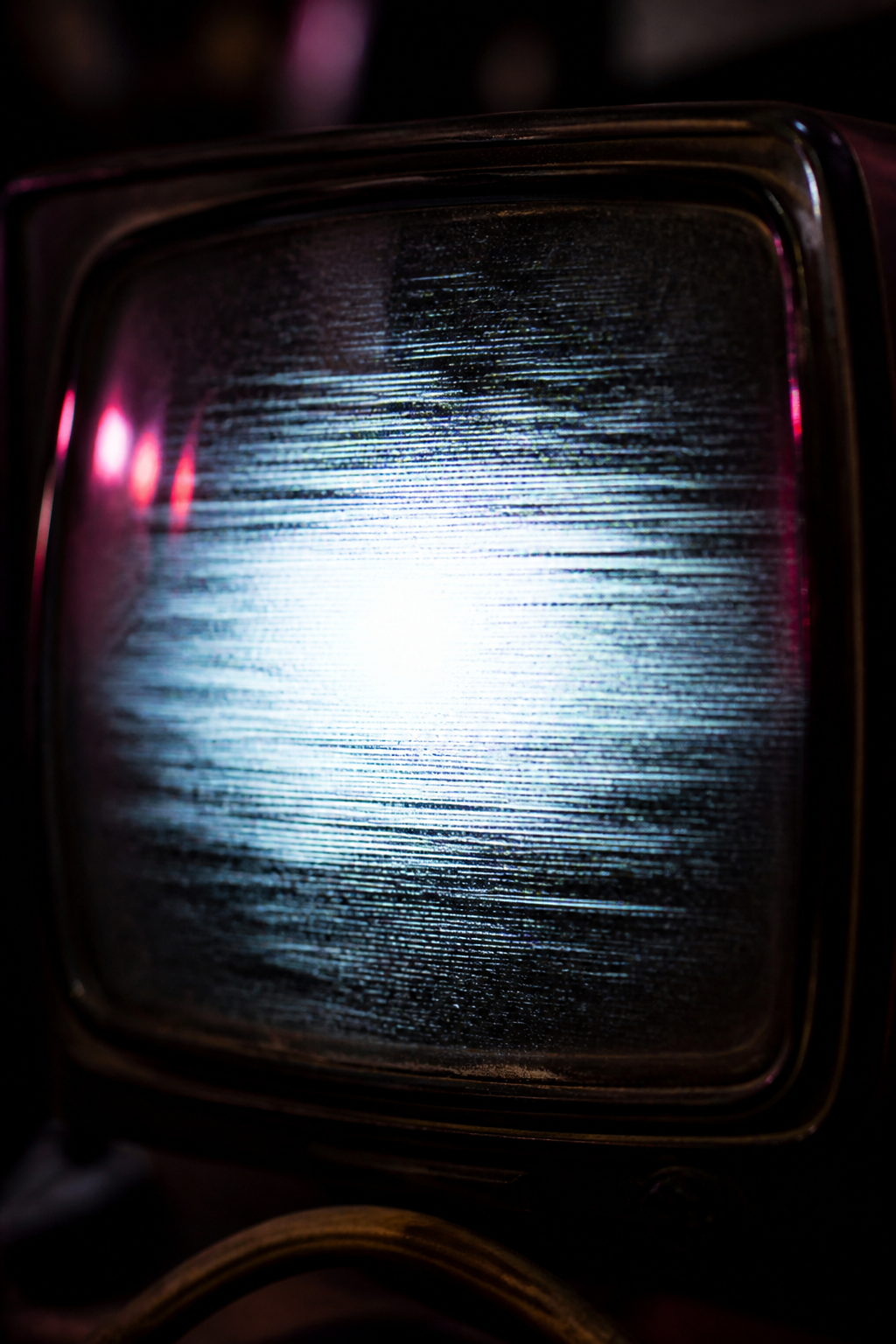
- The four photographic‑looking images on this page are generated reconstructions made for this station. They are not documentation of the installation and must never be cited or circulated as such.
- The screens in the model above are abstract representations of screen behaviour. None of the moving images in the work are shown, imitated or implied; that material sits with its rights holders and no claim is made about it here.
- No Korean‑language source is presented, because none was verified for this station. Adding one without evidence would be a fabricated route into Paik's work.
- Your interventions in the model are a teaching device, not a record of any real decision taken by any real conservator.
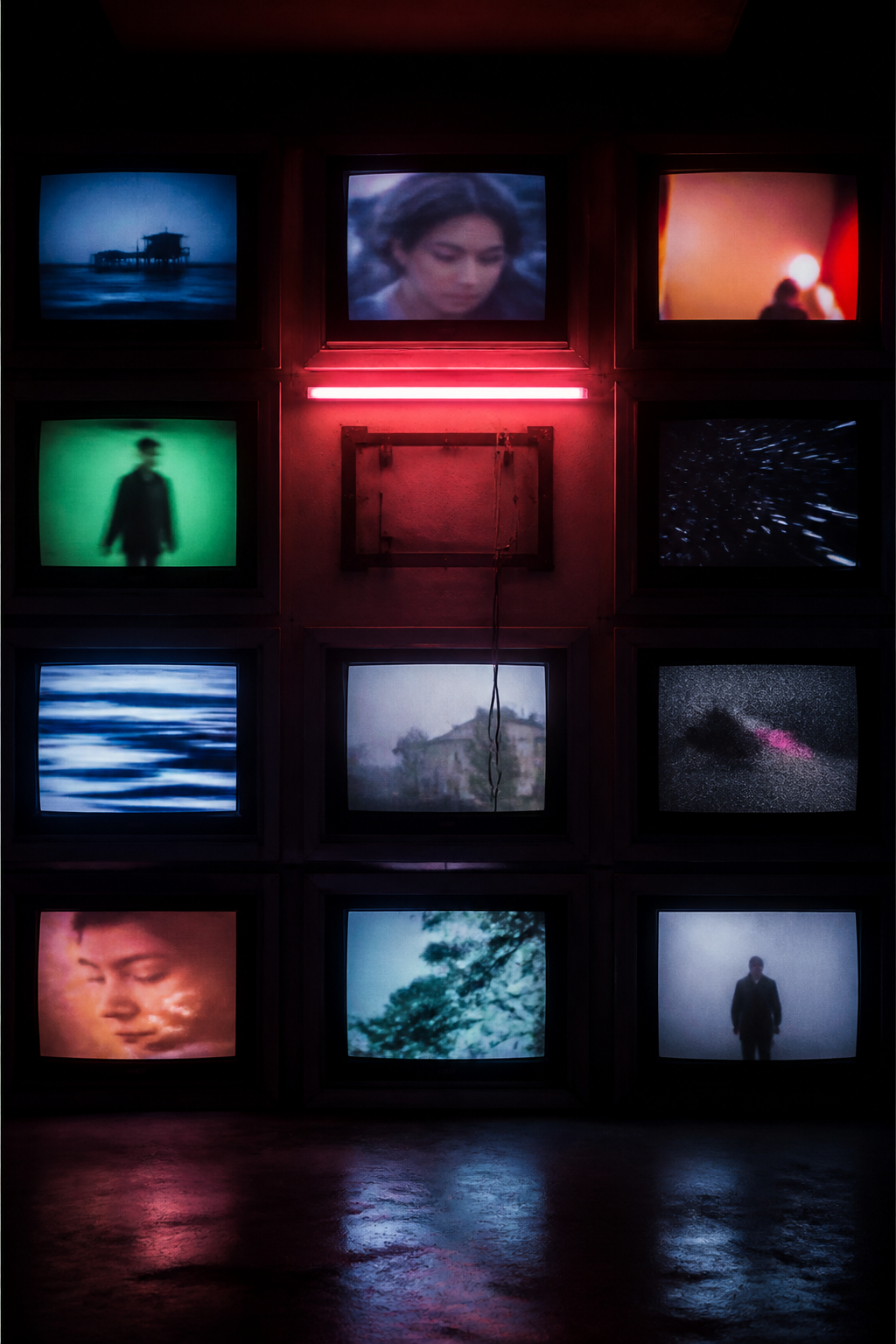
A dark socket is a decision. So is a bright new tube. Someone is making one tonight.
Reconstruction: the space where a screen was. Generated for this station.