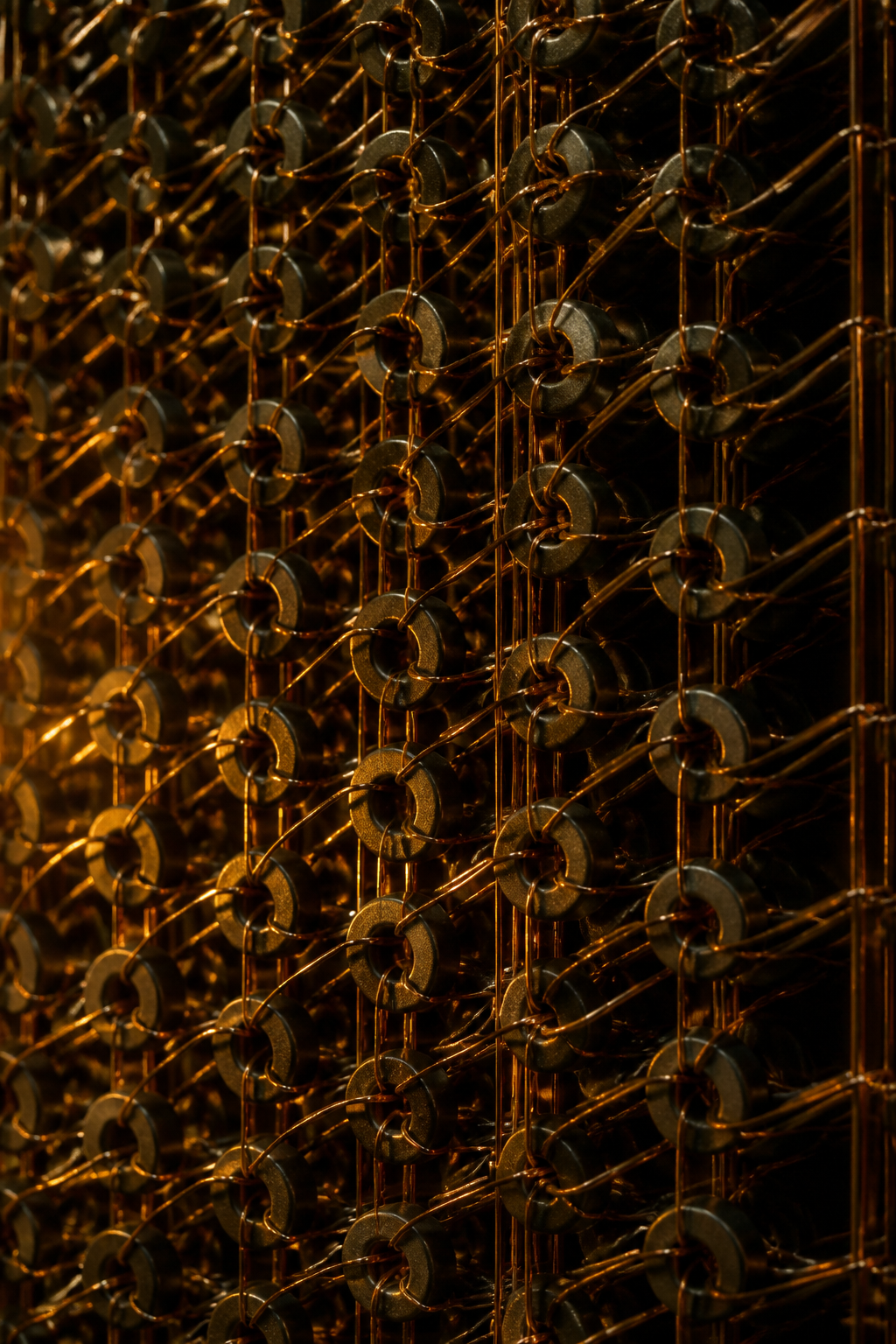
Six cores. One instruction.
Send the wire through a core, or take it around. Through and around are the only two things a wire can say. Nothing is fixed until you weave it.
above the core = around = 0through the core = 1slack = undecided
- Routing
- · · · · · ·
- Reads as (octal)
- —
- Rope state
- planning
- Cores re-threaded
- 0
Tap a core to route the wire. 0 of 6 routed.
* core re-threaded after unpickingreconstruction · not to scale
WM50-S36 · kongCast World Memory Station
Software Woven into Hardware
Apollo Guidance Computer core-rope memory
You have just done, in miniature, the thing this station is about. A pattern of decisions left the realm of thought and became a routing — a physical arrangement of thread and core that a machine could read and a person had to make.
Memory is encountered before it is explained.
01 · Allocation
Before a wire moved, someone decided where the program would live
The Apollo Guidance Computer's memory was small and finite. What the on-board software would do, and how much room each part of it could be given, was settled first — in specification, argument, and revision — by the flight-software work at the MIT Instrumentation Laboratory, where Margaret Hamilton and her team developed and tested Apollo on-board software.
Allocation was not bookkeeping. Deciding what fit was deciding what the spacecraft could do.
02 · Engineering
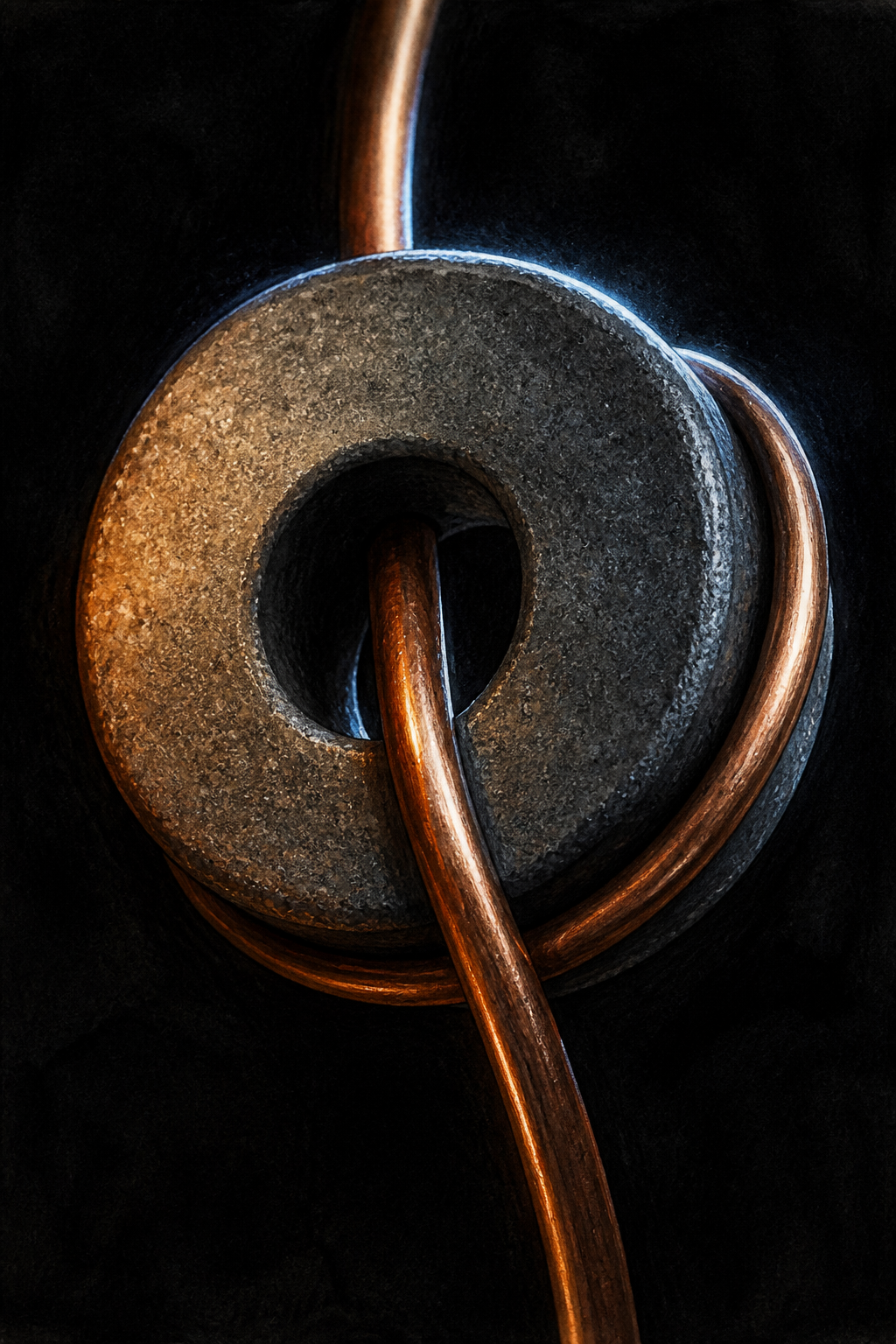
Through, or around
The computer's fixed memory held the program in cores and wire. A wire routed through a core registered as one value; the same wire routed around that core registered as the other. There was no third option, and no way to write a value that was not a route.
So the design of the memory and the design of the program met in the same place. The engineers were not describing code to a machine; they were describing a shape to a factory.
03 · Weaving
The pattern left paper and entered a pair of hands
Core-rope memory for Apollo was manufactured by Raytheon, where the routing was carried out as handwork — thread drawn through or around each core, in sequence, without error, at a scale far beyond the six cores you touched. Women were among the manufacturing workers who physically wove this memory.
This is the point the station exists to hold open: a line of software had a wrist, a needle, a working day, and a tolerance for mistakes of zero.
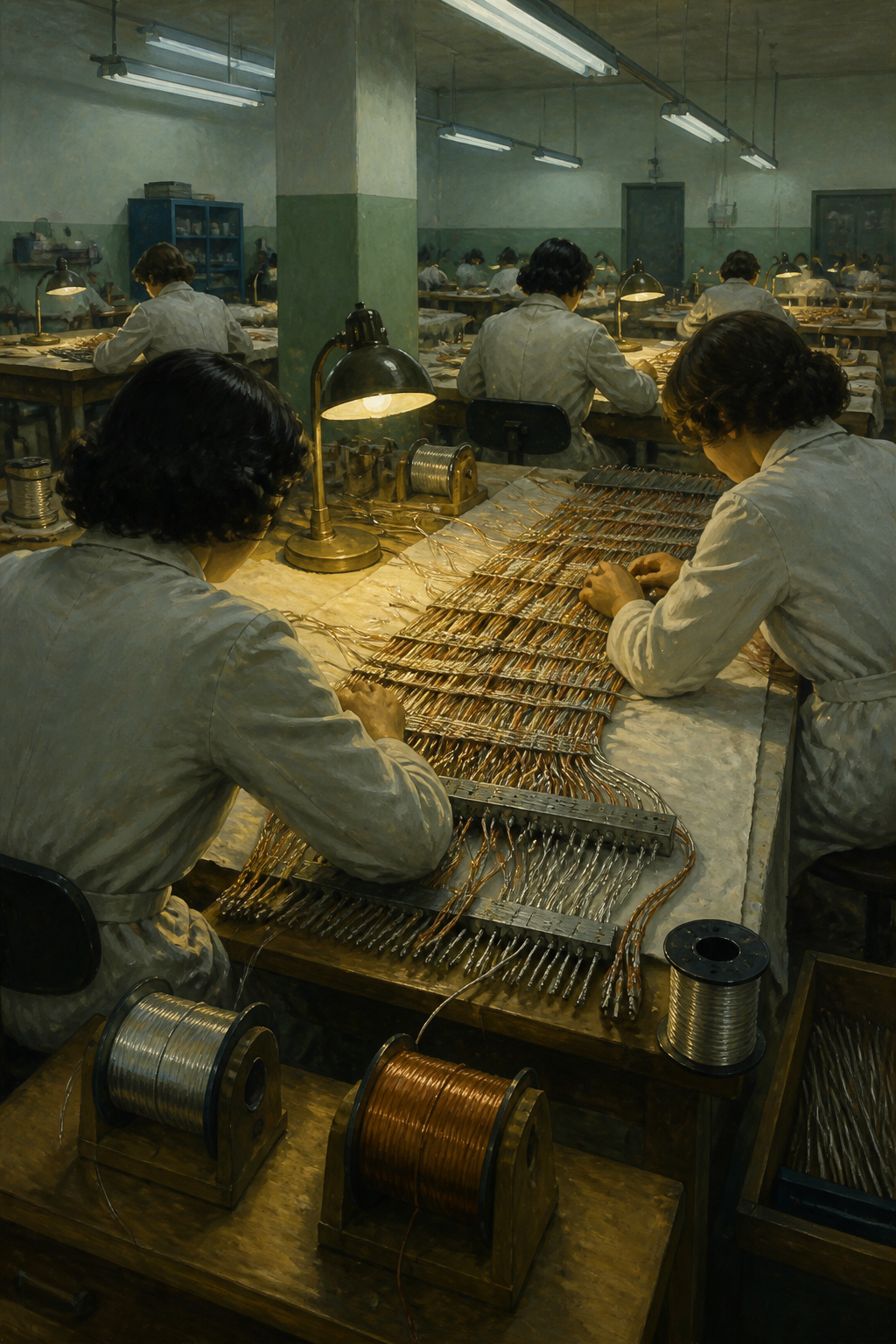
On naming: no individual manufacturing worker is named on this page. Their labour is documented in the record; specific names are not attributed here because this station will not claim attribution it cannot support.
04 · Testing
A woven rope had to be proved to be the program it claimed to be
Between the loom and the launch pad sat verification: the physical article checked against the software it was supposed to contain. A fault found here was not a line to retype. It was an object to inspect, unpick, or replace.
That asymmetry is the whole cost. Late software change and manufacturing rework were the same event, seen from two rooms.
05 · Flight
Then it flew, exactly as it had been threaded
In flight, astronauts and mission controllers worked with a program that had been fixed in matter months earlier. Nothing about it could be patched in the moment. What the rope said, it said because of routing decisions already made, already woven, already tested.
The account, in plain text
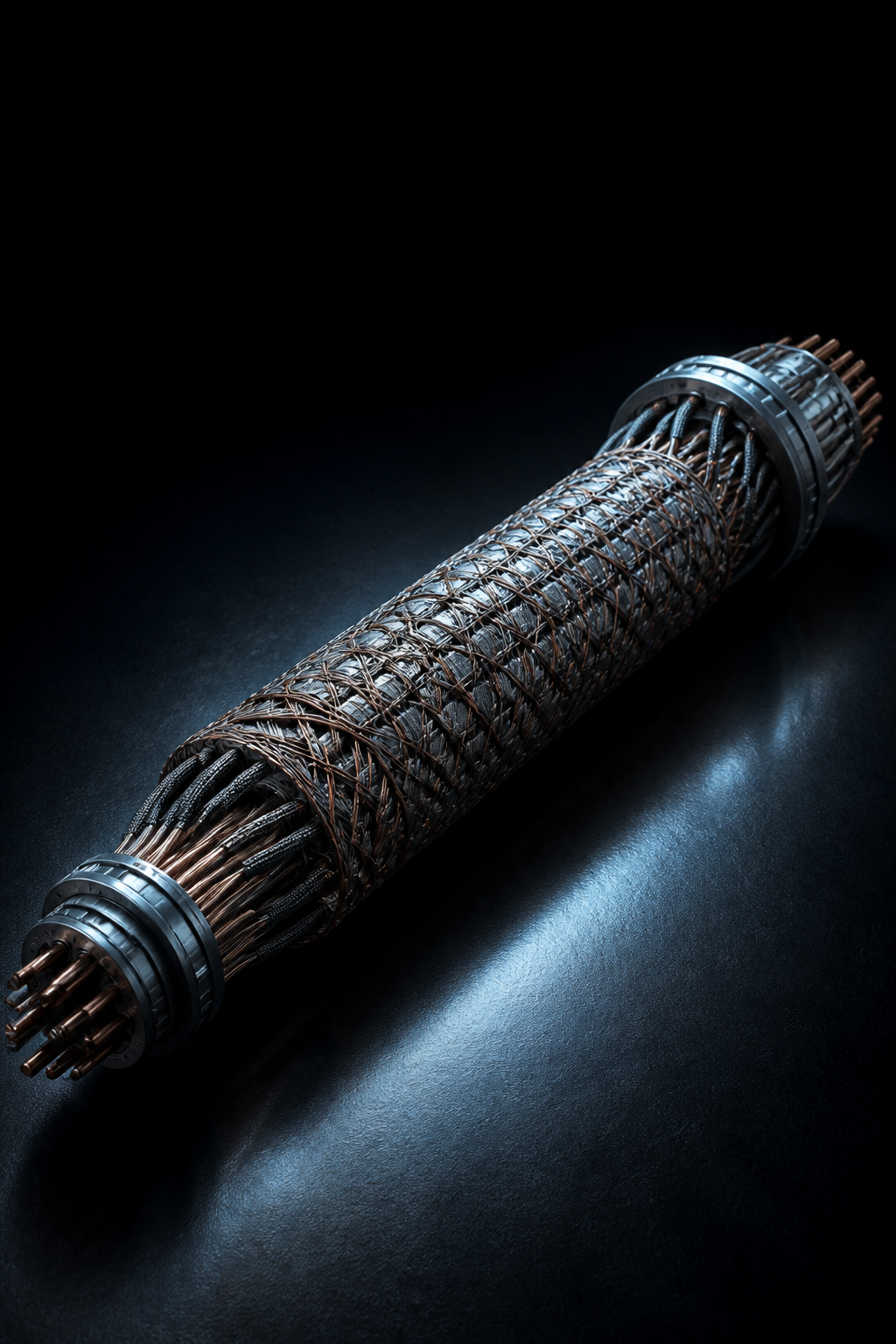
In the Apollo Guidance Computer, the program was held in fixed memory built from small magnetic cores and wire. A wire routed through a core registered as one value; routed around it, the other. A decision made in software therefore had to become a physical routing — and that routing was made by hand.
Flight-software work at the MIT Instrumentation Laboratory, including Margaret Hamilton and her team, set what the program would be and how the computer's scarce memory would be spent. Manufacturing workers at Raytheon — among them women who wove core-rope memory — turned that pattern into an object. The object was then tested against the program it claimed to hold, and flown.
The understanding this station asks for: to change the software after the rope was woven was to change a manufactured physical object, and to ask a person to do exacting, reliable work over again. Not an edit. A remaking.
Source paths & how to read this page
- Primary evidence pathNASA — record on Margaret Hamilton and her Apollo on-board flight-software work at the MIT Instrumentation Laboratory.
- Primary evidence pathMIT Instrumentation Laboratory — final report on the Apollo Guidance Computer (guidance, navigation and control), for the design and construction of fixed rope memory.
- InterpretationThe framing of manufacturing as software labour, and of late change as rework, is this station's reading of the above. It is marked wherever it appears.
- ReconstructionEvery image here is generated for this station. None is an archival photograph, document, or artefact, and none should be cited as one. The six-core loom is a simplified model, not a depiction of an actual Apollo rope.
- WithheldNo individual manufacturing worker is named. No date, quantity, or attribution beyond the sources above is asserted.
You changed a program by changing a thing.
That is the difference this station wanted you to feel in your hands rather than read in a caption. Software that has been woven is no longer only software. It is an object with a maker, and the maker has to be asked again.
- Your routing
- —
- Reads as (octal)
- —
- Cores re-threaded
- 0
- Ropes rejected
- 0
Station closed inline · WM50-S36 · Software Woven into Hardware