The future as drawn by people who had not yet been disappointed.
01
What it looks like
The Power
The atom, and it is going to be free
The Shape
Parabolas, boomerangs, starbursts, upswept roofs
The Surface
Enamel, chrome, moulded plastic, primary colour
The Sky
A destination, not a limit
The Mood
A brochure, not a warning
The Feeling
Certainty
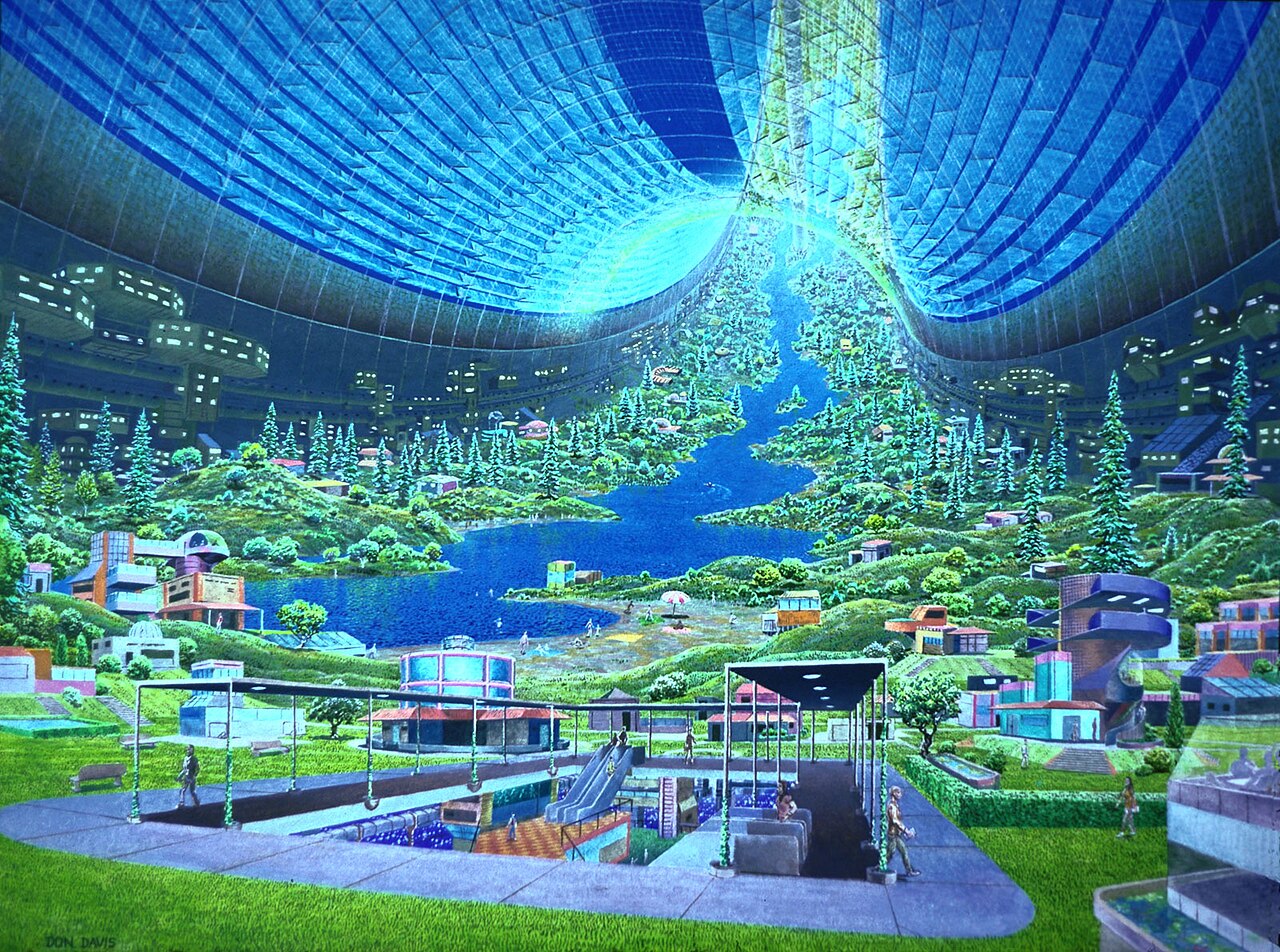
Interior of a Stanford torus. Painting by Don Davis for NASA, 1975. Public domain.
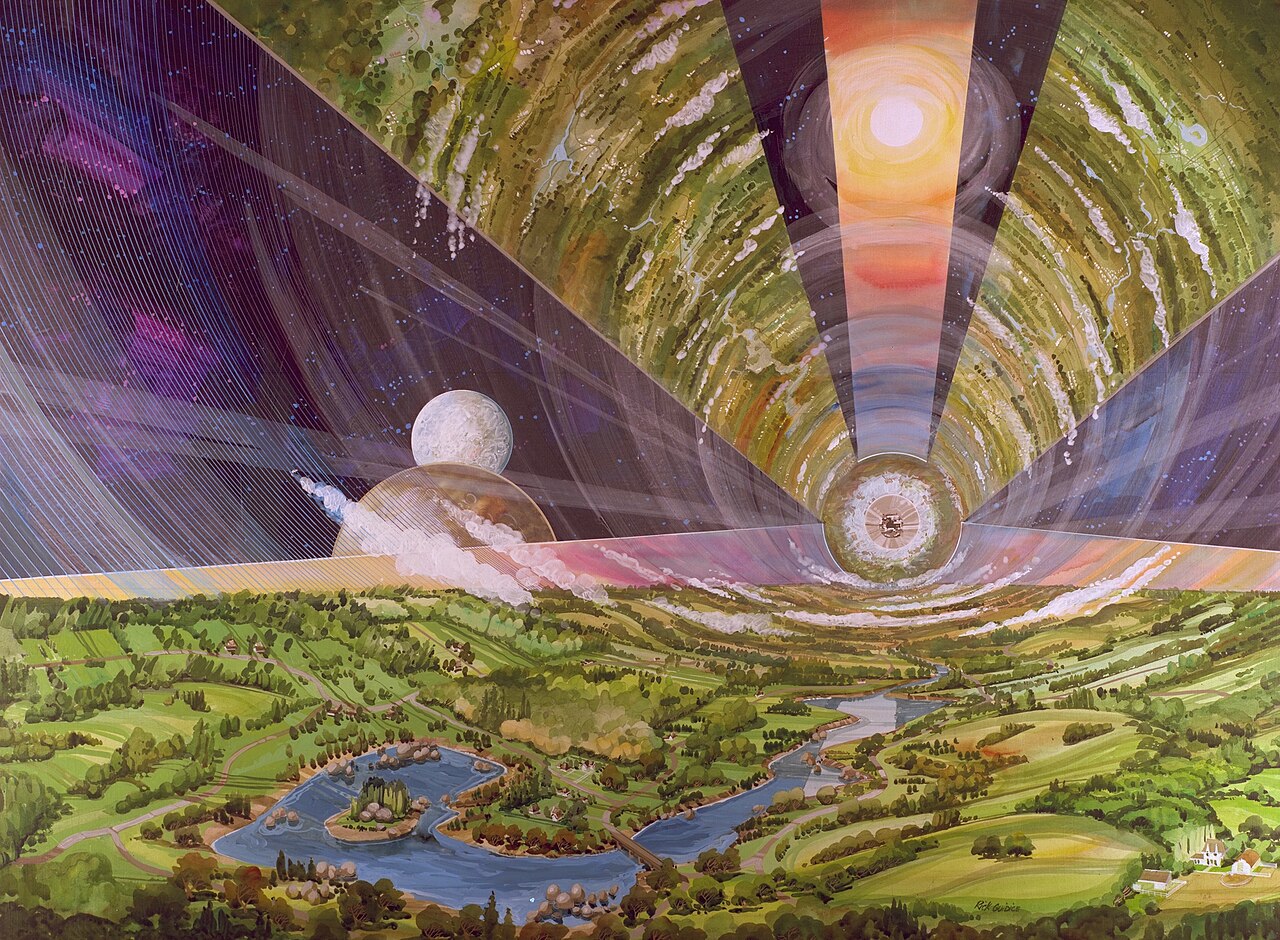
Interior of a torus colony. Painting by Rick Guidice for NASA, 1975. Public domain.
Nobody in these paintings is worried about anything.
02
The people who painted it
Atompunk is the only one of these worlds that was drawn by employees. In 1975 NASA's Ames Research Center ran a summer study on space colonies and commissioned artists — Don Davis, Rick Guidice — to paint what the results would look like from the inside. They painted lawns, swimming pools, low apartment blocks, joggers, a river, and a sky that curves upward at the edges because you are standing inside a wheel.
These were not illustrations for a novel. They were attachments to an engineering report.
03
Where the confidence came from
Between roughly 1945 and 1965 the atom and the rocket arrived at the same time, and a great deal of design was built on the assumption that both would keep going. Electricity was promised too cheap to meter. Architecture answered with Googie: diners, motels and gas stations with upswept roofs, boomerang canopies and starburst signs, all leaning forward. The 1962 Seattle World's Fair built a saucer on a stalk and called it the Space Needle.
The Space Needle, Seattle, built for the 1962 World's Fair. Public domain.
04
The three questions
Which machine rulesThe atom, and the rocket it pays for
Who holds powerThe state, the laboratory, the space agency
Who fights backNobody. Everyone in the picture is a citizen
Atompunk has authorities but no rebels, which makes it the least punk of all the -punks. Its protagonist is an engineer with a good job.
05
The same decade made two aesthetics
The atomic age produced optimism and dread from identical materials. Atompunk is usually the anxious reading — fallout shelters, duck-and-cover, laboratories with warning lights — while the confident reading is often filed separately as Raygun Gothic: rocket fins, ray guns, chrome and a friendly future. Same reactors, same rockets, two moods, and the split is mostly one of temperament.
Exterior of a Stanford torus. NASA Ames, 1975. Public domain.
Bernal sphere colony. NASA Ames, 1975. Public domain.
06
What actually happened
Electricity did not become free. No colony was built. The Space Race ended and the budget went elsewhere. What survives is the artwork — which is why atompunk is unusual among these worlds: its evidence is almost entirely pictures of things that were never made, produced by institutions that fully intended to make them.
The only imagined world here that was drawn on government time.