Walden Pond · 42.4427° N, 71.3425° W

Concord · Massachusetts

Walden Pond

A cabin · a kettle pond · a shore loop

A pond, a cabin, and a slower way to live.

61 acresSurface
102 ftDeepest
1.7 miShore loop
Start the walk
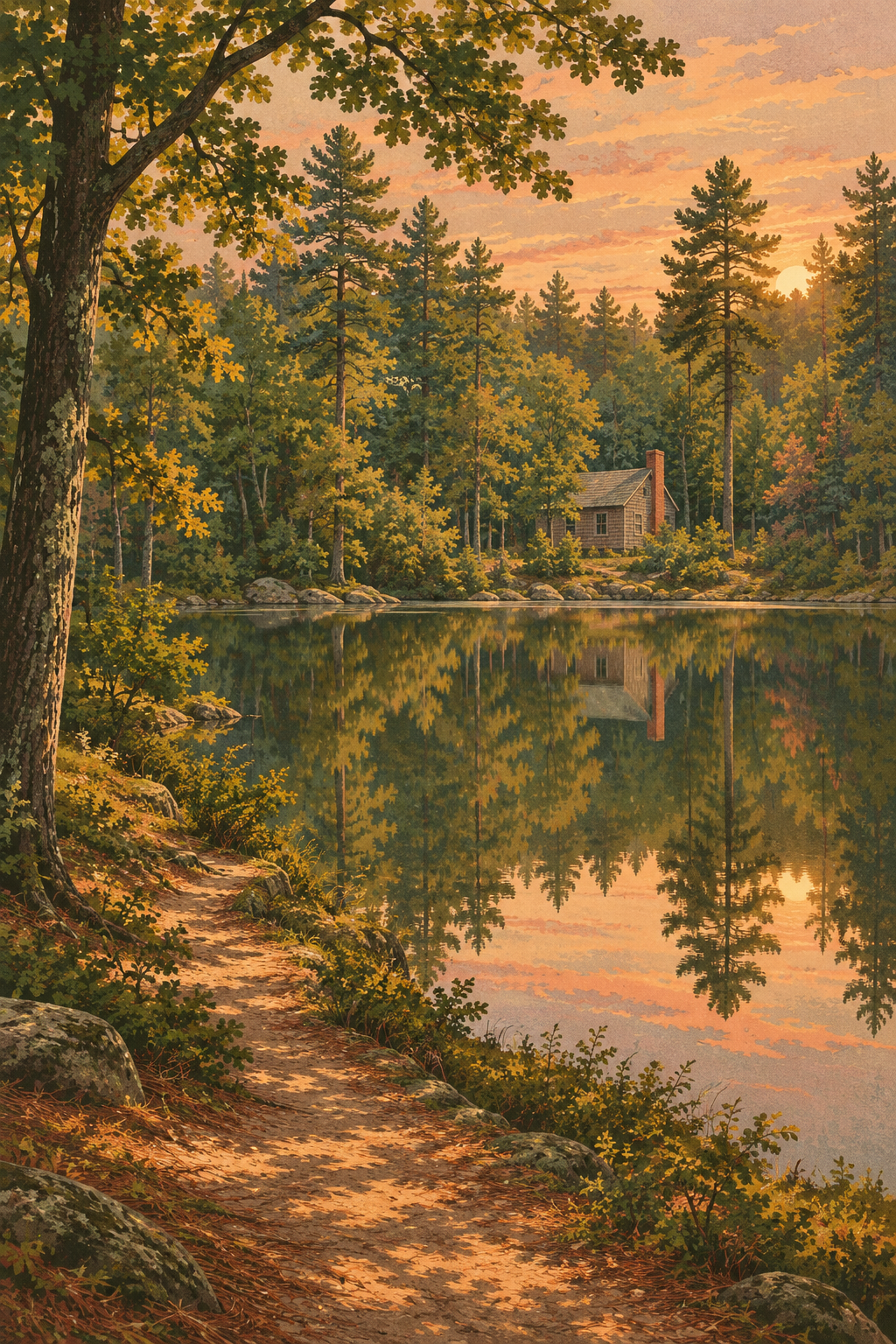
Vintage travel poster of Walden Pond

1995

A note from the visitor

Late summer, 1995. I had just arrived at MIT in Cambridge, and on a free weekend I found my way to Walden Pond in Concord. The still water, the forest around it and the path along the shore turned out to be a place I kept going back to. And beyond the nature, there is the human story: this is where Thoreau wrote Walden.

The man in the woods

An experiment in living deliberately

In the spring of 1845, Henry David Thoreau, a 27-year-old Concord native, former schoolteacher and son of a pencil-maker, asked his friend Ralph Waldo Emerson, who owned woodland at the pond, if he could build a small house there. He wanted to find out how little a life really needs, and he wanted quiet to write: he was already shaping a book about a river trip he once took with his late brother John.

  1. 1845.07.04

    Moves into a small house he built himself, about 10 by 15 feet, for roughly $28 in materials.

  2. 1845–47

    Plants a bean field, takes soundings of the pond, walks, reads, and fills his journals. Those notes become the raw material of Walden.

  3. 1846.07

    Spends a night in the Concord jail for refusing to pay a poll tax. The essay that follows is later known as “Civil Disobedience.”

  4. 1847.09.06

    Leaves the pond after two years, two months and two days.

  5. 1854

    Walden; or, Life in the Woods is published. Thoreau folds the two years into a single turn of the seasons.

I went to the woods because I wished to live deliberately, to front only the essential facts of life, and see if I could not learn what it had to teach, and not, when I came to die, discover that I had not lived.

Henry D. Thoreau · Walden, 1854

The shore loop

Six stops around the water

Tap a pin or a photo to read about that stop.

Walden Pond61 acres

Hand-drawn sketch, not to scale. The stops follow the order of a walk, not exact positions. For the real satellite view, open Google Maps. Satellite map

Stop 1 of 6

The Replica House

The place

A full-size replica of the cabin stands near the parking area, with a bronze figure of Thoreau out front. It is the natural first stop, and the quickest way to feel how small ten by fifteen feet really is.

Thoreau here

He furnished it with a bed, a desk and a few chairs. “I had three chairs in my house,” he wrote: one for solitude, two for friendship, three for society.

Wildlife & woods

Oak and white pine woods surround the lot. Chickadees, nuthatches and woodpeckers stay all year, so even a winter visit isn't silent.

Stop 2 of 6

The House Site

The place

Granite posts mark the footprint of the real cabin, a short walk from the replica. The signboard tells the story: Emerson owned the land, and in 1945 archaeologist Roland Wells Robbins dug here for three months and found the remnants that pinpointed the house.

Thoreau here

This is where the experiment actually happened: he hoed a bean field, watched the seasons turn, and kept the journals that became Walden. The board calls it “an experiment in simplicity and observation.”

Wildlife & woods

Pitch pine and white pine crowd the slope, with oaks, hickories and red maples above and huckleberry and blueberry shrubs underfoot.

Stop 3 of 6

The Cairn & the Sign

The place

Behind a pile of stones stands a wooden sign hand-lettered with Thoreau's most quoted lines. Cairns lean in on both sides, some tiny, some knee-high. Everyone adds one.

Thoreau here

The habit is old. In 1872, ten years after Thoreau's death, Bronson Alcott led a Walden enthusiast to the site and they set down stones in his honor. Visitors have kept the pilgrimage going ever since.

Wildlife & woods

Gaps between the stones shelter chipmunks, and the granite posts grow patches of lichen: slow, quiet life at a monument to slow, quiet living.

Stop 4 of 6

The Wading Path

The place

The shore path hugs the water, and in a wet season the pond climbs over parts of it. You just wade a few steps. Nobody minds; it's half the fun.

Thoreau here

Thoreau watched the pond rise and fall from year to year and wrote about it. To him the water was a living thing with moods, and he knew its shore on foot.

Wildlife & woods

In the sandy shallows look for sunfish and yellow perch, dragonflies skimming in summer, and green frogs along the edge.

Stop 5 of 6

A Quiet Cove

The place

Away from the beach the water goes glassy and the shoreline slips into shade. If you bring your own canoe or kayak, this is the kind of cove you'll want to drift into. (Check the posted rules before you launch.)

Thoreau here

Thoreau spent much of his time on the water. In the winter of 1846 he sounded the pond through the ice and found its deepest point at about 102 feet, quietly ending the local legend that Walden had no bottom.

Wildlife & woods

Quiet coves like this suit great blue herons stalking the edge, and in spring and autumn a loon may drop in for a day.

Stop 6 of 6

The Swimming Beach

The place

At the main beach the whole pond opens up. Walden is a kettle pond, a hollow left by a melting block of glacier more than ten thousand years ago: about 61 acres of clear water, with a roped swim area and lifeguards in summer.

Thoreau here

He bathed in the pond every morning and called it a religious exercise, one of the best things he did. Jump in on a hot day and you'll see what he meant.

Wildlife & woods

Yellow perch, pumpkinseed, bluegill and largemouth bass live in the clear water, and pine woods ring the whole shore.

Come walk it yourself

Walden Pond, Concord, Massachusetts. Bring a towel, and shoes you don't mind getting wet.

42.44274, −71.34248

Get directions in Google Maps